I recently learned that Ben Barres died at the end of the year.
When his article about gender came out in 2006, I was in grad school at Yale. (Also known as Snooty U, in past years). I wrote to Dr. Barres - and I don't remember, all these years later, exactly what I said - but I wrote that I was frustrated, and I could see discrimination around me, and I could feel the discrimination, and I didn't see how I would ever become a research scientist.
He wrote back to me, a great kindness to a stranger amidst what must have surely been hundreds and hundreds of similar messages. The West Coast is nicer, he wrote; maybe you could be happier here. The Yales of the world are the worst places for a young woman like you to be, he wrote. I hope you find perseverance and strength and success.
I didn't end up as research scientist, and I doubt I ever will, but I will always remember his kindness. Rest in power, and the knowledge that you did righteous work of so many kinds, Dr. Barres.
Showing posts with label Women in science. Show all posts
Showing posts with label Women in science. Show all posts
Monday, January 08, 2018
Sunday, June 12, 2016
You Never Write, You Never Call
Dear Readers, there have been THINGS going on.
(I have three small children. There are always THINGS, frankly.)
I weaned Sweetpea two months ago; I have been either pregnant or nursing for seven of the last eight years. My health was most charitably described as not fantastic. I am now giving my health a year to recover from All That Stuff. (Also, a nice course of steroids and three kinds of antihistamines... yeah.)
I rage-quit the local LLL group after one round too many of "Food before one is just for fun!" Oddly, the WHO believes it is for not having fucking malnutrition. Apparently science is only for when convenient.
My lovely flower bed is almost too full of plants to plant anything else.
(I have started another, deer-resistant, one. There are worse problems to have.)
My part-time job has had Issues. I can't really talk about those issues. Let's just say, someone quit but is still hanging around, someone needs to be hired temporarily, the local accreditor threw their usual fit over 18 Credit Hours Of Thing (my actual PhD in science from fucking Snooty U may be insufficient qualification to keep first-year students from setting themselves on fire, and teach them titration, my hand to God). A somewhat unfortunate conversation left me with the impression that my work is not valued. This set off a round of my Screw You Reflex, which was already present due to Person Who Quit (I have applied for 6 jobs in the last 3 months).
Also, I've been engaged in fine round of reflection on "Is this what I really want to be doing with my life?"
I am an adjunct. I'm well-paid to do this, but there is no room for any kind of advancement, more pay, or even more work. How long do I want to do this? I don't know. Somewhere between one more year and five more years, but probably not more than that. Also, they still haven't told me if I'll even be teaching... in August. You know, in two months.
So! What am I going to do with my life? I have been working on it.
Here are the things I value: time to pursue hobbies like gardening; money; social interaction with reasonable humans; work that I feel has purpose; work that is interesting; work that has social value to me;
Right now, I have very little time not devoted to child-wrangling, and so only the social-interaction gets filled. That is necessary, but not sufficient. What would be sufficient? At least two. Time and social value would do, but that won't happen until the children are all in school. Otherwise, one needs to be money.
ADJUNCTING: Pluses: convenient, local, money per hour is good. Minuses: cap means my max earnings there ever will be ~30,000/year (for 15-20 hr/week of work for 9 months a year); will likely never do anything but intro chem; lack of professional respect*; nowhere to go; may limit future career prospects; unpleasant uncertainty until the last minute, apparently forever. Uncertain factors: New boss who isn't really the boss yet; nobody knows what is happening including new boss.** VERDICT: Form exit strategy for within next 4 years.***
SKIPPING TOWN: Pluses: literally anywhere else has more employment prospects. Minuses: we are near my parents, who are fantastic and make my life 50% easier; we live in literally the most beautiful part of the state; we have a nice house and a really good life; the local public schools are pretty good; a huge set of benefits including college tuition; Dr. S has a fantastic job with fantastic people, which he really likes and which is basically optimized in a lot of ways that are difficult to achieve. In essence, all parameters except 'acceptable employment for me' are met. Surely I can find something acceptable in the next four years?
WAITING IT OUT: Jobs do, periodically, come open at the colleges. (One for which I applied is now open AGAIN because the lady they hired instead of me... up and quit!).
MOAR EDUCATION: Pluses: there is an online course at Nearby Respected State University in computer stuff; this would probably make me more competitive for all the IT stuff. Would actually give me interesting useful skills. Minuses: Would still need to find something I could do remotely, or would have to commute 2+ hrs/day; or could wait it out for an IT job at local college (iffy!). Money for course (not excessive).
REALLY MOAR EDUCATION: I could go get a bachelor's in computer science and redo from start. While this seems ridiculous, if my knowledge/experience/credentials are doing me no good now, they are a sunk cost and it's time to move on. Pluses: I could be a programmer for real! More possibilities for remote work. Minuses: Time, initial investment, other programmers.
POSSIBLE JOB AT COLLEGE IN NEXT CITY OVER: I applied for an adjunct job there and the chair emailed me about a job opening up next year. I mean... really? There is no way. But let's pretend. Would I even want to do this? I DON'T KNOW.
POSSIBLE OTHER JOBS: Would need to convince various parties to employ me long-distance. Current job contacts work in defense (I am an honest-to-God pacifist) and education software (about which I know little). Would prob need at least the Moar Ed option.
I have no more time to reflect right now, but, More Thoughts Later.
* I am 'not competetive' for a 'real' faculty job because I didn't go do research at an R1 for 5 years after getting my honest-to-God research PhD. Which, fine, whatever, I wasn't willing to pay that price. But still: Academia, DIAF.
** We did have a friendly conversation the other day in which I said "If this continues to be one course per semester there will come a time when it is no longer worth it to me." (Implied: That time will be really soon.)
*** At which point Sweetpea will be in school and Dr. S will have gone up for tenure, which gives us both more latitude and time to deal with everything and, for many reasons, would make it easier for him to find another job if we have to burn it all down and move.
(I have three small children. There are always THINGS, frankly.)
I weaned Sweetpea two months ago; I have been either pregnant or nursing for seven of the last eight years. My health was most charitably described as not fantastic. I am now giving my health a year to recover from All That Stuff. (Also, a nice course of steroids and three kinds of antihistamines... yeah.)
I rage-quit the local LLL group after one round too many of "Food before one is just for fun!" Oddly, the WHO believes it is for not having fucking malnutrition. Apparently science is only for when convenient.
My lovely flower bed is almost too full of plants to plant anything else.
(I have started another, deer-resistant, one. There are worse problems to have.)
My part-time job has had Issues. I can't really talk about those issues. Let's just say, someone quit but is still hanging around, someone needs to be hired temporarily, the local accreditor threw their usual fit over 18 Credit Hours Of Thing (my actual PhD in science from fucking Snooty U may be insufficient qualification to keep first-year students from setting themselves on fire, and teach them titration, my hand to God). A somewhat unfortunate conversation left me with the impression that my work is not valued. This set off a round of my Screw You Reflex, which was already present due to Person Who Quit (I have applied for 6 jobs in the last 3 months).
Also, I've been engaged in fine round of reflection on "Is this what I really want to be doing with my life?"
I am an adjunct. I'm well-paid to do this, but there is no room for any kind of advancement, more pay, or even more work. How long do I want to do this? I don't know. Somewhere between one more year and five more years, but probably not more than that. Also, they still haven't told me if I'll even be teaching... in August. You know, in two months.
So! What am I going to do with my life? I have been working on it.
Here are the things I value: time to pursue hobbies like gardening; money; social interaction with reasonable humans; work that I feel has purpose; work that is interesting; work that has social value to me;
Right now, I have very little time not devoted to child-wrangling, and so only the social-interaction gets filled. That is necessary, but not sufficient. What would be sufficient? At least two. Time and social value would do, but that won't happen until the children are all in school. Otherwise, one needs to be money.
ADJUNCTING: Pluses: convenient, local, money per hour is good. Minuses: cap means my max earnings there ever will be ~30,000/year (for 15-20 hr/week of work for 9 months a year); will likely never do anything but intro chem; lack of professional respect*; nowhere to go; may limit future career prospects; unpleasant uncertainty until the last minute, apparently forever. Uncertain factors: New boss who isn't really the boss yet; nobody knows what is happening including new boss.** VERDICT: Form exit strategy for within next 4 years.***
SKIPPING TOWN: Pluses: literally anywhere else has more employment prospects. Minuses: we are near my parents, who are fantastic and make my life 50% easier; we live in literally the most beautiful part of the state; we have a nice house and a really good life; the local public schools are pretty good; a huge set of benefits including college tuition; Dr. S has a fantastic job with fantastic people, which he really likes and which is basically optimized in a lot of ways that are difficult to achieve. In essence, all parameters except 'acceptable employment for me' are met. Surely I can find something acceptable in the next four years?
WAITING IT OUT: Jobs do, periodically, come open at the colleges. (One for which I applied is now open AGAIN because the lady they hired instead of me... up and quit!).
MOAR EDUCATION: Pluses: there is an online course at Nearby Respected State University in computer stuff; this would probably make me more competitive for all the IT stuff. Would actually give me interesting useful skills. Minuses: Would still need to find something I could do remotely, or would have to commute 2+ hrs/day; or could wait it out for an IT job at local college (iffy!). Money for course (not excessive).
REALLY MOAR EDUCATION: I could go get a bachelor's in computer science and redo from start. While this seems ridiculous, if my knowledge/experience/credentials are doing me no good now, they are a sunk cost and it's time to move on. Pluses: I could be a programmer for real! More possibilities for remote work. Minuses: Time, initial investment, other programmers.
POSSIBLE JOB AT COLLEGE IN NEXT CITY OVER: I applied for an adjunct job there and the chair emailed me about a job opening up next year. I mean... really? There is no way. But let's pretend. Would I even want to do this? I DON'T KNOW.
POSSIBLE OTHER JOBS: Would need to convince various parties to employ me long-distance. Current job contacts work in defense (I am an honest-to-God pacifist) and education software (about which I know little). Would prob need at least the Moar Ed option.
I have no more time to reflect right now, but, More Thoughts Later.
* I am 'not competetive' for a 'real' faculty job because I didn't go do research at an R1 for 5 years after getting my honest-to-God research PhD. Which, fine, whatever, I wasn't willing to pay that price. But still: Academia, DIAF.
** We did have a friendly conversation the other day in which I said "If this continues to be one course per semester there will come a time when it is no longer worth it to me." (Implied: That time will be really soon.)
*** At which point Sweetpea will be in school and Dr. S will have gone up for tenure, which gives us both more latitude and time to deal with everything and, for many reasons, would make it easier for him to find another job if we have to burn it all down and move.
Monday, April 01, 2013
Rational Decisions About Academia
The very intelligent and determined Biochem Belle recently posted a link to Jo Handelsman's depressing study on gender bias among scientists. (The results are the latest in a long series showing the same thing. I have a scientist friend with a gender-ambiguous name - in fact, he's married to a woman with the same gender-ambiguous name - and some of his recent grant reviewers were distinctly more disparaging in particular ways when they thought he was a woman.)
When I was a young, new, stupid, naive grad student, I didn't know what challenges were going to come my way specifically because I am female. I surely learned a lot over the years. In fact, I have already expressed exactly how I felt about it:
If women want to be professors, run research labs - that's great. If they are willing to put up with climbing an extra-steep hill, much steeper than their male counterparts, then it's their hill to trudge up. Then, the justification is not future-benefit-for-others, it's that that person really wants a certain thing and is working for it. Fantastic! Go for it, female-scientist colleagues! Kick some ass for me.
But women also make rational decisions to go into careers where the uphill is more equal, where salaries are more equitable, and where people have children when and how they want without their bosses publicly wondering if they're really committed to their careers. At Snooty U, only one female professor in my department had any children- one child, the year she went up for tenure. ONE.
Do you want to guess how many male professors waited for tenure?
Industry has problems. Industry has glass ceilings. Women probably still earn lower salaries on average, are penalized for female-ness, and definitely run against sexist bullshit. Nowhere is perfect. However, in academia, where the turnover is so low and the old-white-guy quotient is so high and the governance on faculty is so weak, I think the opportunities are greater for all these conditions to approach their maxima.
I liked working at Bicycle Company for many reasons, but this was the biggest: I never noticed anybody giving me a hard time for my female-ness. I stood in rooms full of male engineers, all of whom had ten times the technical knowledge I did, and I told them what to do, and they listened, because by God, I was in charge. I had a baby because I damn well felt like it, and got a $5000 raise and a $1000 bonus that year. If there was a price for motherhood, it was the same price anyone would pay for being physically absent from work for eighteen weeks - not a surcharge.
Staying in academia may be an act of love for one's work, but my love wasn't sufficient. It is a rational choice to leave, too.
When I was a young, new, stupid, naive grad student, I didn't know what challenges were going to come my way specifically because I am female. I surely learned a lot over the years. In fact, I have already expressed exactly how I felt about it:
Academia tells me that I should stay and make sacrifices for the greater good. I should see the barriers in front of me, and they should be overcome by the force of my desire to be professorial. I should compare what I want to what I can have in academia, and give up what I want. I should see the price of motherhood in academia and elsewhere, and pay it.And furthermore, apparently, I should have put up with my competence being judged less, and with still being offered less salary, so that I and other women could change this system from the inside. In other words, I should endure personal misery, from which I would gain nothing, so that in future, people I didn't even know can benefit.
If women want to be professors, run research labs - that's great. If they are willing to put up with climbing an extra-steep hill, much steeper than their male counterparts, then it's their hill to trudge up. Then, the justification is not future-benefit-for-others, it's that that person really wants a certain thing and is working for it. Fantastic! Go for it, female-scientist colleagues! Kick some ass for me.
But women also make rational decisions to go into careers where the uphill is more equal, where salaries are more equitable, and where people have children when and how they want without their bosses publicly wondering if they're really committed to their careers. At Snooty U, only one female professor in my department had any children- one child, the year she went up for tenure. ONE.
Do you want to guess how many male professors waited for tenure?
Industry has problems. Industry has glass ceilings. Women probably still earn lower salaries on average, are penalized for female-ness, and definitely run against sexist bullshit. Nowhere is perfect. However, in academia, where the turnover is so low and the old-white-guy quotient is so high and the governance on faculty is so weak, I think the opportunities are greater for all these conditions to approach their maxima.
I liked working at Bicycle Company for many reasons, but this was the biggest: I never noticed anybody giving me a hard time for my female-ness. I stood in rooms full of male engineers, all of whom had ten times the technical knowledge I did, and I told them what to do, and they listened, because by God, I was in charge. I had a baby because I damn well felt like it, and got a $5000 raise and a $1000 bonus that year. If there was a price for motherhood, it was the same price anyone would pay for being physically absent from work for eighteen weeks - not a surcharge.
Staying in academia may be an act of love for one's work, but my love wasn't sufficient. It is a rational choice to leave, too.
Monday, January 28, 2013
In Which I Wish To Give Unsolicited Advice
There are currently three young women in Dr. S's lab. All three are grad students, and one just joined. (There are several not-as-young women, ranging from about 30 to about 60, who are all able to take care of themselves.)
The two older grad students are hopeless. They cry in lab meeting* (italics are insufficient to convey my horror!) when asked to justify their conclusions. They don't tell people to shut up. They're told to do pointless, won't-get-you-out projects - and they do them!
The third grad student is a little more clever. She had the sense to ask Dr. S (the longest-serving lab member at present) what the lab was really like and what was good and what was bad. But.
She's not tough. I have met very few grad students coming out of Cold University who are tough. My theory is this: They get pushed, but not enough. Their advisors don't mentor them well and don't encourage them to be independent- for example, at Snooty U it was pretty standard to spend a month reading up after quals, before picking a project- and then bully them into taking bad projects. And somehow, most of them never get pushed far enough to tell their advisors to take it and stuff it. And their colleagues are the same. (I once told the postdoc with the next desk over to shut the !@#$ up because I was talking, thank you. We were then the best of friends.) So when they leave, they're completely unprepared to be anywhere less nice than here, the nicest place in the Midwest.
I'm not saying that the piranha tank is good. But academic science is a piranha tank. Scientists are pushy, naturally skeptical people who ask "Why do you think that? Are you sure you didn't label your tubes wrong? Is it possible that Thing X has contaminated** your experiment and you're completely wrong?"
What I want to do is take the third young lady aside and say, "Look. You need to know a few things. One: nobody but you has your best interest at heart, and most especially not this advisor. Two: A week in the library will save you six months in lab; read a lot at the beginning and your work will go much better.*** Three: it's pretty hard to fire a grad student, so you have a fair bit of freedom. Four: you need to think about every single experiment, "What will I learn from doing this? Will it get me out faster?" And if it's not a useful answer that will get you somewhere in some way, don't do it. Five: if you've done an experiment correctly twice and it didn't work, it's not going to work, and don't do it again. And six: only 20% of grad students end up with tenure-track academic jobs. The seventh thing is optional, and it's this: If someone's trying to take you down, hit back hard, so you only have to do it once."
*There's no crying in lab meeting.
** Famous Russian (?) retraction about alternate ice structure; was actually a contaminant in their tubes.
*** They don't do this here. It's a travesty.
The two older grad students are hopeless. They cry in lab meeting* (italics are insufficient to convey my horror!) when asked to justify their conclusions. They don't tell people to shut up. They're told to do pointless, won't-get-you-out projects - and they do them!
The third grad student is a little more clever. She had the sense to ask Dr. S (the longest-serving lab member at present) what the lab was really like and what was good and what was bad. But.
She's not tough. I have met very few grad students coming out of Cold University who are tough. My theory is this: They get pushed, but not enough. Their advisors don't mentor them well and don't encourage them to be independent- for example, at Snooty U it was pretty standard to spend a month reading up after quals, before picking a project- and then bully them into taking bad projects. And somehow, most of them never get pushed far enough to tell their advisors to take it and stuff it. And their colleagues are the same. (I once told the postdoc with the next desk over to shut the !@#$ up because I was talking, thank you. We were then the best of friends.) So when they leave, they're completely unprepared to be anywhere less nice than here, the nicest place in the Midwest.
I'm not saying that the piranha tank is good. But academic science is a piranha tank. Scientists are pushy, naturally skeptical people who ask "Why do you think that? Are you sure you didn't label your tubes wrong? Is it possible that Thing X has contaminated** your experiment and you're completely wrong?"
What I want to do is take the third young lady aside and say, "Look. You need to know a few things. One: nobody but you has your best interest at heart, and most especially not this advisor. Two: A week in the library will save you six months in lab; read a lot at the beginning and your work will go much better.*** Three: it's pretty hard to fire a grad student, so you have a fair bit of freedom. Four: you need to think about every single experiment, "What will I learn from doing this? Will it get me out faster?" And if it's not a useful answer that will get you somewhere in some way, don't do it. Five: if you've done an experiment correctly twice and it didn't work, it's not going to work, and don't do it again. And six: only 20% of grad students end up with tenure-track academic jobs. The seventh thing is optional, and it's this: If someone's trying to take you down, hit back hard, so you only have to do it once."
*There's no crying in lab meeting.
** Famous Russian (?) retraction about alternate ice structure; was actually a contaminant in their tubes.
*** They don't do this here. It's a travesty.
Wednesday, August 06, 2008
Gender Stereotyped, Or, But the Baby Is So Cute!
BELLE and I, out walking, meet my COMMITTEE MEMBER (male) pushing a stroller full of BABY, his SPOUSE (female), and a GRAD STUDENT (male) from my lab.
Belle and me: Cute! baby!!!!
GS and CM: [Something about doing a postdoc.]
Me to Spouse: What's the baby's name?
Spouse: L.
Me: Look at those cheeks!!
GS and CM: [Something about grant writing.]
Belle: How old is he?
Spouse: Four months today.
Me: [Playing with chubby little hands.]
GS and CM: [Something about research.]
Belle: He's adorable.
Me: He's adorable.
Spouse: Thank you.
Exeunt.
P.S. Many thanks to Aurelia and Julia. Clearly, my vitamins are eeeeevile. I feel rather better without them (but with folic acid, of course!).
Belle and me: Cute! baby!!!!
GS and CM: [Something about doing a postdoc.]
Me to Spouse: What's the baby's name?
Spouse: L.
Me: Look at those cheeks!!
GS and CM: [Something about grant writing.]
Belle: How old is he?
Spouse: Four months today.
Me: [Playing with chubby little hands.]
GS and CM: [Something about research.]
Belle: He's adorable.
Me: He's adorable.
Spouse: Thank you.
Exeunt.
P.S. Many thanks to Aurelia and Julia. Clearly, my vitamins are eeeeevile. I feel rather better without them (but with folic acid, of course!).

Sunday, July 20, 2008
Post Hoc Ergo Propter Hoc
I read this moderately moronic column today. Steam immediately issued from my ears. Here is all of it that you need to read:
(FSP has already eviscerated it quite neatly, as well. See also here.)
Here, can anyone spot the logical flaw? That's right. This entire argument assumes that the system is just fine as it is, and also equitable, and therefore only differences interest can account for the data. Good job, Mr. Tierney! Mooooooron.So far, these Title IX compliance reviews haven’t had much visible impact on campuses beyond inspiring a few complaints from faculty members... But some critics fear that the process could lead to a quota system that could seriously hurt scientific research and do more harm than good for women.
The members of Congress and women’s groups who have pushed for science to be “Title Nined” say there is evidence that women face discrimination in certain sciences, but the quality of that evidence is disputed. Critics say there is far better research showing that on average, women’s interest in some fields isn’t the same as men’s...
(FSP has already eviscerated it quite neatly, as well. See also here.)
Wednesday, June 04, 2008
In Which I Demand Attention, NOW
I spent several years in my lab feeling invisible. There would be two or three days in a row when literally all anyone said to me would be 'Are you done with that?' and 'It's on that shelf.' Needless to say, I hated it.
My professional life here is now exactly as I would want. My advisor listens- listens!- when I talk, and tells others to take my suggestions. My lab listens. They even talk to me sometimes. (Kidding! We talk all the time.)
As previously mentioned, I spent a lot of time learning how to be heard. Probably the single most effective things I've learned were to talk quite loudly at work, and to interrupt. All the public speaking I did as a journal editor didn't hurt either, nor the cutting off of respected senior doctor-types. My voice has grown HUUUUUGE!*
Because I'm now heard, because I have a real presence in my work, well, I almost want to whisper, but... I kind of like my lab.** In part it's because they treat me better, and in part it's because I accept nothing less. I expect to get the respect and courtesy I deserve for being an experienced, intelligent, stuffed-with-useful-knowledge colleague. I demand my place by having a firm respect for my own abilities.
I've also learned to believe, completely and firmly, that things are going to happen the way I want.*** This is also hard for me to explain. It's kind of like... a complete refusal to accept circumstances that I find unacceptable. People interrupt me and I stare them down. People propose things that are not okay and I tell them, 'That will not work for me. Find an alternative.'
I have overcome my Southern, female training to be unobtrusive and polite.
The biggest difference from even a year ago is that I finally expect to be heard. I don't think anyone can give you this kind of belief. But it's great.
*Except at home, where Dr. S can never bloody well hear me.
**Not just because I'm about to leave. But it doesn't hurt.
***But not experimental data, which is beyond even my power of belief.
My professional life here is now exactly as I would want. My advisor listens- listens!- when I talk, and tells others to take my suggestions. My lab listens. They even talk to me sometimes. (Kidding! We talk all the time.)
As previously mentioned, I spent a lot of time learning how to be heard. Probably the single most effective things I've learned were to talk quite loudly at work, and to interrupt. All the public speaking I did as a journal editor didn't hurt either, nor the cutting off of respected senior doctor-types. My voice has grown HUUUUUGE!*
Because I'm now heard, because I have a real presence in my work, well, I almost want to whisper, but... I kind of like my lab.** In part it's because they treat me better, and in part it's because I accept nothing less. I expect to get the respect and courtesy I deserve for being an experienced, intelligent, stuffed-with-useful-knowledge colleague. I demand my place by having a firm respect for my own abilities.
I've also learned to believe, completely and firmly, that things are going to happen the way I want.*** This is also hard for me to explain. It's kind of like... a complete refusal to accept circumstances that I find unacceptable. People interrupt me and I stare them down. People propose things that are not okay and I tell them, 'That will not work for me. Find an alternative.'
I have overcome my Southern, female training to be unobtrusive and polite.
The biggest difference from even a year ago is that I finally expect to be heard. I don't think anyone can give you this kind of belief. But it's great.
*Except at home, where Dr. S can never bloody well hear me.
**Not just because I'm about to leave. But it doesn't hurt.
***But not experimental data, which is beyond even my power of belief.
Thursday, May 01, 2008
A Curious Thing
Today I read an article from 1999. The authors have since, of course, moved. So I searched for the last author's last name on PubMed.
After 2004 she did not exist.
I searched on Google. After 2004: nothing. I searched for her and 2007. I paged through several sets of uninformative data. Finally, on page 6, there was a 2007 conference program.
She got married and hyphenated her name. PubMed cannot find B. Godenot when listed as B. Godenot-Anstruther. (I am making this up, but both names are very distinctive and quite uncommon.)
Ladies and gentlemen, do not hyphenate your names, or the world of biology will think you've quit science, joined the circus, or died.
Addendum: You can harass by emailing custserv AT nlm DOT nih DOT gov, or by calling 1-888-346-3656. (See here.) I'm going to write them a vehement letter. And don't even get me started on their problems with Asian names.
After 2004 she did not exist.
I searched on Google. After 2004: nothing. I searched for her and 2007. I paged through several sets of uninformative data. Finally, on page 6, there was a 2007 conference program.
She got married and hyphenated her name. PubMed cannot find B. Godenot when listed as B. Godenot-Anstruther. (I am making this up, but both names are very distinctive and quite uncommon.)
Ladies and gentlemen, do not hyphenate your names, or the world of biology will think you've quit science, joined the circus, or died.
Addendum: You can harass by emailing custserv AT nlm DOT nih DOT gov, or by calling 1-888-346-3656. (See here.) I'm going to write them a vehement letter. And don't even get me started on their problems with Asian names.
Tuesday, April 08, 2008
Just Like A Switch
I used to scoff at the idea of a biological clock that went DING and suddenly the young woman in question had an overwhelming desire for a squishy baby.
I am here to tell you that my timer has gone off.
A few months ago, I woke up one morning and said to Dr. S, 'I want a baby.'
'Now???' he asked.
'Yes. But... I'll wait a little longer. That whole PhD thing, so inconvenient.'
'Ulp.'
'WHAT?'
'Just... a little sudden... I need to sit down.'
(On a related note, rather in contrast to FCSGS, grad school has inspired me to a high degree of 'just knowing.' The other way is probably more rational. But I also woke up one day to the certainty that I was, after all, going to marry Dr. S. I think it's my subconscious hitting my conscious with a bat. Hello! Pay attention to your feelings here! THWACK.)
We talked about it a while. When is the right time to start trying? Aside from not now. Fatigue or nausea would not help me graduate. But after, I'm taking some time off. Should I find a job before attempting to cause a baby? Work there long enough to get leave? Find a job before I'm showing? What if they won't hire a pregnant woman? What if I want to work part time? What about insurance coverage? What if we don't know about Dr. S's fellowships until it's too late and.... what if what if what if.
And then the other day I realized, you know what? Screw it. There is, very emphatically, never a perfect time. If they won't hire a pregnant lady they can take the proverbial long jump off a short pier- conveniently located downtown. I have had it up to some point over my head with putting my life on hold for The Ideal Career Trajectory. The day I graduate... well, you know. Take that, patriarchy!
I am here to tell you that my timer has gone off.
A few months ago, I woke up one morning and said to Dr. S, 'I want a baby.'
'Now???' he asked.
'Yes. But... I'll wait a little longer. That whole PhD thing, so inconvenient.'
'Ulp.'
'WHAT?'
'Just... a little sudden... I need to sit down.'
(On a related note, rather in contrast to FCSGS, grad school has inspired me to a high degree of 'just knowing.' The other way is probably more rational. But I also woke up one day to the certainty that I was, after all, going to marry Dr. S. I think it's my subconscious hitting my conscious with a bat. Hello! Pay attention to your feelings here! THWACK.)
We talked about it a while. When is the right time to start trying? Aside from not now. Fatigue or nausea would not help me graduate. But after, I'm taking some time off. Should I find a job before attempting to cause a baby? Work there long enough to get leave? Find a job before I'm showing? What if they won't hire a pregnant woman? What if I want to work part time? What about insurance coverage? What if we don't know about Dr. S's fellowships until it's too late and.... what if what if what if.
And then the other day I realized, you know what? Screw it. There is, very emphatically, never a perfect time. If they won't hire a pregnant lady they can take the proverbial long jump off a short pier- conveniently located downtown. I have had it up to some point over my head with putting my life on hold for The Ideal Career Trajectory. The day I graduate... well, you know. Take that, patriarchy!
Friday, March 21, 2008
Marriage Quiz, BONUS!
Your nut of an advisor (see below), recently returned from sabbatical, has a Bright Idea. It is the exact same thing that your spouse (in City A) is working on. To the letter. What do you say?
Extra credit:
(5 points) You are the postdoc in City A. Your spouse signs up for the above with nary a word of protest, and then calls to cheerily tell you about it. What do you say?
(5 points) Estimate the chances that Nut of Advisor came up with this idea completely independently and it's all just a terribly unfortunate coincidence.
- Sounds like a great idea! I'll do it!!!
- Well, I happen to know that [Other, Bigger, More Famous Lab] is already working on it and I don't think we want to be in direct competition with them.
- It is a bright idea; in fact, my spouse is already doing it. So I don't think it's a good idea for us. And I wouldn't be able to work on it.
- Are you OUT of your MIND?
Extra credit:
(5 points) You are the postdoc in City A. Your spouse signs up for the above with nary a word of protest, and then calls to cheerily tell you about it. What do you say?
(5 points) Estimate the chances that Nut of Advisor came up with this idea completely independently and it's all just a terribly unfortunate coincidence.
Thursday, March 20, 2008
Quiz on Marriage
Choose all that apply:
Your spouse of one month gets two postdoc offers at [Top Labs in X] in Cities A and C, and wants to go to A. Do you:
Your spouse's family is having a big party this weekend for your spouse's Nth important birthday. Your advisor, who has been traveling, wants to 'talk to you' about writing something due in six months. This weekend. All weekend. To 'talk about' this lame-o project. What is the proper response?
Your advisor, newly returned from sabbatical, announces a desire for you to work from Early O'Clock until Wee Hours of the Morning. Every day. For about 16 hours a day. No, really. What is the proper response?
You and your spouse of N months where N less than 12 agree that you will trade off visiting one another. Every Friday when it is your turn, you call and say:
Your spouse of N months where N less than 12 chooses (1) for all of the above. What is the proper response?
Your spouse of one month gets two postdoc offers at [Top Labs in X] in Cities A and C, and wants to go to A. Do you:
- Apply for postdocs only in City B, 5 hours away, where there are no top labs in X and where your spouse has no offer?
- Apply for postdocs only in City B and in City C? (You both hate the labs in C.)
- Apply for postdocs in all 3 cities, and go to City B?
- Compromise like a reasonable human?
Your spouse's family is having a big party this weekend for your spouse's Nth important birthday. Your advisor, who has been traveling, wants to 'talk to you' about writing something due in six months. This weekend. All weekend. To 'talk about' this lame-o project. What is the proper response?
- Of course! I'd be delighted.
- Perhaps we could talk about it next week.
- I'll be away this weekend. Perhaps we could talk about it next week.
- Are you OUT of your MIND?
Your advisor, newly returned from sabbatical, announces a desire for you to work from Early O'Clock until Wee Hours of the Morning. Every day. For about 16 hours a day. No, really. What is the proper response?
- Of course! I'd be delighted.
- No.
- Hell, no.
- Are you OUT of your MIND?
You and your spouse of N months where N less than 12 agree that you will trade off visiting one another. Every Friday when it is your turn, you call and say:
- Oh, I'm just so busy in lab with all this important work. How about you come?
- I don't give a damn about YOUR work. How about you come?
- I'm stupid and a jerk. How about you come?
- I'll see you in a few hours.
Your spouse of N months where N less than 12 chooses (1) for all of the above. What is the proper response?
- Dear, I think we need to talk.
- Dear, I feel you're putting your work ahead of our marriage, and it's beginning to be a serious problem.
- Dear, I feel you're putting your work ahead of my life and work, and it's beginning to be a serious problem.
- Here's the number of my divorce lawyer. She'll call you Monday.
Tuesday, March 11, 2008
Worthless Sacrifices
Sometimes one decides to give up something for a certain gain. One lives in a superbly dreadful town, for example, in exchange for getting paid to do a PhD there. I am not prevented from hating it by having chosen, but I accept the consequences. So I don't go out after dark, so what?*
What I see a lot among women (and sometimes men) here is they give up something they're not really willing to give up. They put up with harassment or discrimination because complaining might hurt their chances of a good job later. They work ridiculous hours because it makes their advisor happier. They are submissive in situations where they want to slap the other person, verbally if nothing else. They put in extra time grading things that aren't their job** because some professor asked and we must play the game or we won't get a good enough recommendation for just the right postdoc followed by any faculty job.
Yes, I know that there is a certain amount of game-playing to stay in academia. It happens to be a game I don't care to play, not least because your average professor drives me kind of nuts. I'd probably kill someone. Or get fired. Or maybe both.
If being an academic professor is really more important than anything to these women, then they have the right to make the choices they want. But what happens a lot- what I see- is that they make choices and then they are utterly miserable because they have given up too much. They feel exploited, degraded, used. Because they are. And they're buying into The Crazy.
I can see giving up a few things you really want for at least a moderate certainty of reward. (See also: PhD.) I cannot understand giving up many things you want for the dim possibility of future reward. If Professor Geezer is being completely inappropriate, why put up with it? Yes, all right, being rude to Dr. Geezer might mean he doesn't vote for tenure in five more years. Meanwhile he's inappropriate every week. Is it worth it? It wouldn't be worth it to me.
One of the reasons I think academic science is so broken is that it's so hard to change, especially if one does not have tenure. And one reason it's hard to change is that people are kept in line by fear of ruining 'their careers' by one wrong word. Surely many wrong words would be required to totally ruin it.
*No, really.
**Long explanation, but trust me, really not at all.
What I see a lot among women (and sometimes men) here is they give up something they're not really willing to give up. They put up with harassment or discrimination because complaining might hurt their chances of a good job later. They work ridiculous hours because it makes their advisor happier. They are submissive in situations where they want to slap the other person, verbally if nothing else. They put in extra time grading things that aren't their job** because some professor asked and we must play the game or we won't get a good enough recommendation for just the right postdoc followed by any faculty job.
Yes, I know that there is a certain amount of game-playing to stay in academia. It happens to be a game I don't care to play, not least because your average professor drives me kind of nuts. I'd probably kill someone. Or get fired. Or maybe both.
If being an academic professor is really more important than anything to these women, then they have the right to make the choices they want. But what happens a lot- what I see- is that they make choices and then they are utterly miserable because they have given up too much. They feel exploited, degraded, used. Because they are. And they're buying into The Crazy.
I can see giving up a few things you really want for at least a moderate certainty of reward. (See also: PhD.) I cannot understand giving up many things you want for the dim possibility of future reward. If Professor Geezer is being completely inappropriate, why put up with it? Yes, all right, being rude to Dr. Geezer might mean he doesn't vote for tenure in five more years. Meanwhile he's inappropriate every week. Is it worth it? It wouldn't be worth it to me.
One of the reasons I think academic science is so broken is that it's so hard to change, especially if one does not have tenure. And one reason it's hard to change is that people are kept in line by fear of ruining 'their careers' by one wrong word. Surely many wrong words would be required to totally ruin it.
*No, really.
**Long explanation, but trust me, really not at all.
Wednesday, October 17, 2007
Where Can I Get Some Advice Around Here?
Or: Free-Range Mentoring
Sometimes people ask, 'So where do I find mentoring?'
I have two answers:
1) Wherever you can.
2) Everywhere.
Maybe your school has a formal program set up, and they'll match you with some kind person who will give you good advice. Maybe there's a young professional or faculty member, or an old faculty member, who you think is sane; ask her if she'll have lunch with you next week. I think you can't count on any one person meeting even most of your professional needs. Find a variety of people who have what you need, and ask them all.
My Philosophy on Learning v.5.3 is this: If you need to know something, first look it up, and then if you need to, find someone who knows. Then ask. Will you teach me how to do this? What would you do in this situation? I'm thinking of X, do you have any other ideas to add? How did you make it through grad school? Does it get any better? Because most of the time, there's no framework set up. You have to do it yourself.
It's kind of a part of the whole academic-politics system: shyness gets you nowhere. If you don't have confidence, fake it. If you can't find the thing you need, make it.
Go out and find people. Grad school isn't set up to educate you. You have to do it yourself.
Other mentoring thoughts?
Sometimes people ask, 'So where do I find mentoring?'
I have two answers:
1) Wherever you can.
2) Everywhere.
Maybe your school has a formal program set up, and they'll match you with some kind person who will give you good advice. Maybe there's a young professional or faculty member, or an old faculty member, who you think is sane; ask her if she'll have lunch with you next week. I think you can't count on any one person meeting even most of your professional needs. Find a variety of people who have what you need, and ask them all.
My Philosophy on Learning v.5.3 is this: If you need to know something, first look it up, and then if you need to, find someone who knows. Then ask. Will you teach me how to do this? What would you do in this situation? I'm thinking of X, do you have any other ideas to add? How did you make it through grad school? Does it get any better? Because most of the time, there's no framework set up. You have to do it yourself.
It's kind of a part of the whole academic-politics system: shyness gets you nowhere. If you don't have confidence, fake it. If you can't find the thing you need, make it.
Go out and find people. Grad school isn't set up to educate you. You have to do it yourself.
Other mentoring thoughts?
Wednesday, August 29, 2007
On (Not) Being One of the Boys
Or: Networking Is So Important
In my lab, there are N people, where N>10, and 2 women.
The men spend a lot of time together outside lab. They play tennis. They go running. They go out for dinner. They go out for drinks. They invite one another to parties.
I don't. Why?
Well, probably they don't like me. They're civil enough at work- at least, now they are (and may the Evil Ex, the Untreated Bipolar, and the Physics Harpy be forever forgotten). But I'm sure I wander about with a scowl on, looking quite unfriendly. And then there's the three years I spent really, really depressed. I wasn't so good at the socializing then.
Besides that, it would be weird to invite a girl out for drinks; it would be weird for me to ask just one of the guys out for a drink. It somehow wouldn't be appropriate; insert bizarre societal taboo here. And then come the pursuits which women are expected not to share: basketball, golf, football watching. I read periodically of other women who are shut out of the 'network' because what, they're going to go golfing with the chair? Out for dinner with the male junior faculty down the hall? Not so much.
In fact, 'Lifting a Ton of Feathers', among other excellent scholarly works, confirms that We're Not Making This Up. It really happens. Women are, consciously or unconsciously, excluded from the social networks that will make up (on average) 60 to 75% of their professional colleagues.
It's frustrating when I see others assume I wouldn't be interested in, say, playing tennis, because I'm a girl. Many other women, as well as me, are excluded from the next generation of old boys' club because we're not boys, because it would be uncomfortable, because women don't talk about sports. I can see the club forming before my eyes.
How do women break in? How do we make ourselves part of the club?
We go to meetings. We organize parties for the department. We round up people to go to dinner. We hang out with... who? We find a mentor. But what else? What can take the place of golfing with the chair? Is it possible for the current chairs-of-departments to recognize the inadvertent discrimination and make an active effort to change? (I must say I am well acquainted with my department's chair and he thinks he isn't discriminating. It's hard for people to see their own bias, no?) How can we help this change? Discuss.
In my lab, there are N people, where N>10, and 2 women.
The men spend a lot of time together outside lab. They play tennis. They go running. They go out for dinner. They go out for drinks. They invite one another to parties.
I don't. Why?
Well, probably they don't like me. They're civil enough at work- at least, now they are (and may the Evil Ex, the Untreated Bipolar, and the Physics Harpy be forever forgotten). But I'm sure I wander about with a scowl on, looking quite unfriendly. And then there's the three years I spent really, really depressed. I wasn't so good at the socializing then.
Besides that, it would be weird to invite a girl out for drinks; it would be weird for me to ask just one of the guys out for a drink. It somehow wouldn't be appropriate; insert bizarre societal taboo here. And then come the pursuits which women are expected not to share: basketball, golf, football watching. I read periodically of other women who are shut out of the 'network' because what, they're going to go golfing with the chair? Out for dinner with the male junior faculty down the hall? Not so much.
In fact, 'Lifting a Ton of Feathers', among other excellent scholarly works, confirms that We're Not Making This Up. It really happens. Women are, consciously or unconsciously, excluded from the social networks that will make up (on average) 60 to 75% of their professional colleagues.
It's frustrating when I see others assume I wouldn't be interested in, say, playing tennis, because I'm a girl. Many other women, as well as me, are excluded from the next generation of old boys' club because we're not boys, because it would be uncomfortable, because women don't talk about sports. I can see the club forming before my eyes.
How do women break in? How do we make ourselves part of the club?
We go to meetings. We organize parties for the department. We round up people to go to dinner. We hang out with... who? We find a mentor. But what else? What can take the place of golfing with the chair? Is it possible for the current chairs-of-departments to recognize the inadvertent discrimination and make an active effort to change? (I must say I am well acquainted with my department's chair and he thinks he isn't discriminating. It's hard for people to see their own bias, no?) How can we help this change? Discuss.
Monday, July 09, 2007
Ask A Scientist: Real, Crying Co-Workers
Edited: My expand-post script isn't working. Here's the whole thing.
A correspondent, Nice Post-Doc, writes (I summarize):
I agree that checking up in a 'did you get through X, Y and Z on the plan yet?' way would be annoying. Since she's already asked for help with language, and presumably with organization as well, I think it's appropriate to check up in a professional way. It's nice to know that someone cares about one's work, and is willing to help. If you want to ask SGS how her thesis is going every several days or so, and if there's anything yo can do to help out at present, I think that would be great. She knows that she needs more guidance than she's getting, and that's what you've offered. In effect, you are her (surrogate) advisor, except without the pressuring-to-finish part that advisers generally supply.
I wouldn't bring up the crying in a 'Remember that time you had a nervous breakdown' kind of way (not that NPD would!), nor really go into her feelings unless she brings it up. The last thing I want in lab is someone to ask me if I'm less upset now.
Speaking of emotions, I'm all for work situations where one needn't pretend to be emotionless. The response to her tears- this is upsetting, I found it upsetting too, and I'll try to help you get through it- is the best one I could imagine. You acknowledged that SGS was upset, told her you had been upset in similar situations himself, and helped her to find her feet professionally. To me, the wrong response is to ignore that someone's upset. Usually there's a reason, and ignoring it is like pretending the terminally frustrating situation is all okay. Especially if it has to do with work frustration, the cryer doesn't want to feel they're crazy to be upset. When this happens to me, I want to know that I'm perceiving a difficult situation accurately, and that there's a way out. I don't want to be treated as less intelligent or able, which is the sometime downside of crying in lab. But that isn't happening here; you made it clear to SGS that she is legitimately upset at an upsetting situation.
The dinner invitation was also very nice, and I don't think condescending; more nice and sociable. Clearly you treated SGS with respect, which in my experience is sufficient to overcome the embarrassment of having cried in front of someone.
On a more personal note: Like NPD, I am also somewhat disconcerted when my own co-workers cry in front of me! (Rare though it is.) For some reason, if someone from the next lab over cries, it doesn't bother me. They work on nuclear submarine construction, which is nothing like bricklaying, so our interactions beyond 'Could I use your soldering iron' are mainly social. In fact, the last time I was sobbing in the bathroom, a submarine tech patted me on the shoulder for a half-hour. Maybe it's because there's no particular expectation of a purely professional relationship between us that crying is less alarming.
Good luck to SGS and her frustrating thesis. May it be over soon, because while 'done to perfection' is good, 'done' is usually better.
Thoughts, dear readers?
A correspondent, Nice Post-Doc, writes (I summarize):
'I remember you wrote about women scientists needing to behave like "one of the boys" and not be too emotional at work. So, I thought you might have some advice for a well meaning post-doc... Today, a female student who's writing her thesis broke down crying. She's losing her stipend, her friends have left, her project didn't turn out well, etc. I'm helping with language in her thesis. We sat down to talk today, and she had come out of our boss's office, and she came unglued. I was pretty uncomfortable. She was clearly embarrassed about it, but she settled down and I managed to tell her about the tears I shed during the writing of my thesis, among other things and we agreed on a plan between the two of us, the kind of plan she should be making with my [male] adviser. So what is your advice? Should I never mention this ever again? Check on her a little since I know she doesn't have family close? I don't want to treat her like a little sister or some sort of emotional cripple either nor do I want to increase her embarrassment, but she is rather alone.' [In a later message:] 'She came over for dinner Sunday, and is clearly over most of the embarrassment.'First, I applaud NPD for not only stepping in for the professionally absent advisor, but for also empathizing to put his colleague, Stressed Grad Student, at her ease! Would that everyone's colleagues were so nice, sensitive, and helpful. (Sigh.) Can you come re-train my colleagues?
I agree that checking up in a 'did you get through X, Y and Z on the plan yet?' way would be annoying. Since she's already asked for help with language, and presumably with organization as well, I think it's appropriate to check up in a professional way. It's nice to know that someone cares about one's work, and is willing to help. If you want to ask SGS how her thesis is going every several days or so, and if there's anything yo can do to help out at present, I think that would be great. She knows that she needs more guidance than she's getting, and that's what you've offered. In effect, you are her (surrogate) advisor, except without the pressuring-to-finish part that advisers generally supply.
I wouldn't bring up the crying in a 'Remember that time you had a nervous breakdown' kind of way (not that NPD would!), nor really go into her feelings unless she brings it up. The last thing I want in lab is someone to ask me if I'm less upset now.
Speaking of emotions, I'm all for work situations where one needn't pretend to be emotionless. The response to her tears- this is upsetting, I found it upsetting too, and I'll try to help you get through it- is the best one I could imagine. You acknowledged that SGS was upset, told her you had been upset in similar situations himself, and helped her to find her feet professionally. To me, the wrong response is to ignore that someone's upset. Usually there's a reason, and ignoring it is like pretending the terminally frustrating situation is all okay. Especially if it has to do with work frustration, the cryer doesn't want to feel they're crazy to be upset. When this happens to me, I want to know that I'm perceiving a difficult situation accurately, and that there's a way out. I don't want to be treated as less intelligent or able, which is the sometime downside of crying in lab. But that isn't happening here; you made it clear to SGS that she is legitimately upset at an upsetting situation.
The dinner invitation was also very nice, and I don't think condescending; more nice and sociable. Clearly you treated SGS with respect, which in my experience is sufficient to overcome the embarrassment of having cried in front of someone.
On a more personal note: Like NPD, I am also somewhat disconcerted when my own co-workers cry in front of me! (Rare though it is.) For some reason, if someone from the next lab over cries, it doesn't bother me. They work on nuclear submarine construction, which is nothing like bricklaying, so our interactions beyond 'Could I use your soldering iron' are mainly social. In fact, the last time I was sobbing in the bathroom, a submarine tech patted me on the shoulder for a half-hour. Maybe it's because there's no particular expectation of a purely professional relationship between us that crying is less alarming.
Good luck to SGS and her frustrating thesis. May it be over soon, because while 'done to perfection' is good, 'done' is usually better.
Thoughts, dear readers?
Tuesday, June 26, 2007
Encouragement Isn't Enough; Reality Interferes
Mr. S was recently at a conference. His field has many famous female scientists- in part because back in the day, it was considered trivial and boring. PIs kept coming up to him and asking what was he doing next year and was he looking for a postdoc? Maybe with them? And he kept explaining that he'd stay at Snooty U another year while I finished. And they'd say, 'Oh, is she looking for a postdoc too? I know those dual-scientist job searches can be hard.' And he'd say, 'No, she's not.'
To a woman, the female PIs said, in tones of horror, 'Oh no! You must encourage her to stay! Can't you change her mind? We need more female faculty!'
I think that many women, myself included, love research and want to do it. But we don't want it twice as much as our husbands. We don't want it enough to see women passed over or denied tenure because we took time 'off' to have a baby and didn't publish anything that year. We don't want it enough to earn $10,000 less than the male junior professor in the next office over.
Aside from the purely financial, childbearing is a very real barrier. When I see the obstacles, especially in academia, to having children, it does not make me want to postdoc so I can be faculty one day if I'm a very good girl. Yes, women have children in college, in grad school, before tenure, whenever. Sometimes it's fine, professionally. But especially at places like this, women with children pay a heavy professional as well as economic price for their children. This on top of the inherent disadvantages of being female in a world run by 60-year-old white men.
When I look at all these factors together, I am left with utterly no desire to be faculty. I, and all the women I know whose career plan is 'run away', have already eaten all the condescension and slights and obstruction that we want to for just now. We want to go somewhere else, where there is a chance for professionalism and respect. We already know what it's like in here. We don't want it.
I applaud the women who want more women to do postdocs and come to the academic-research world. It's wonderful to tell us we can do it and we should do it. Their encouragement to stay in the academy is lovely. But it's not what I need. I need things to change. Yesterday, ideally.
(P.S. Yes, my sister's baby is due like tomorrow. What? An obsession with offspring? Who, me?)
To a woman, the female PIs said, in tones of horror, 'Oh no! You must encourage her to stay! Can't you change her mind? We need more female faculty!'
I think that many women, myself included, love research and want to do it. But we don't want it twice as much as our husbands. We don't want it enough to see women passed over or denied tenure because we took time 'off' to have a baby and didn't publish anything that year. We don't want it enough to earn $10,000 less than the male junior professor in the next office over.
Aside from the purely financial, childbearing is a very real barrier. When I see the obstacles, especially in academia, to having children, it does not make me want to postdoc so I can be faculty one day if I'm a very good girl. Yes, women have children in college, in grad school, before tenure, whenever. Sometimes it's fine, professionally. But especially at places like this, women with children pay a heavy professional as well as economic price for their children. This on top of the inherent disadvantages of being female in a world run by 60-year-old white men.
When I look at all these factors together, I am left with utterly no desire to be faculty. I, and all the women I know whose career plan is 'run away', have already eaten all the condescension and slights and obstruction that we want to for just now. We want to go somewhere else, where there is a chance for professionalism and respect. We already know what it's like in here. We don't want it.
I applaud the women who want more women to do postdocs and come to the academic-research world. It's wonderful to tell us we can do it and we should do it. Their encouragement to stay in the academy is lovely. But it's not what I need. I need things to change. Yesterday, ideally.
(P.S. Yes, my sister's baby is due like tomorrow. What? An obsession with offspring? Who, me?)
Monday, June 11, 2007
Continued Disturbance About Motherhood, Price Of
My dear spouse wants to teach and do research: he wants it passionately. He loves it. He wants a job that also happens to be a career. His academic life is laid out, one, two, three: grad school, postdoc, faculty job. Minivan, 2.5 kids, publish, tenure. A straight path with (supposedly) no interruptions.
I want... to not be here.
So what does this have to do with my price of motherhood? In my ideal universe the Scientist household will be blessed with little ones and I will work part-time. What a lovely picture it makes. (Also, if I stayed home full-time, I would lose my mind.)
Except it probably won't happen that way. Statistically speaking, I will be unable to find a decent part-time job. Even if I do, the ratio of my earnings to either what I would earn full-time or to childcare costs will be a small, small number. And I certainly can't get a part-time job being a professor and running a lab. The straight path doesn't work well with childbearing, and it doesn't work well with less than 60-hour weeks. At least not in my field.
(Incidentally, a woman who was on the 'Beyond Bias and Barriers' panel spoke here a while ago. A professor in my department said 'But I cannot work part-time and run a lab. I cannot work even forty hours a week, not if I want tenure!' And the speaker said, 'Why not?' Because it is that way, but it doesn't have to be.)
The dilemma is about guilt. If I can't have what I want- intellectually satisfying work AND children- I don't want to play that game. If I have to pay a high price for motherhood, especially in the academic world, I don't want to be there. But maybe I should. If we, as women, don't fight the good fight to make it better for the next generation in science, are we at fault? If we choose to leave 'science', i.e. the work of a PI in academia, is it because we don't want it enough?
Or not.
I know that this kind of system benefits no-one: not parents, not single people, and certainly not single parents. At the same time, I have never once heard a young man in my class say 'I don't know if I could have children and tenure.' As long as women are asked to pay such a high price, the percentage of women scientists will creep up ever so slowly.... just like it's doing now.
scientiae-carnival
I want... to not be here.
So what does this have to do with my price of motherhood? In my ideal universe the Scientist household will be blessed with little ones and I will work part-time. What a lovely picture it makes. (Also, if I stayed home full-time, I would lose my mind.)
Except it probably won't happen that way. Statistically speaking, I will be unable to find a decent part-time job. Even if I do, the ratio of my earnings to either what I would earn full-time or to childcare costs will be a small, small number. And I certainly can't get a part-time job being a professor and running a lab. The straight path doesn't work well with childbearing, and it doesn't work well with less than 60-hour weeks. At least not in my field.
(Incidentally, a woman who was on the 'Beyond Bias and Barriers' panel spoke here a while ago. A professor in my department said 'But I cannot work part-time and run a lab. I cannot work even forty hours a week, not if I want tenure!' And the speaker said, 'Why not?' Because it is that way, but it doesn't have to be.)
The dilemma is about guilt. If I can't have what I want- intellectually satisfying work AND children- I don't want to play that game. If I have to pay a high price for motherhood, especially in the academic world, I don't want to be there. But maybe I should. If we, as women, don't fight the good fight to make it better for the next generation in science, are we at fault? If we choose to leave 'science', i.e. the work of a PI in academia, is it because we don't want it enough?
Or not.
"You can say we actively chose to leave the academic path, and some of us never gave it a backward glance. We chose, but it was a choice with a lot of push behind it. And we were all aware of how we were viewed by those who stayed on the path - those who were still in the pipeline. We had leaked out through our own fault... If we had been good enough to become professors, we would never have wanted to do anything else." (courtesy of the excellent Zuska)Academia tells me that I should stay and make sacrifices for the greater good. I should see the barriers in front of me, and they should be overcome by the force of my desire to be professorial. I should compare what I want to what I can have in academia, and give up what I want. I should see the price of motherhood in academia and elsewhere, and pay it.
I know that this kind of system benefits no-one: not parents, not single people, and certainly not single parents. At the same time, I have never once heard a young man in my class say 'I don't know if I could have children and tenure.' As long as women are asked to pay such a high price, the percentage of women scientists will creep up ever so slowly.... just like it's doing now.
scientiae-carnival
Monday, June 04, 2007
Not All Choices Were Created Equal
I just finished reading The Price of Motherhood, which everyone should read.
I am disturbed.
I am the very most disturbed by the chapter 'It Was Her Choice.'
This is what I have always wanted to have the words to say, about women’s choices to stay home:
If family members could file separately, rather than creating an artificial divide of ‘head of household’ versus his or her ‘dependents,’ second earners would have less of their earnings eaten up by childcare, and the option of satisfying work would be open to more people. If caregivers got Social Security credits on their household’s income, poverty (especially among elderly women) would shrink. If there were more and better child-care available, it would be less heart-wrenching to put one’s children in it. Rather than offering a false dichotomy and a false choice- family or work; be a good mother or have a career- family-friendly leave policies, better child care, and a larger market in part-time jobs could remove some of the anguish of these hard choices.
But these are not precisely free choices. To some extent, yes, we are all constrained by outside forces in our decisions, but women and mothers are constrained more. If maternity leave means no promotions, if having a child before tenure means no tenure, if even new female professors are consistently paid $10,000 less than their male counterparts- the choices are not equal for men and for women. We choose, but we cannot choose willingly, freely, if our alternatives are constrained by our gender.
(Next week: And I Do It Too.)
scientiae-carnival
I am disturbed.
I am the very most disturbed by the chapter 'It Was Her Choice.'
This is what I have always wanted to have the words to say, about women’s choices to stay home:
'… The sidelined ambitions, the compromises mothers live with that their husbands never had to make, all justified on the grounds of women’s choice… If they do this willingly, there's no problem. It's their choice. No one "made them do it," so no one has to do anything about it.'The author goes on to point out that our country taxes a second, usually female-earned, income as part of pooled 'household moneys,' thereby raising its marginal tax rate much higher. At the same time, money earned by one person is treated in the tax code as the sole property of the earner. Second earners are treated as if all the family's money were one for taxes, but mothers do not get Social Security credits on half the family’s income. Why not?
'The big problem with the rhetoric of choice is that it leaves out power Those who benefit from the status quo always attribute inequities to the choices of the underdog. The current rhetoric about choosing motherhood sounds suspiciously like the 1950s rhetoric about "happy" women…. The modern version of the old "true woman” argument—the true woman appreciates that her proper place is in the home—is the "choice" argument.'
If family members could file separately, rather than creating an artificial divide of ‘head of household’ versus his or her ‘dependents,’ second earners would have less of their earnings eaten up by childcare, and the option of satisfying work would be open to more people. If caregivers got Social Security credits on their household’s income, poverty (especially among elderly women) would shrink. If there were more and better child-care available, it would be less heart-wrenching to put one’s children in it. Rather than offering a false dichotomy and a false choice- family or work; be a good mother or have a career- family-friendly leave policies, better child care, and a larger market in part-time jobs could remove some of the anguish of these hard choices.
But these are not precisely free choices. To some extent, yes, we are all constrained by outside forces in our decisions, but women and mothers are constrained more. If maternity leave means no promotions, if having a child before tenure means no tenure, if even new female professors are consistently paid $10,000 less than their male counterparts- the choices are not equal for men and for women. We choose, but we cannot choose willingly, freely, if our alternatives are constrained by our gender.
(Next week: And I Do It Too.)
scientiae-carnival
Monday, May 14, 2007
Conduct Code of Scientific Uniform
This is what I wear every day: jeans, knit shirt; khakis, polo shirt; knit shirt, denim knee-length skirt. Oxford shoes. Earrings. Lab coat. Nothing too nice.
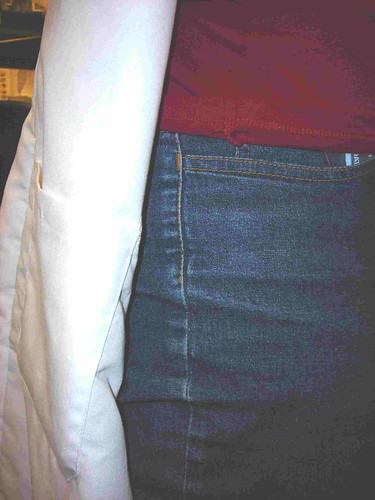
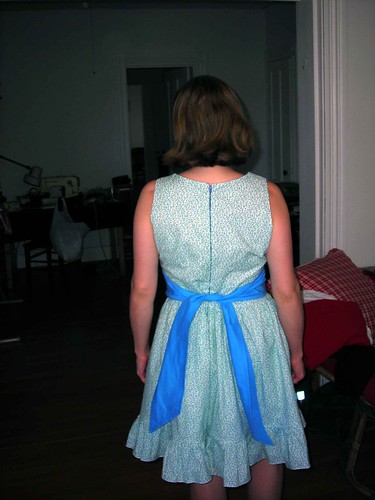
And this is the dress I just sewed in a fit of nostalgia for girly, frilly clothing. The ruffler attachment and I had a fine time.
On the one hand, every work place has a dress code. Bankers wear suits. Nurses wear scrubs (or slacks and a shirt). Business-casual workers wear khakis and a nice shirt, and so on. To some extent, these acceptable categories are narrowly defined, unless one is in California or some similarly enlightened place. (Or in a more, shall we say, accepting academic environment.)
On the other hand, I have never seen any of our female faculty wear other than: shirtdresses; slacks and a blouse; slacks or skirt and a sweater. And I saw one wear a suit once.
If I wore this dress to lab, it would destroy whatever credibility I have left in my coworkers' eyes. One mustn't be too frilly, after all. Why? Well, in my experience, some of it is because, as I've said before, feminine is equated with not-serious-about-work. A floral skirt means you were thinking about clothing rather than science that morning. And so on.
But some of it is legitimate. Stiletto heels are not appropriate for treating indigent patients at the free clinic. Flouncy dresses will, inevitably, knock over the pipettes' bleach bath.
I think part of this attitude springs from- I don't quite know how to express it- expecting women to pretend to be men. Heaven forbid you should wear anything with lace at the hem. It doesn't project tough and in charge, which, at least around here, is what one needs to succeed.
Where does pretty clothing become truly inappropriate for work? Other than the obvious: stilettos and feathered headdresses. So where's the line?
And this is the dress I just sewed in a fit of nostalgia for girly, frilly clothing. The ruffler attachment and I had a fine time.
On the one hand, every work place has a dress code. Bankers wear suits. Nurses wear scrubs (or slacks and a shirt). Business-casual workers wear khakis and a nice shirt, and so on. To some extent, these acceptable categories are narrowly defined, unless one is in California or some similarly enlightened place. (Or in a more, shall we say, accepting academic environment.)
On the other hand, I have never seen any of our female faculty wear other than: shirtdresses; slacks and a blouse; slacks or skirt and a sweater. And I saw one wear a suit once.
If I wore this dress to lab, it would destroy whatever credibility I have left in my coworkers' eyes. One mustn't be too frilly, after all. Why? Well, in my experience, some of it is because, as I've said before, feminine is equated with not-serious-about-work. A floral skirt means you were thinking about clothing rather than science that morning. And so on.
But some of it is legitimate. Stiletto heels are not appropriate for treating indigent patients at the free clinic. Flouncy dresses will, inevitably, knock over the pipettes' bleach bath.
I think part of this attitude springs from- I don't quite know how to express it- expecting women to pretend to be men. Heaven forbid you should wear anything with lace at the hem. It doesn't project tough and in charge, which, at least around here, is what one needs to succeed.
Where does pretty clothing become truly inappropriate for work? Other than the obvious: stilettos and feathered headdresses. So where's the line?
Wednesday, March 07, 2007
Sports Analogies and Strong Women
And now for more of our regularly scheduled women-in-science programming. Themes: You Can Do It, We're Getting Better, and Keep Trying.
****
A woman recently came to speak here. She's worked as dean or president at six or so colleges; she's retired now.
She talked about being in college in the 50's. "The dean of Pretentious University called me into his office at the beginning of my senior year and told me I couldn't be a math major because I was a woman. [Had he not noticed until then?] I'd taken a lot of classes and done very well, but too bad! So I switched."
"After I graduated and got married, I was looking for jobs in science. This was during the post-war industrial boom. But every time they said, 'We don't hire women for technical positions. But can you type?' So I got a job as a technical writer. That's like science, but it has words; and you know women are good with words. Hah."
"And I got pregnant and they fired me. Never let anyone tell you laws can't change discrimination: that's illegal now."
"I'd put my husband through medical school; our kids were in high school. So I was working as an editor, and I started working on a PhD, just for fun, you know. I'd bought a doctor, I figured I'd never have to work again. And then! one day my husband ran off with his teenage receptionist."
....
"I was the first female president in an entirely male hierarchy. And I have to tell you, I was good at my work, I was very good, but I don't think I would have gotten any of those jobs without affirmative action. Without external pressure for change, as well as pressure from their constituencies, the female students, they wouldn't have hired a woman.
They were trying to be all friendly and welcoming, so they organized a retreat. They'd never done a retreat before. And at the end of it someone asked me, 'So, how's it been, Sue? What do you think?' And I said, 'It's been lovely, very interesting. The only thing is, I wish everyone could use some metaphors other than sports. Up to bat. Home stretch. Team player. All the time. Maybe art, or literature, or politics, or, ah, anything else?'
And this person, to whom I had spoken in private, told everyone else. To be malicious. So for years, it was 'Well, let's level the playing field. Oh! So sorry! I forgot, you don't like sports.' Fifteen times a day. It was harassment. I could have sued them, but I bit my tongue. I knew what it was, and it was on purpose, a distancing thing: You're not one of us."
[I asked: Do you have advice for us young women on how to deal without discrimination without being furious all the time?]
"Furious! Well, it's better than depression, which is what most people experience when they realize there's discrimination. But really, choose your battles. And make allies. Avoid venting to the people who are driving you nuts. And have good friends so you can vent."
****
I can never decide if hearing these things is heartening or not. It was worse: much worse. And women still earn 75 cents for every dollar our spouses, sons, partners, friends, and fathers make. (For a bunch of complicated reasons, only some of which are to do with discrimination, but many of which are to do with structural inequalities.)
In an effort to be more positive, and in response to someone's question, I was trying to think of things I like about being a woman in science. I like meeting other smart men and women. And I like science. But I don't think I like a single other thing about it.
What's good about being a woman in science? Or, if you're not in science, about being a woman in your profession?
(Comments are open; welcome, any carnival readers! Drop in and say hi!)
(scientiae-carnival)
****
A woman recently came to speak here. She's worked as dean or president at six or so colleges; she's retired now.
She talked about being in college in the 50's. "The dean of Pretentious University called me into his office at the beginning of my senior year and told me I couldn't be a math major because I was a woman. [Had he not noticed until then?] I'd taken a lot of classes and done very well, but too bad! So I switched."
"After I graduated and got married, I was looking for jobs in science. This was during the post-war industrial boom. But every time they said, 'We don't hire women for technical positions. But can you type?' So I got a job as a technical writer. That's like science, but it has words; and you know women are good with words. Hah."
"And I got pregnant and they fired me. Never let anyone tell you laws can't change discrimination: that's illegal now."
"I'd put my husband through medical school; our kids were in high school. So I was working as an editor, and I started working on a PhD, just for fun, you know. I'd bought a doctor, I figured I'd never have to work again. And then! one day my husband ran off with his teenage receptionist."
....
"I was the first female president in an entirely male hierarchy. And I have to tell you, I was good at my work, I was very good, but I don't think I would have gotten any of those jobs without affirmative action. Without external pressure for change, as well as pressure from their constituencies, the female students, they wouldn't have hired a woman.
They were trying to be all friendly and welcoming, so they organized a retreat. They'd never done a retreat before. And at the end of it someone asked me, 'So, how's it been, Sue? What do you think?' And I said, 'It's been lovely, very interesting. The only thing is, I wish everyone could use some metaphors other than sports. Up to bat. Home stretch. Team player. All the time. Maybe art, or literature, or politics, or, ah, anything else?'
And this person, to whom I had spoken in private, told everyone else. To be malicious. So for years, it was 'Well, let's level the playing field. Oh! So sorry! I forgot, you don't like sports.' Fifteen times a day. It was harassment. I could have sued them, but I bit my tongue. I knew what it was, and it was on purpose, a distancing thing: You're not one of us."
[I asked: Do you have advice for us young women on how to deal without discrimination without being furious all the time?]
"Furious! Well, it's better than depression, which is what most people experience when they realize there's discrimination. But really, choose your battles. And make allies. Avoid venting to the people who are driving you nuts. And have good friends so you can vent."
****
I can never decide if hearing these things is heartening or not. It was worse: much worse. And women still earn 75 cents for every dollar our spouses, sons, partners, friends, and fathers make. (For a bunch of complicated reasons, only some of which are to do with discrimination, but many of which are to do with structural inequalities.)
In an effort to be more positive, and in response to someone's question, I was trying to think of things I like about being a woman in science. I like meeting other smart men and women. And I like science. But I don't think I like a single other thing about it.
What's good about being a woman in science? Or, if you're not in science, about being a woman in your profession?
(Comments are open; welcome, any carnival readers! Drop in and say hi!)
(scientiae-carnival)
Subscribe to:
Posts (Atom)