The latest Scientiae theme, is appropriately enough, 'transitions.' What, like moving? Oh, can I ever blather on about moving.
I've lived in thirteen different places since I went off to college. Somewhere along the way, I developed a terrible anticipatory dread; I associate moving with being lonely and confused, so hey, rev up the anxiety in advance! Speaking of, we finally found an apartment I don't hate, which is all of a) on the bus line; b) reasonably priced; c) tolerant of cats; d) not hideous and e) willing to offer a 6-month lease, this last because we have an elaborate plan in which house-purchasing depends on fellowship getting because of funding hell.
Anyhow. We're supposed to move in six weeks. I still don't know if I get to leave for real, because my experiments aren't so much done, but I will be definitively apartmentless in six weeks. I am filled with dread, which is strange, because I really really REALLY want to leave. Some part of my bear brain is convinced I will NEVER EVER LEAVE. Suddenly, the European 'You've been here X years and now you're leaving BYE' thing looks a lot better.
I always worry about the unknown, but this is getting a little ridiculous. I don't even have time to worry I'll be lonely! Too worried about lab!
P.S. What could I do differently to deal better? SLEEP THROUGH THE DAMN NIGHT. Except I can't.
Showing posts with label Scientiae. Show all posts
Showing posts with label Scientiae. Show all posts
Thursday, July 17, 2008
Wednesday, June 04, 2008
In Which I Demand Attention, NOW
I spent several years in my lab feeling invisible. There would be two or three days in a row when literally all anyone said to me would be 'Are you done with that?' and 'It's on that shelf.' Needless to say, I hated it.
My professional life here is now exactly as I would want. My advisor listens- listens!- when I talk, and tells others to take my suggestions. My lab listens. They even talk to me sometimes. (Kidding! We talk all the time.)
As previously mentioned, I spent a lot of time learning how to be heard. Probably the single most effective things I've learned were to talk quite loudly at work, and to interrupt. All the public speaking I did as a journal editor didn't hurt either, nor the cutting off of respected senior doctor-types. My voice has grown HUUUUUGE!*
Because I'm now heard, because I have a real presence in my work, well, I almost want to whisper, but... I kind of like my lab.** In part it's because they treat me better, and in part it's because I accept nothing less. I expect to get the respect and courtesy I deserve for being an experienced, intelligent, stuffed-with-useful-knowledge colleague. I demand my place by having a firm respect for my own abilities.
I've also learned to believe, completely and firmly, that things are going to happen the way I want.*** This is also hard for me to explain. It's kind of like... a complete refusal to accept circumstances that I find unacceptable. People interrupt me and I stare them down. People propose things that are not okay and I tell them, 'That will not work for me. Find an alternative.'
I have overcome my Southern, female training to be unobtrusive and polite.
The biggest difference from even a year ago is that I finally expect to be heard. I don't think anyone can give you this kind of belief. But it's great.
*Except at home, where Dr. S can never bloody well hear me.
**Not just because I'm about to leave. But it doesn't hurt.
***But not experimental data, which is beyond even my power of belief.
My professional life here is now exactly as I would want. My advisor listens- listens!- when I talk, and tells others to take my suggestions. My lab listens. They even talk to me sometimes. (Kidding! We talk all the time.)
As previously mentioned, I spent a lot of time learning how to be heard. Probably the single most effective things I've learned were to talk quite loudly at work, and to interrupt. All the public speaking I did as a journal editor didn't hurt either, nor the cutting off of respected senior doctor-types. My voice has grown HUUUUUGE!*
Because I'm now heard, because I have a real presence in my work, well, I almost want to whisper, but... I kind of like my lab.** In part it's because they treat me better, and in part it's because I accept nothing less. I expect to get the respect and courtesy I deserve for being an experienced, intelligent, stuffed-with-useful-knowledge colleague. I demand my place by having a firm respect for my own abilities.
I've also learned to believe, completely and firmly, that things are going to happen the way I want.*** This is also hard for me to explain. It's kind of like... a complete refusal to accept circumstances that I find unacceptable. People interrupt me and I stare them down. People propose things that are not okay and I tell them, 'That will not work for me. Find an alternative.'
I have overcome my Southern, female training to be unobtrusive and polite.
The biggest difference from even a year ago is that I finally expect to be heard. I don't think anyone can give you this kind of belief. But it's great.
*Except at home, where Dr. S can never bloody well hear me.
**Not just because I'm about to leave. But it doesn't hurt.
***But not experimental data, which is beyond even my power of belief.

Tuesday, April 29, 2008
From Definite To Definitely Vague
Ten years ago I was just entering college. I wanted to study abroad, do chemistry, and go hiking and canoeing a lot. (I did.)
Five years ago I had left a long relationship and was alternating long days at work with sitting on my bed staring at the ceiling. It was not a good year.
When I came to grad school, I wanted to teach at a SLAC. I loved my professors, and they loved teaching. They all did research, but we did real experiments and went to conferences. Eventually I realized, and later accepted, that I could take this path, but I was unwilling to.
So in the last year, I've looked at my options and decided I want something more stable, predictable, and well-paid. Right now, I don’t have career goals. To paraphrase Mrs. Whatsit, I have few desires remaining to me:
1) Sleep
2) Have a baby.
Later I may add:
3) Sew and garden
4) Earn money.
There are a lot of possibilities for jobs, going from science education and editing at the top down to supertech/lab manager at the very bottom. (Somewhere in the sub-basement is ‘Postdoc.’) While my little bear-brain is terrified of nobody wanting to hire me, my science-brain reminds me that two headhunters have already called and I haven't even been looking. So: Work. At something. Near family. This is my career goal for in five years. Plus a baby and a dog. Maybe two. (Each.) Oh yes, and the adorable husband; I'd like to keep him.
What has been amazing- and not necessarily in a good way- is my friends and I have changed. My girlfriends have children; many of them have become stereotypical wives, so it’s grown harder to understand each others’ daily lives. I have become a different person: harder, meaner, sharper-tongued, less patient, less tolerant, but also better at helping others even when I'm exhausted, more able to realize what's truly important, less likely to argue with my loved ones. I have absorbed enormous amounts of science. I can think up a coherent and plausible-sounding answer to any question in 10 seconds or less.
What I want personally, for the next five years, is to continue in a loving partnership with my spouse, to start a family, and to settle down somewhere. I have a picture in my head of how it'll be. I am going to make it happen.
Ten years, though? Too far away!
Five years ago I had left a long relationship and was alternating long days at work with sitting on my bed staring at the ceiling. It was not a good year.
When I came to grad school, I wanted to teach at a SLAC. I loved my professors, and they loved teaching. They all did research, but we did real experiments and went to conferences. Eventually I realized, and later accepted, that I could take this path, but I was unwilling to.
So in the last year, I've looked at my options and decided I want something more stable, predictable, and well-paid. Right now, I don’t have career goals. To paraphrase Mrs. Whatsit, I have few desires remaining to me:
1) Sleep
2) Have a baby.
Later I may add:
3) Sew and garden
4) Earn money.
There are a lot of possibilities for jobs, going from science education and editing at the top down to supertech/lab manager at the very bottom. (Somewhere in the sub-basement is ‘Postdoc.’) While my little bear-brain is terrified of nobody wanting to hire me, my science-brain reminds me that two headhunters have already called and I haven't even been looking. So: Work. At something. Near family. This is my career goal for in five years. Plus a baby and a dog. Maybe two. (Each.) Oh yes, and the adorable husband; I'd like to keep him.
What has been amazing- and not necessarily in a good way- is my friends and I have changed. My girlfriends have children; many of them have become stereotypical wives, so it’s grown harder to understand each others’ daily lives. I have become a different person: harder, meaner, sharper-tongued, less patient, less tolerant, but also better at helping others even when I'm exhausted, more able to realize what's truly important, less likely to argue with my loved ones. I have absorbed enormous amounts of science. I can think up a coherent and plausible-sounding answer to any question in 10 seconds or less.
What I want personally, for the next five years, is to continue in a loving partnership with my spouse, to start a family, and to settle down somewhere. I have a picture in my head of how it'll be. I am going to make it happen.
Ten years, though? Too far away!
Thursday, February 28, 2008
Renewal
Spring is my very favorite season. Even more than little green shoots pushing up through the mud, I love the colors and the sun. I love the promise that the grey, dreary skies will eventually clear.
I am, I hope, close to done with my six-year winter. I tell people that I've learned a great deal in grad school, and almost none of it what I thought I'd learn. I've learned to come up with quick answers- one of our postdocs thinks I should be a lawyer!- be assertive in the extreme, cut people off at the knees, rely on only myself for professional support and never expect encouragement. These are not necessarily things I want to know. This is not the person I want to be.
Appropriately enough, the Jewish New Year is always in the fall, with the harvest. I want the next year, once we leave, to be a season of renewal; perhaps a PhD is a harvest of years of suffering. It is supposed to start a new calendar for what one owes, to the Temple in past times and now, in a way, to one's community.
I want my new year to renew my faith in others and in myself. I want to believe that the people around me will do their jobs competently and to receive useful feedback in my job. With my faith in others, I want to tune down the cutthroat impulses, because I surely sharpen them on people who don't deserve it. I want to plant flowers and trees, repaint walls and sand down cupboards, and make a new home for myself and my sweet husband.
After I am done with six years of winter, I want to bring a little light. I want to have enough time away from work to give something back to my new city. I want to teach people about science, and see their faces light up, and know that my work is making the world a better place in some small way. My hope for renewal is that the spring will help me bring my love of science, beaten down by six years of this, back to life, if only as a little sprout.
scientiae-carnival
I am, I hope, close to done with my six-year winter. I tell people that I've learned a great deal in grad school, and almost none of it what I thought I'd learn. I've learned to come up with quick answers- one of our postdocs thinks I should be a lawyer!- be assertive in the extreme, cut people off at the knees, rely on only myself for professional support and never expect encouragement. These are not necessarily things I want to know. This is not the person I want to be.
Appropriately enough, the Jewish New Year is always in the fall, with the harvest. I want the next year, once we leave, to be a season of renewal; perhaps a PhD is a harvest of years of suffering. It is supposed to start a new calendar for what one owes, to the Temple in past times and now, in a way, to one's community.
I want my new year to renew my faith in others and in myself. I want to believe that the people around me will do their jobs competently and to receive useful feedback in my job. With my faith in others, I want to tune down the cutthroat impulses, because I surely sharpen them on people who don't deserve it. I want to plant flowers and trees, repaint walls and sand down cupboards, and make a new home for myself and my sweet husband.
After I am done with six years of winter, I want to bring a little light. I want to have enough time away from work to give something back to my new city. I want to teach people about science, and see their faces light up, and know that my work is making the world a better place in some small way. My hope for renewal is that the spring will help me bring my love of science, beaten down by six years of this, back to life, if only as a little sprout.
scientiae-carnival
Tuesday, October 30, 2007
The Voices In My Head
A propos of the next Scientiae carnival- as usual, I'm just too late!- on inner voices:
Here's a surprise for you: I talk to myself. All the time.
In the lonelier years of grad school, I would have entire conversations with absent friends and relatives. I would come up with biting retorts- inevitably, of course, three days later.
The voice in my head is focused now. It's there to help me graduate. It talks about experiments, hypotheses, things I should remember. It says, every day, 'You can do it. You will do it.'
Most importantly, I have a stock of answers. You know when Professor Dinosaur says something horrendous? My inner voice always has a snippy reply. 'Such an attractive young lady!' 'I'd rather you pay attention to my genius ideas and brilliant mind, thank you.' When someone flames me in lab meeting, the inner voice pulls something out of the files. 'Yes, it is surprising, but real data's like that.' 'Shut up, I'm talking.' 'In my extensive experience with this experiment that YOU have never done...'
Sometimes the inner snark creeps into the outside voice in full-on Southern. 'Don't you ever talk to me like that.' 'I beg your pardon but I do believe you are mistaken.' And sometimes, when I'm really losing it, 'Listen to the WORDS coming out of my MOUTH!!!'
The inner voice gets a real workout when I'd rather be smacking someone. I recite every day, 'I am not here to vent my feelings. I am here to accomplish my goals. I am here to accomplish my goals. I am here to get my FUCKING PHD, what is wrong with these people?!?!.. Deep breath... I am not here to vent my feelings...'
Here's a surprise for you: I talk to myself. All the time.
In the lonelier years of grad school, I would have entire conversations with absent friends and relatives. I would come up with biting retorts- inevitably, of course, three days later.
The voice in my head is focused now. It's there to help me graduate. It talks about experiments, hypotheses, things I should remember. It says, every day, 'You can do it. You will do it.'
Most importantly, I have a stock of answers. You know when Professor Dinosaur says something horrendous? My inner voice always has a snippy reply. 'Such an attractive young lady!' 'I'd rather you pay attention to my genius ideas and brilliant mind, thank you.' When someone flames me in lab meeting, the inner voice pulls something out of the files. 'Yes, it is surprising, but real data's like that.' 'Shut up, I'm talking.' 'In my extensive experience with this experiment that YOU have never done...'
Sometimes the inner snark creeps into the outside voice in full-on Southern. 'Don't you ever talk to me like that.' 'I beg your pardon but I do believe you are mistaken.' And sometimes, when I'm really losing it, 'Listen to the WORDS coming out of my MOUTH!!!'
The inner voice gets a real workout when I'd rather be smacking someone. I recite every day, 'I am not here to vent my feelings. I am here to accomplish my goals. I am here to accomplish my goals. I am here to get my FUCKING PHD, what is wrong with these people?!?!.. Deep breath... I am not here to vent my feelings...'
Sunday, September 30, 2007
Realistic Mentors Say 'I'm Telling You This For Your Own Good' (3)
Or: And this has what to do with mentoring?
Part 1: Funding
Part 2: Publishing and Grant Writing
Part 3: Realism
A few further cheering statistics: Of the 30% of sci/eng PhDs who are in academia, only about 50% of them get tenure. (This reminds me of the 5% tenure rate among humanities profs here; they all think they'll get tenure, but 95% of them are wrong.)
And, if you factor in, say, gender?
So what does this have to do with mentoring? These are all things your advisor should tell you, and judging from the sample around here, likely hasn't.
I'm not saying: Nobody should go into academia. If you love science and want to be an academic researcher, great! Good for you! Hip hip hurrah. And all that. I'm saying: Nobody should go into academia blind.
A good mentor is realistic. He or she will do their best to help you write a good grant application, or help come up with productive ideas, or just supply decent letters of reference. But your advisor should be straight with you: You have a 16% chance of being funded.
It's the difference between, oh, going somewhere new when you know how far it is, and driving along lost with a burnt-out headlight in the middle of nowhere. In the first case, you can check your speedometer; you know how much gas you need, when you need a tune-up, etc. In the second case you have no idea what you're going to need. It's easier to do hard work when you know how hard it's going to be. If you know it's going to hurt, it hurts less. (Plus, apparently you're less anxious. Hmmm.)
I think part of what happens is the best scientists leave. Anyone who is too frustrated with the Byzantine grant system, the old-boys' club,the long postdocs and the cult-like work culture, leaves. Only thosewhose determination to play the game is greatest become NIH-funded
researchers (or HHMI, or NSF, or whatever). This does not necessarily overlap with the most innovative minds, though sometimes it does. But it surely does not SELECT for it.
What can a mentor do? Teach you how to play the game. Tell you the tricks. Encourage you through the difficult bits, because funding is tough. Tell you straight up you'll have a 1 in 2 chance of getting tenure, and that only 15% of science PhDs end up with tenure. Give you a realistic picture of what your path will be like, and give you enough data to make an informed decision.
Good mentoring is honest. But also: not deluded.
If you want to be faculty and your mentor hasn't talked to you about money, here's what I think you should do: go talk to three junior professors at your school, and at the kind of place you want to work. Ask them how their funding really works. Ask what they wish they'd known X years ago. Ask them how arbitrary they've found the tenure process, and what helps. Then go ask your advisor, armed with a slightly expanded perspective. Get advice on negotiating your salary. Start writing your grant as soon as possible.
Now you'll have some idea of where the bumps will be in your road. At least you'll be warned.
scientiae-carnival
Part 1: Funding
Part 2: Publishing and Grant Writing
Part 3: Realism
A few further cheering statistics: Of the 30% of sci/eng PhDs who are in academia, only about 50% of them get tenure. (This reminds me of the 5% tenure rate among humanities profs here; they all think they'll get tenure, but 95% of them are wrong.)
And, if you factor in, say, gender?
- After accounting for controls, women are less likely than men to be tenured. Gender differences in tenure rates decline if we exclude from our samples doctorate recipients employed in nontenure-track positions.
- Our analysis suggests that women's chances for earning tenure are influenced by family characteristics, both directly and indirectly through the relation of family characteristics to the likelihood of being employed in tenure-track positions.
- Having young children later in their careers is positively related to women's chances for earning tenure.
- Estimates of gender differences in tenure rates are relatively insensitive to the characteristics of the employer or to the primary work activity.
So what does this have to do with mentoring? These are all things your advisor should tell you, and judging from the sample around here, likely hasn't.
I'm not saying: Nobody should go into academia. If you love science and want to be an academic researcher, great! Good for you! Hip hip hurrah. And all that. I'm saying: Nobody should go into academia blind.
A good mentor is realistic. He or she will do their best to help you write a good grant application, or help come up with productive ideas, or just supply decent letters of reference. But your advisor should be straight with you: You have a 16% chance of being funded.
It's the difference between, oh, going somewhere new when you know how far it is, and driving along lost with a burnt-out headlight in the middle of nowhere. In the first case, you can check your speedometer; you know how much gas you need, when you need a tune-up, etc. In the second case you have no idea what you're going to need. It's easier to do hard work when you know how hard it's going to be. If you know it's going to hurt, it hurts less. (Plus, apparently you're less anxious. Hmmm.)
I think part of what happens is the best scientists leave. Anyone who is too frustrated with the Byzantine grant system, the old-boys' club,the long postdocs and the cult-like work culture, leaves. Only thosewhose determination to play the game is greatest become NIH-funded
researchers (or HHMI, or NSF, or whatever). This does not necessarily overlap with the most innovative minds, though sometimes it does. But it surely does not SELECT for it.
What can a mentor do? Teach you how to play the game. Tell you the tricks. Encourage you through the difficult bits, because funding is tough. Tell you straight up you'll have a 1 in 2 chance of getting tenure, and that only 15% of science PhDs end up with tenure. Give you a realistic picture of what your path will be like, and give you enough data to make an informed decision.
Good mentoring is honest. But also: not deluded.
If you want to be faculty and your mentor hasn't talked to you about money, here's what I think you should do: go talk to three junior professors at your school, and at the kind of place you want to work. Ask them how their funding really works. Ask what they wish they'd known X years ago. Ask them how arbitrary they've found the tenure process, and what helps. Then go ask your advisor, armed with a slightly expanded perspective. Get advice on negotiating your salary. Start writing your grant as soon as possible.
Now you'll have some idea of where the bumps will be in your road. At least you'll be warned.
scientiae-carnival
Friday, September 28, 2007
Realistic Mentors Say 'Play the Game (And If You Want To Innovate, Game the System)' (2)
Or: Science Assessment and Publishing: Was It Perhaps Set Up By Monkeys?
Part 1: Funding
Part 2: Publishing and Grant Writing
Part 3: Realism
This whole funding and publishing system largely rewards brick-in-the-wall science (so to speak), because it has continual publishable payouts. It's the moral equivalent of school testing: each PI creates their own little empire, and their people can only work on things that fit into the grant. There is no chasing of interesting asides; I can't work on the bizarre RNA suppression phenomena that I observe, because we're not an RNA lab. Everyone has to pursue a 'publishable story' to get money/ papers/ PhDs. And, to sweeten the pot, papers are frequently rejected if the results are, and I quote, 'Too different and new.'*
As Henry so feelingly expressed in the comments, you have to have preliminary data to get a grant, but you can't get preliminary data without money, so everyone (well, at least almost everyone) fudges their grants (by including a fraction of the results).
And then further grants are judged by your citation index.
The NIH recently started a new award for daring projects and young researchers, but there are only a tiny, tiny number. Meanwhile, the mean age at first NIH grant has risen to 42, and 4% of grants go to people under 35. Yes, that's right: FOUR PERCENT.
Somewhere around 30% of all science and engineering PhDs work in academia. Half of all PhD scientists work in non-science, or only tangentially scientific, jobs- consulting, business, law, whatever. Cause, or effect? Hard to say.
*This happened to someone I know. Or: why many truly groundbreaking papers appeared in PNAS rather than the Unholy Trinity; it publishes any solid work, and with more words; there's even a non-reviewed track, though that's cheating. The Unholies also have enormously high retraction rates, for obvious reasons.
scientiae-carnival
Part 1: Funding
Part 2: Publishing and Grant Writing
Part 3: Realism
This whole funding and publishing system largely rewards brick-in-the-wall science (so to speak), because it has continual publishable payouts. It's the moral equivalent of school testing: each PI creates their own little empire, and their people can only work on things that fit into the grant. There is no chasing of interesting asides; I can't work on the bizarre RNA suppression phenomena that I observe, because we're not an RNA lab. Everyone has to pursue a 'publishable story' to get money/ papers/ PhDs. And, to sweeten the pot, papers are frequently rejected if the results are, and I quote, 'Too different and new.'*
As Henry so feelingly expressed in the comments, you have to have preliminary data to get a grant, but you can't get preliminary data without money, so everyone (well, at least almost everyone) fudges their grants (by including a fraction of the results).
And then further grants are judged by your citation index.
"It is fun to imagine song writers being assessed in the way that scientists are today. Bureaucrats employed by DAFTA (Ditty, Aria, Fugue and Toccata Assessment) would count the number of songs produced and rank them by which radio stations they were played on during the first two weeks after release. The song writers would soon find that producing junky Christmas tunes and cosying up to DJs from top radio stations advanced their careers more than composing proper music. It is not so funny that, in the real world of science, dodgy evaluation criteria such as impact factors and citations are dominating minds, distorting behaviour and determining careers."This is exactly what's happened to biology. Supervisors write grants all the time; almost no senior professors do bench research. They are glorified lab managers, and my boss for one has virtually no contact with the day-to-day operations of the lab. There is no funding for 'risky' projects; many arise as some grad student's (or postdoc's) on-the-side unmentioned thingummy.
The NIH recently started a new award for daring projects and young researchers, but there are only a tiny, tiny number. Meanwhile, the mean age at first NIH grant has risen to 42, and 4% of grants go to people under 35. Yes, that's right: FOUR PERCENT.
Somewhere around 30% of all science and engineering PhDs work in academia. Half of all PhD scientists work in non-science, or only tangentially scientific, jobs- consulting, business, law, whatever. Cause, or effect? Hard to say.
*This happened to someone I know. Or: why many truly groundbreaking papers appeared in PNAS rather than the Unholy Trinity; it publishes any solid work, and with more words; there's even a non-reviewed track, though that's cheating. The Unholies also have enormously high retraction rates, for obvious reasons.
scientiae-carnival
Wednesday, September 26, 2007
Realistic Mentors Say 'Chances of Funding Are Slim, Check Magic 8 Ball' (1)
Or: How Science Funding (Doesn't) Really Work (What Your Mentor Should Tell You But Probably Hasn't)
Part 1: Funding
Part 2: Publishing and Grant Writing
Part 3: Realism
A friend set me off by sending me this. The current Scientiae's theme is mentoring, so let's talk how to mentor honestly and effectively on careers and money.
The NSF gets about $4.5b for research funding, currently. A good chunk of this goes to permanent and/or large initiatives: telescopes, education projects, grad student training grant. The NSF 'receives approximately 40,000 proposals each year for research, education and training projects, of which approximately 11,000 are funded'.
The NIH gets about $30 billion total, half of which goes to research. Approximately 20% of all grants are funded, including 'competetive' renewals. Only 17% of new grants are funded, but 37% of renewals and 30% of supplements are.* You will note that established labs have a two-fold advantage. Applications are sometimes semi-blinded, but everyone in the field will know who wrote it anyways. This ensures that some labs may coast on their reputations.
'Average grant sizes have grown by 40% since the doubling began, from $275,000 in 1998 to $400,000 today', which is part of why- ironically- success rates are lower now that the NIH has more money.
Equally ironically, more money doesn't correspond to more productivity, in part because papers now have six figures and ten pages of supplemental, and in part because of... inefficiency? Expensive clinical trials? 60% overhead?
At Snooty U, we get over $300 million from the NIH alone, and 90% if it goes to the med school. Internal med all by its little lonesome gets 25%, and Psych gets 15%. Biology gets the remaining 10%, and another $180 million goes straight into the university's pockets. Per year. (By the way, this handy little tool will show you your tax dollars at work.)
When Leo Szilard was asked how to slow science, he said:
*My skepticism about the competetiveness derives in part from the supplement my lab got last year. We wrote a two-page thing about how we wanted a super-fancy electronically controlled brick baking oven with automatic feedback and bells on. We got $200,000. Noncompetetive.
**Or: why many groundbreaking papers appeared in PNAS rather than the Unholy Trinity; it publishes any solid work, and with more words; there's even a non-reviewed track, though that's cheating. The Unholies also have enormously high retraction rates, for obvious reasons. (Edited: Whoops, this one belongs with the next part...)
scientiae-carnival
Part 1: Funding
Part 2: Publishing and Grant Writing
Part 3: Realism
A friend set me off by sending me this. The current Scientiae's theme is mentoring, so let's talk how to mentor honestly and effectively on careers and money.
The NSF gets about $4.5b for research funding, currently. A good chunk of this goes to permanent and/or large initiatives: telescopes, education projects, grad student training grant. The NSF 'receives approximately 40,000 proposals each year for research, education and training projects, of which approximately 11,000 are funded'.
The NIH gets about $30 billion total, half of which goes to research. Approximately 20% of all grants are funded, including 'competetive' renewals. Only 17% of new grants are funded, but 37% of renewals and 30% of supplements are.* You will note that established labs have a two-fold advantage. Applications are sometimes semi-blinded, but everyone in the field will know who wrote it anyways. This ensures that some labs may coast on their reputations.

'Average grant sizes have grown by 40% since the doubling began, from $275,000 in 1998 to $400,000 today', which is part of why- ironically- success rates are lower now that the NIH has more money.
Equally ironically, more money doesn't correspond to more productivity, in part because papers now have six figures and ten pages of supplemental, and in part because of... inefficiency? Expensive clinical trials? 60% overhead?
At Snooty U, we get over $300 million from the NIH alone, and 90% if it goes to the med school. Internal med all by its little lonesome gets 25%, and Psych gets 15%. Biology gets the remaining 10%, and another $180 million goes straight into the university's pockets. Per year. (By the way, this handy little tool will show you your tax dollars at work.)
When Leo Szilard was asked how to slow science, he said:
"You could set up a foundation with an annual endowment of thirty million dollars. Research workers in need of funds could apply for grants, if they could make a convincing case. Have ten committees, each composed of twelve scientists, appointed to pass on these applications. Take the most active scientists out of the laboratory and make them members of these committees. …First of all, the best scientists would be removed from their laboratories and kept busy on committees passing on applications for funds. Secondly the scientific workers in need of funds would concentrate on problems which were considered promising and were pretty certain to lead to publishable results. …By going after the obvious, pretty soon science would dry out. Science would become something like a parlor game. …There would be fashions. Those who followed the fashions would get grants. Those who wouldn't would not."You know the old joke: 'What's a camel?' 'A horse designed by a committee.'
*My skepticism about the competetiveness derives in part from the supplement my lab got last year. We wrote a two-page thing about how we wanted a super-fancy electronically controlled brick baking oven with automatic feedback and bells on. We got $200,000. Noncompetetive.
**Or: why many groundbreaking papers appeared in PNAS rather than the Unholy Trinity; it publishes any solid work, and with more words; there's even a non-reviewed track, though that's cheating. The Unholies also have enormously high retraction rates, for obvious reasons. (Edited: Whoops, this one belongs with the next part...)
scientiae-carnival
Wednesday, August 22, 2007
Truth: Still Stranger Than Fiction
Scene: Dreaded Semi-Annual Meeting With Advisor [In Which Said Advisor (Historically Speaking) Inspires In Me Two Entire Weeks Of Looking For a New Job, Whilst Moaning and Gnashing of Teeth; Also In Which Said Advisor Releases His Inner, Er, Advisor, In Consequence of Which I Am Shocked But Not Dismayed]
Advisor: So what's your plan for the next six months?
Me: Well, I'm starting an experimental wall-building series on Monday. Then every Tuesday I'm baking bricks, and every week I'm going to make a new decorative lattice until it's aesthetically and structurally sound. Once I've figured out what works best I'll start the final construction.
A: Sounds good. When will you be done with the test patterns?
Me: End of September, I hope.
A: (Technical question on clay mixtures and firing temperatures.)
Me: (Long boring answer on various details.)
A: This is going to make a really nice paper.
Me: ..... um, yeah.
A: I hope you're proud of all you've learned while you've been here. You've really made great progress.
Me: ..... Well, I'm a lot more efficient ....
A: So are you going to try to make the March deadline?
Me: .....
A: I think you probably could, but it might be a bit tight.
Me: ... uh ... as long as I defend by September, it'll be fine.
A: Well, it all looks great! You've done good work.
Me: .... [Abducted by aliens, maybe??] ....
A: I'm looking forward to seeing those walls!
Me: ... yeah, me too!
A: This was the shortest meeting I've had! It's because you're so organized.
Me: ....
Exit precipitously through office door, shaking head.
*****
I would like to imagine that my inner science-lover would be a happy, productive researcher, and that my three-year-long-headache only a bad dream, if the Inner Advisor were let loose more often. I would revel in my experiments, rather than dreading them; the long hours in lab would be an inconvenience gladly borne in the name of interesting data. I would believe that research science is my life's work, if only I occasionally received feedback instead of receiving attacks. I would also like to imagine that the anger which leads me to blog would be much diminished if not dissipated, in which case, alas, I wouldn't have your charming company, dear reader.
(scientiae-carnival)
Advisor: So what's your plan for the next six months?
Me: Well, I'm starting an experimental wall-building series on Monday. Then every Tuesday I'm baking bricks, and every week I'm going to make a new decorative lattice until it's aesthetically and structurally sound. Once I've figured out what works best I'll start the final construction.
A: Sounds good. When will you be done with the test patterns?
Me: End of September, I hope.
A: (Technical question on clay mixtures and firing temperatures.)
Me: (Long boring answer on various details.)
A: This is going to make a really nice paper.
Me: ..... um, yeah.
A: I hope you're proud of all you've learned while you've been here. You've really made great progress.
Me: ..... Well, I'm a lot more efficient ....
A: So are you going to try to make the March deadline?
Me: .....
A: I think you probably could, but it might be a bit tight.
Me: ... uh ... as long as I defend by September, it'll be fine.
A: Well, it all looks great! You've done good work.
Me: .... [Abducted by aliens, maybe??] ....
A: I'm looking forward to seeing those walls!
Me: ... yeah, me too!
A: This was the shortest meeting I've had! It's because you're so organized.
Me: ....
Exit precipitously through office door, shaking head.
*****
I would like to imagine that my inner science-lover would be a happy, productive researcher, and that my three-year-long-headache only a bad dream, if the Inner Advisor were let loose more often. I would revel in my experiments, rather than dreading them; the long hours in lab would be an inconvenience gladly borne in the name of interesting data. I would believe that research science is my life's work, if only I occasionally received feedback instead of receiving attacks. I would also like to imagine that the anger which leads me to blog would be much diminished if not dissipated, in which case, alas, I wouldn't have your charming company, dear reader.
(scientiae-carnival)
Tuesday, June 26, 2007
Encouragement Isn't Enough; Reality Interferes
Mr. S was recently at a conference. His field has many famous female scientists- in part because back in the day, it was considered trivial and boring. PIs kept coming up to him and asking what was he doing next year and was he looking for a postdoc? Maybe with them? And he kept explaining that he'd stay at Snooty U another year while I finished. And they'd say, 'Oh, is she looking for a postdoc too? I know those dual-scientist job searches can be hard.' And he'd say, 'No, she's not.'
To a woman, the female PIs said, in tones of horror, 'Oh no! You must encourage her to stay! Can't you change her mind? We need more female faculty!'
I think that many women, myself included, love research and want to do it. But we don't want it twice as much as our husbands. We don't want it enough to see women passed over or denied tenure because we took time 'off' to have a baby and didn't publish anything that year. We don't want it enough to earn $10,000 less than the male junior professor in the next office over.
Aside from the purely financial, childbearing is a very real barrier. When I see the obstacles, especially in academia, to having children, it does not make me want to postdoc so I can be faculty one day if I'm a very good girl. Yes, women have children in college, in grad school, before tenure, whenever. Sometimes it's fine, professionally. But especially at places like this, women with children pay a heavy professional as well as economic price for their children. This on top of the inherent disadvantages of being female in a world run by 60-year-old white men.
When I look at all these factors together, I am left with utterly no desire to be faculty. I, and all the women I know whose career plan is 'run away', have already eaten all the condescension and slights and obstruction that we want to for just now. We want to go somewhere else, where there is a chance for professionalism and respect. We already know what it's like in here. We don't want it.
I applaud the women who want more women to do postdocs and come to the academic-research world. It's wonderful to tell us we can do it and we should do it. Their encouragement to stay in the academy is lovely. But it's not what I need. I need things to change. Yesterday, ideally.
(P.S. Yes, my sister's baby is due like tomorrow. What? An obsession with offspring? Who, me?)
To a woman, the female PIs said, in tones of horror, 'Oh no! You must encourage her to stay! Can't you change her mind? We need more female faculty!'
I think that many women, myself included, love research and want to do it. But we don't want it twice as much as our husbands. We don't want it enough to see women passed over or denied tenure because we took time 'off' to have a baby and didn't publish anything that year. We don't want it enough to earn $10,000 less than the male junior professor in the next office over.
Aside from the purely financial, childbearing is a very real barrier. When I see the obstacles, especially in academia, to having children, it does not make me want to postdoc so I can be faculty one day if I'm a very good girl. Yes, women have children in college, in grad school, before tenure, whenever. Sometimes it's fine, professionally. But especially at places like this, women with children pay a heavy professional as well as economic price for their children. This on top of the inherent disadvantages of being female in a world run by 60-year-old white men.
When I look at all these factors together, I am left with utterly no desire to be faculty. I, and all the women I know whose career plan is 'run away', have already eaten all the condescension and slights and obstruction that we want to for just now. We want to go somewhere else, where there is a chance for professionalism and respect. We already know what it's like in here. We don't want it.
I applaud the women who want more women to do postdocs and come to the academic-research world. It's wonderful to tell us we can do it and we should do it. Their encouragement to stay in the academy is lovely. But it's not what I need. I need things to change. Yesterday, ideally.
(P.S. Yes, my sister's baby is due like tomorrow. What? An obsession with offspring? Who, me?)
Monday, June 11, 2007
Continued Disturbance About Motherhood, Price Of
My dear spouse wants to teach and do research: he wants it passionately. He loves it. He wants a job that also happens to be a career. His academic life is laid out, one, two, three: grad school, postdoc, faculty job. Minivan, 2.5 kids, publish, tenure. A straight path with (supposedly) no interruptions.
I want... to not be here.
So what does this have to do with my price of motherhood? In my ideal universe the Scientist household will be blessed with little ones and I will work part-time. What a lovely picture it makes. (Also, if I stayed home full-time, I would lose my mind.)
Except it probably won't happen that way. Statistically speaking, I will be unable to find a decent part-time job. Even if I do, the ratio of my earnings to either what I would earn full-time or to childcare costs will be a small, small number. And I certainly can't get a part-time job being a professor and running a lab. The straight path doesn't work well with childbearing, and it doesn't work well with less than 60-hour weeks. At least not in my field.
(Incidentally, a woman who was on the 'Beyond Bias and Barriers' panel spoke here a while ago. A professor in my department said 'But I cannot work part-time and run a lab. I cannot work even forty hours a week, not if I want tenure!' And the speaker said, 'Why not?' Because it is that way, but it doesn't have to be.)
The dilemma is about guilt. If I can't have what I want- intellectually satisfying work AND children- I don't want to play that game. If I have to pay a high price for motherhood, especially in the academic world, I don't want to be there. But maybe I should. If we, as women, don't fight the good fight to make it better for the next generation in science, are we at fault? If we choose to leave 'science', i.e. the work of a PI in academia, is it because we don't want it enough?
Or not.
I know that this kind of system benefits no-one: not parents, not single people, and certainly not single parents. At the same time, I have never once heard a young man in my class say 'I don't know if I could have children and tenure.' As long as women are asked to pay such a high price, the percentage of women scientists will creep up ever so slowly.... just like it's doing now.
scientiae-carnival
I want... to not be here.
So what does this have to do with my price of motherhood? In my ideal universe the Scientist household will be blessed with little ones and I will work part-time. What a lovely picture it makes. (Also, if I stayed home full-time, I would lose my mind.)
Except it probably won't happen that way. Statistically speaking, I will be unable to find a decent part-time job. Even if I do, the ratio of my earnings to either what I would earn full-time or to childcare costs will be a small, small number. And I certainly can't get a part-time job being a professor and running a lab. The straight path doesn't work well with childbearing, and it doesn't work well with less than 60-hour weeks. At least not in my field.
(Incidentally, a woman who was on the 'Beyond Bias and Barriers' panel spoke here a while ago. A professor in my department said 'But I cannot work part-time and run a lab. I cannot work even forty hours a week, not if I want tenure!' And the speaker said, 'Why not?' Because it is that way, but it doesn't have to be.)
The dilemma is about guilt. If I can't have what I want- intellectually satisfying work AND children- I don't want to play that game. If I have to pay a high price for motherhood, especially in the academic world, I don't want to be there. But maybe I should. If we, as women, don't fight the good fight to make it better for the next generation in science, are we at fault? If we choose to leave 'science', i.e. the work of a PI in academia, is it because we don't want it enough?
Or not.
"You can say we actively chose to leave the academic path, and some of us never gave it a backward glance. We chose, but it was a choice with a lot of push behind it. And we were all aware of how we were viewed by those who stayed on the path - those who were still in the pipeline. We had leaked out through our own fault... If we had been good enough to become professors, we would never have wanted to do anything else." (courtesy of the excellent Zuska)Academia tells me that I should stay and make sacrifices for the greater good. I should see the barriers in front of me, and they should be overcome by the force of my desire to be professorial. I should compare what I want to what I can have in academia, and give up what I want. I should see the price of motherhood in academia and elsewhere, and pay it.
I know that this kind of system benefits no-one: not parents, not single people, and certainly not single parents. At the same time, I have never once heard a young man in my class say 'I don't know if I could have children and tenure.' As long as women are asked to pay such a high price, the percentage of women scientists will creep up ever so slowly.... just like it's doing now.
scientiae-carnival
Monday, June 04, 2007
Not All Choices Were Created Equal
I just finished reading The Price of Motherhood, which everyone should read.
I am disturbed.
I am the very most disturbed by the chapter 'It Was Her Choice.'
This is what I have always wanted to have the words to say, about women’s choices to stay home:
If family members could file separately, rather than creating an artificial divide of ‘head of household’ versus his or her ‘dependents,’ second earners would have less of their earnings eaten up by childcare, and the option of satisfying work would be open to more people. If caregivers got Social Security credits on their household’s income, poverty (especially among elderly women) would shrink. If there were more and better child-care available, it would be less heart-wrenching to put one’s children in it. Rather than offering a false dichotomy and a false choice- family or work; be a good mother or have a career- family-friendly leave policies, better child care, and a larger market in part-time jobs could remove some of the anguish of these hard choices.
But these are not precisely free choices. To some extent, yes, we are all constrained by outside forces in our decisions, but women and mothers are constrained more. If maternity leave means no promotions, if having a child before tenure means no tenure, if even new female professors are consistently paid $10,000 less than their male counterparts- the choices are not equal for men and for women. We choose, but we cannot choose willingly, freely, if our alternatives are constrained by our gender.
(Next week: And I Do It Too.)
scientiae-carnival
I am disturbed.
I am the very most disturbed by the chapter 'It Was Her Choice.'
This is what I have always wanted to have the words to say, about women’s choices to stay home:
'… The sidelined ambitions, the compromises mothers live with that their husbands never had to make, all justified on the grounds of women’s choice… If they do this willingly, there's no problem. It's their choice. No one "made them do it," so no one has to do anything about it.'The author goes on to point out that our country taxes a second, usually female-earned, income as part of pooled 'household moneys,' thereby raising its marginal tax rate much higher. At the same time, money earned by one person is treated in the tax code as the sole property of the earner. Second earners are treated as if all the family's money were one for taxes, but mothers do not get Social Security credits on half the family’s income. Why not?
'The big problem with the rhetoric of choice is that it leaves out power Those who benefit from the status quo always attribute inequities to the choices of the underdog. The current rhetoric about choosing motherhood sounds suspiciously like the 1950s rhetoric about "happy" women…. The modern version of the old "true woman” argument—the true woman appreciates that her proper place is in the home—is the "choice" argument.'
If family members could file separately, rather than creating an artificial divide of ‘head of household’ versus his or her ‘dependents,’ second earners would have less of their earnings eaten up by childcare, and the option of satisfying work would be open to more people. If caregivers got Social Security credits on their household’s income, poverty (especially among elderly women) would shrink. If there were more and better child-care available, it would be less heart-wrenching to put one’s children in it. Rather than offering a false dichotomy and a false choice- family or work; be a good mother or have a career- family-friendly leave policies, better child care, and a larger market in part-time jobs could remove some of the anguish of these hard choices.
But these are not precisely free choices. To some extent, yes, we are all constrained by outside forces in our decisions, but women and mothers are constrained more. If maternity leave means no promotions, if having a child before tenure means no tenure, if even new female professors are consistently paid $10,000 less than their male counterparts- the choices are not equal for men and for women. We choose, but we cannot choose willingly, freely, if our alternatives are constrained by our gender.
(Next week: And I Do It Too.)
scientiae-carnival
Monday, May 14, 2007
Conduct Code of Scientific Uniform
This is what I wear every day: jeans, knit shirt; khakis, polo shirt; knit shirt, denim knee-length skirt. Oxford shoes. Earrings. Lab coat. Nothing too nice.
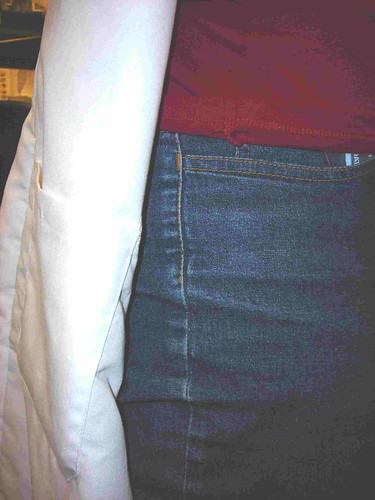
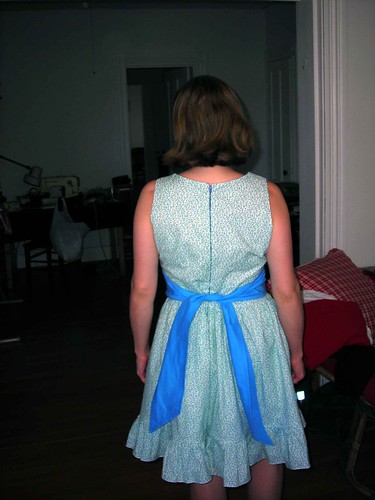
And this is the dress I just sewed in a fit of nostalgia for girly, frilly clothing. The ruffler attachment and I had a fine time.
On the one hand, every work place has a dress code. Bankers wear suits. Nurses wear scrubs (or slacks and a shirt). Business-casual workers wear khakis and a nice shirt, and so on. To some extent, these acceptable categories are narrowly defined, unless one is in California or some similarly enlightened place. (Or in a more, shall we say, accepting academic environment.)
On the other hand, I have never seen any of our female faculty wear other than: shirtdresses; slacks and a blouse; slacks or skirt and a sweater. And I saw one wear a suit once.
If I wore this dress to lab, it would destroy whatever credibility I have left in my coworkers' eyes. One mustn't be too frilly, after all. Why? Well, in my experience, some of it is because, as I've said before, feminine is equated with not-serious-about-work. A floral skirt means you were thinking about clothing rather than science that morning. And so on.
But some of it is legitimate. Stiletto heels are not appropriate for treating indigent patients at the free clinic. Flouncy dresses will, inevitably, knock over the pipettes' bleach bath.
I think part of this attitude springs from- I don't quite know how to express it- expecting women to pretend to be men. Heaven forbid you should wear anything with lace at the hem. It doesn't project tough and in charge, which, at least around here, is what one needs to succeed.
Where does pretty clothing become truly inappropriate for work? Other than the obvious: stilettos and feathered headdresses. So where's the line?
And this is the dress I just sewed in a fit of nostalgia for girly, frilly clothing. The ruffler attachment and I had a fine time.
On the one hand, every work place has a dress code. Bankers wear suits. Nurses wear scrubs (or slacks and a shirt). Business-casual workers wear khakis and a nice shirt, and so on. To some extent, these acceptable categories are narrowly defined, unless one is in California or some similarly enlightened place. (Or in a more, shall we say, accepting academic environment.)
On the other hand, I have never seen any of our female faculty wear other than: shirtdresses; slacks and a blouse; slacks or skirt and a sweater. And I saw one wear a suit once.
If I wore this dress to lab, it would destroy whatever credibility I have left in my coworkers' eyes. One mustn't be too frilly, after all. Why? Well, in my experience, some of it is because, as I've said before, feminine is equated with not-serious-about-work. A floral skirt means you were thinking about clothing rather than science that morning. And so on.
But some of it is legitimate. Stiletto heels are not appropriate for treating indigent patients at the free clinic. Flouncy dresses will, inevitably, knock over the pipettes' bleach bath.
I think part of this attitude springs from- I don't quite know how to express it- expecting women to pretend to be men. Heaven forbid you should wear anything with lace at the hem. It doesn't project tough and in charge, which, at least around here, is what one needs to succeed.
Where does pretty clothing become truly inappropriate for work? Other than the obvious: stilettos and feathered headdresses. So where's the line?
Tuesday, April 17, 2007
Scientiae 4: Read read read!
The fourth Scientiae carnival is up at See Jane Compute. Some excellent writing, funny stories, not-so-funny stories... Read! Write! Contribute!
Wednesday, April 11, 2007
Let's Play 'Sexist Ninny Bingo'!!!
(Also known by a less polite name.)
Scene: Belle is in the offices of her Department of Hermeneutic Predicative Poststructuralism.* Two male graduate students- hereafter Sexist Ninnies 1 and 2- are in the lounge.
SN1: Yeah, so Arla is out on maternity leave now. I guess she took a year off.
SN2: Did you hear? The chick they hired to take her classes was pregnant too. She had to leave before the end of the semester.
Belle: [Thinks: Maybe the baby was early! You idiots.]
SN1: That is sooooo unfair. I mean, she should have told them. It was so inconvenient for the department!
Belle: [Tell them? So they could not hire her? Inconvenient??? You idiots.]
SN2: Or she shouldn't have taken the job.
SN1: Yeah, it's already so hard for men to get jobs in Hermeneutics, Poststructuralism, and Predication. The departments always want to hire a woman.
Belle: [No, there are more female PhDs in HPP. You idiots.]
SN2: I can't imagine how hard it's going to be for us to get jobs.
SN1: It's so hard to be a man in this field.
Belle: [There are seven tenured profs here and ONE is a woman! You idiots!]
Fade to the sound of a head banging against the copier.
How many squares can we fill in here? Let's see:
Bonus!
Advisor in lab meeting: 'I just sent Ruth [who had a C-section 24 hours ago] back her paper- we need to get it out soon. I'm sure she'll be able to read it right away. There's really nothing to do the first few weeks anyways!'
Us, in the background: Major surgery... newborn... yep, that screams 'editing figure legends' to me!
*Belle dear, I hope you don't mind me relating this story all anonymous-like and liberally interpreted. It was too good to pass up.
(scientiae-carnival)
Scene: Belle is in the offices of her Department of Hermeneutic Predicative Poststructuralism.* Two male graduate students- hereafter Sexist Ninnies 1 and 2- are in the lounge.
SN1: Yeah, so Arla is out on maternity leave now. I guess she took a year off.
SN2: Did you hear? The chick they hired to take her classes was pregnant too. She had to leave before the end of the semester.
Belle: [Thinks: Maybe the baby was early! You idiots.]
SN1: That is sooooo unfair. I mean, she should have told them. It was so inconvenient for the department!
Belle: [Tell them? So they could not hire her? Inconvenient??? You idiots.]
SN2: Or she shouldn't have taken the job.
SN1: Yeah, it's already so hard for men to get jobs in Hermeneutics, Poststructuralism, and Predication. The departments always want to hire a woman.
Belle: [No, there are more female PhDs in HPP. You idiots.]
SN2: I can't imagine how hard it's going to be for us to get jobs.
SN1: It's so hard to be a man in this field.
Belle: [There are seven tenured profs here and ONE is a woman! You idiots!]
Fade to the sound of a head banging against the copier.
How many squares can we fill in here? Let's see:
- Pregnancies must be scheduled for the academic calendar.
- It's okay to discriminate against pregnant women.
- It's too, too inconvenient to accomodate biology.
- Pregnancies are always on purpose.
- Babies can be precisely timed to two days after finals.
- Maternity leave is like vacation.
- Men are so discriminated against in the academic market.
- Departments with more than 50% women can't be objective.
- Statistics are totally over-rated.
- Men get ahead/tenure because they're better/more qualified/their organs really help with Hermeneutical Stuff.
- Women are only hired for 'diversity'.
- 'Diversity' hires are less qualified.
- Women want preference, not an equal playing field.
- If a department has a woman or two, why does it need more?
- Women do too get tenure, lots. I know one!
Bonus!
Advisor in lab meeting: 'I just sent Ruth [who had a C-section 24 hours ago] back her paper- we need to get it out soon. I'm sure she'll be able to read it right away. There's really nothing to do the first few weeks anyways!'
Us, in the background: Major surgery... newborn... yep, that screams 'editing figure legends' to me!
*Belle dear, I hope you don't mind me relating this story all anonymous-like and liberally interpreted. It was too good to pass up.
(scientiae-carnival)
Friday, March 23, 2007
Assertiveness Training (2)
Public Speaking, Or: How to be an assertive bitch and make people listen.
Stand up for yourself verbally. If you're talking, you're the only one talking. When you’re giving a presentation, draw attention to yourself. Nail people who’re being rude: side conversations are not acceptable. People talking over you is not acceptable. If people interrupt, interrupt them back. Some sample responses: That's an interesting discussion. Perhaps you'd like to continue it after my talk. Next question.; Excuse me. Would you like to hear what I'm saying?; Pardon me, could I finish?
Stand up for yourself professionally. Cultivate useful replies to put-downs and dismissals. If you’re talking about something, make sure you have a theory about what’s happening: a wrong theory is better than not having a clue. If you work in a belligerent group, think about what questions you’ll get and prepare answers in advance. Learn to respond quickly and assertively to destructive criticism: I disagree because; On the contrary, this is an important finding because...; That's true, but also, X is true; That's an interesting point, but not relevant; I tried that and it is technically impossible... and so on.
Stand up for yourself personally. Own and acknowledge your accomplishments. The correct response to That was a good idea or You did a good job is Yes. Thank you. I've been working hard. Not: Oh, well, I don't know, I guess so. You worked hard. Someone is complimenting you. You deserve it. Now say thank you.
Speak with confidence. If you're going to be wrong, do it in a loud, clear voice. Imagine you say it in a whispery quaver. For one, nobody will hear you; for two, they won't listen. Acknowledge when you're wrong, but either believe you know what you're talking about, or pretend. In most settings, you'll get more respect for being wrong in a loud voice than for being right in a quiet voice.
Be as mean to people as they deserve (but as some function of what you can get away with). If the next postdoc over keeps interrupting you, tell her to please be quiet/ shut up. (Or if you're feeling nice, 'Excuse me, I'm talking.') If some professor you're never going to see again says your results are crap, say that you have complete confidence in them and he's never even done the experiment and too fireplacing bad. Don't let a fear of offending others make you lay down and take it. Talk back.
Once you've made your point, it's not up for discussion. If you have made a factual statement and you know it's right and there is no point in talking about it- and I don't mean scientific discussions of hypotheses, I mean useless conversations- don't discuss it. Walk away from pointless arguments and annoying or overbearing people who are wasting your time. You said it. They heard it. That's it.
Practice, practice, practice. If these things don't come naturally to you- and they don't to many people, including me- practice. Talk to your mirror. Mutter to yourself as you walk down the street. Think of ways people are going to criticize your research. (This is generally useful anyhow because it tells you which experiments you should be doing.) Have a friend pretend to be a mean co-worker. Say these things out loud to yourself, and you'll get better at saying them to others.
Find a mentor. If you can, find someone who’s been through the battlefield before and who can offer the occasional word of advice on how to get by. It always helps to have a sympathetic and experienced ear. They've been there; you can benefit from their bad experiences.
Overall: Stand up for yourself. Focus on your own work. Present yourself how you want to be seen: intelligent, competent, and assertive. Value your own achievements, and do your best to make sure others do.
Other advice? Add to the comments!
Part 1 here.
Intro here.
(scientiae-carnival)
Stand up for yourself verbally. If you're talking, you're the only one talking. When you’re giving a presentation, draw attention to yourself. Nail people who’re being rude: side conversations are not acceptable. People talking over you is not acceptable. If people interrupt, interrupt them back. Some sample responses: That's an interesting discussion. Perhaps you'd like to continue it after my talk. Next question.; Excuse me. Would you like to hear what I'm saying?; Pardon me, could I finish?
Stand up for yourself professionally. Cultivate useful replies to put-downs and dismissals. If you’re talking about something, make sure you have a theory about what’s happening: a wrong theory is better than not having a clue. If you work in a belligerent group, think about what questions you’ll get and prepare answers in advance. Learn to respond quickly and assertively to destructive criticism: I disagree because; On the contrary, this is an important finding because...; That's true, but also, X is true; That's an interesting point, but not relevant; I tried that and it is technically impossible... and so on.
Stand up for yourself personally. Own and acknowledge your accomplishments. The correct response to That was a good idea or You did a good job is Yes. Thank you. I've been working hard. Not: Oh, well, I don't know, I guess so. You worked hard. Someone is complimenting you. You deserve it. Now say thank you.
Speak with confidence. If you're going to be wrong, do it in a loud, clear voice. Imagine you say it in a whispery quaver. For one, nobody will hear you; for two, they won't listen. Acknowledge when you're wrong, but either believe you know what you're talking about, or pretend. In most settings, you'll get more respect for being wrong in a loud voice than for being right in a quiet voice.
Be as mean to people as they deserve (but as some function of what you can get away with). If the next postdoc over keeps interrupting you, tell her to please be quiet/ shut up. (Or if you're feeling nice, 'Excuse me, I'm talking.') If some professor you're never going to see again says your results are crap, say that you have complete confidence in them and he's never even done the experiment and too fireplacing bad. Don't let a fear of offending others make you lay down and take it. Talk back.
Once you've made your point, it's not up for discussion. If you have made a factual statement and you know it's right and there is no point in talking about it- and I don't mean scientific discussions of hypotheses, I mean useless conversations- don't discuss it. Walk away from pointless arguments and annoying or overbearing people who are wasting your time. You said it. They heard it. That's it.
Practice, practice, practice. If these things don't come naturally to you- and they don't to many people, including me- practice. Talk to your mirror. Mutter to yourself as you walk down the street. Think of ways people are going to criticize your research. (This is generally useful anyhow because it tells you which experiments you should be doing.) Have a friend pretend to be a mean co-worker. Say these things out loud to yourself, and you'll get better at saying them to others.
Find a mentor. If you can, find someone who’s been through the battlefield before and who can offer the occasional word of advice on how to get by. It always helps to have a sympathetic and experienced ear. They've been there; you can benefit from their bad experiences.
Overall: Stand up for yourself. Focus on your own work. Present yourself how you want to be seen: intelligent, competent, and assertive. Value your own achievements, and do your best to make sure others do.
Other advice? Add to the comments!
Part 1 here.
Intro here.
(scientiae-carnival)
Friday, March 16, 2007
Assertiveness Training (1)
Or: Not That You Asked (But Bad Experiences Are So Educational)
Personal Assertiveness: Common Traps to Avoid
Assert your professional competence. Total ignorance comes off as weakness. Say ‘I don't know’ and you will be steamrollered. Scientists are aggressive, type-A people, overall. Have ideas, and present them. Always have a response other than ‘I have no idea.’ Say: That's interesting, I'll have to think about it; I can't recall the exact number, but I know it's less than ten; I'll have to look that up; That's a good question; I think X is happening, can you explain your theory.
Don't let people put you down. If your advisor says something negative- 'You were really struggling your first year' say 'I've been working very hard and I'm pleased with the results I'm getting.' If someone doubts your data, explain concisely and without apology why the result is X. Don't put up with it. You're better than that. Tell them so.
Don't put yourself down. Women (and, yes, some men) put themselves down too much. Don't start sentences with 'I'm sorry'. Don't apologize for things that aren't your problem and don't say you're sorry unless you did something to be sorry for. (Setting the fume hood on fire, throwing out someone's tube by mistake, or breaking expensive equipment: that, you're sorry for.) Stand up for yourself and speak like YOU believe you're competent. Even if you don't. You're smart, hardworking, and analytical. Don't lower yourself in others' eyes. They don't need the help.
Never volunteer for anything, unless a) it’s your job, b) you get something out of it (recognition, brownie points, money), or c) it has inconvenienced you personally. You are not the lab manager, the lab mom, or a tech. Your time is for your research. If it’s not your job, it’s not your problem. You’re wasting your time.
If you do something extra, make sure you get credit for it. Ask your boss a needless question about the equipment you’re having fixed; email the lab or announce in lab meeting that the incubator is fixed.
Avoid and be aware of stereotypes. The secretary files things. The janitors clean. The lab mom bakes cookies. The lab manager nags people to put stuff away. Don't act like them unless you want to be them. Be aware that if you bake cookies all the time, or listen to Whiny Coworker's woes for more than fifteen seconds, it will have an effect on your professional persona. Work against falling into the nurturing-female stereotype; you risk assuming a role where people will dismiss you professionally. Again, it wastes your time and effort.
Think about what you wear and how you come off. Look around. How do your co-workers dress? In science, usually jeans/khakis, button-down shirts/polos/t-shirts. End of story. Dress to fit in, or be aware that if you don't, you will have to work harder to be taken seriously. Be aware that wearing overly fancy clothes to lab is seen as 'not serious about working.'
Anyone else? Helpful hints for the young and idealistic?
Intro here.
Next week, Part 2: Assertive Public Speaking!
(scientiae-carnival)
Personal Assertiveness: Common Traps to Avoid
Assert your professional competence. Total ignorance comes off as weakness. Say ‘I don't know’ and you will be steamrollered. Scientists are aggressive, type-A people, overall. Have ideas, and present them. Always have a response other than ‘I have no idea.’ Say: That's interesting, I'll have to think about it; I can't recall the exact number, but I know it's less than ten; I'll have to look that up; That's a good question; I think X is happening, can you explain your theory.
Don't let people put you down. If your advisor says something negative- 'You were really struggling your first year' say 'I've been working very hard and I'm pleased with the results I'm getting.' If someone doubts your data, explain concisely and without apology why the result is X. Don't put up with it. You're better than that. Tell them so.
Don't put yourself down. Women (and, yes, some men) put themselves down too much. Don't start sentences with 'I'm sorry'. Don't apologize for things that aren't your problem and don't say you're sorry unless you did something to be sorry for. (Setting the fume hood on fire, throwing out someone's tube by mistake, or breaking expensive equipment: that, you're sorry for.) Stand up for yourself and speak like YOU believe you're competent. Even if you don't. You're smart, hardworking, and analytical. Don't lower yourself in others' eyes. They don't need the help.
Never volunteer for anything, unless a) it’s your job, b) you get something out of it (recognition, brownie points, money), or c) it has inconvenienced you personally. You are not the lab manager, the lab mom, or a tech. Your time is for your research. If it’s not your job, it’s not your problem. You’re wasting your time.
If you do something extra, make sure you get credit for it. Ask your boss a needless question about the equipment you’re having fixed; email the lab or announce in lab meeting that the incubator is fixed.
Avoid and be aware of stereotypes. The secretary files things. The janitors clean. The lab mom bakes cookies. The lab manager nags people to put stuff away. Don't act like them unless you want to be them. Be aware that if you bake cookies all the time, or listen to Whiny Coworker's woes for more than fifteen seconds, it will have an effect on your professional persona. Work against falling into the nurturing-female stereotype; you risk assuming a role where people will dismiss you professionally. Again, it wastes your time and effort.
Think about what you wear and how you come off. Look around. How do your co-workers dress? In science, usually jeans/khakis, button-down shirts/polos/t-shirts. End of story. Dress to fit in, or be aware that if you don't, you will have to work harder to be taken seriously. Be aware that wearing overly fancy clothes to lab is seen as 'not serious about working.'
Anyone else? Helpful hints for the young and idealistic?
Intro here.
Next week, Part 2: Assertive Public Speaking!
(scientiae-carnival)
Friday, March 09, 2007
Assertiveness Training (A Story About Me)
Or: Years of Anger Are Converted to Advice
***
Now announcing a new feature: Friday Advice! My epic-proportioned frustration with students who let themselves be trodden upon- and with the years I wasted underfoot- requires an outlet.
***
There are lots of things I wish I'd known before I came to grad school. One of them is how to choose a good lab. (Upcoming in Friday Advice!) Another is how to be a respected participant rather than a doormat.
In the last several years, I've seen a lot of young women, and rather fewer young men, suffer from not being very assertive. They get talked over, ignored, harassed, pressured, interrupted. It's as much fun as you'd imagine.
My lab, as I have mentioned, is a tank of pirhanas. I tried to be nice and polite. I never interrupted. I never hit back when people said mean, disparaging things about my research. At lab meetings, I cowered in the corner, occasionally offering a meek comment, lest they bite me.
I got saddled with chores that weren't my job. I was lectured on what experiments to do, when all I'd asked was where's the Saran Wrap. I got tired and angry and sad.
And then one day... I snapped. I was sick of being ignored and interrupted. I was ready to deck the next person who dismissed my professional, scientific judgment as 'just being negative'. Someone was rude to me, and I interrupted him back and said "This is what my data say. This is the answer. I don't care if you don't like it. End of story."
Once I decided that I wasn't going to put up with it any more, my frustration quotient went way down, and my colleagues stopped treating me like a punching bag. It's still an enormous effort to be on guard all the time, ready to hit back, but it's better than being put down all the time.
How did I learn these things? I don't quite know. A big part of it was I went and cried all over an acquaintance four years ahead of me, and asked her what to do, because she didn't take any nonsense. She gave me thoughtful advice, and I took notes. I watched other people. I practiced good responses in my head. I learned to take a deep breath before answering, so I wouldn't get flustered by attacks. I made up a set of stock responses and drilled out loud until I could say "That's an interesting idea, but I've already shown it's incorrect" without even thinking. I learned to trust my own judgment.
I still see people get run over. It especially frustrates me when young women do it. I want to shake them and cry "Don't put up with it! Grow a spine!" But I remember I was once like that, and they must learn. They must want to be assertive more than they want to be nice.
Nonetheless, when I get my dream job at the Women in Science and Engineering Leadership Institute, I will teach a yearly course on assertiveness for young women, in hopes of forestalling some of the agony. (A coworker of Mr. S is coming over soon for drinks and a preview course!) And what will I say? Tune in next week!
(scientiae-carnival)
***
Now announcing a new feature: Friday Advice! My epic-proportioned frustration with students who let themselves be trodden upon- and with the years I wasted underfoot- requires an outlet.
***
There are lots of things I wish I'd known before I came to grad school. One of them is how to choose a good lab. (Upcoming in Friday Advice!) Another is how to be a respected participant rather than a doormat.
In the last several years, I've seen a lot of young women, and rather fewer young men, suffer from not being very assertive. They get talked over, ignored, harassed, pressured, interrupted. It's as much fun as you'd imagine.
My lab, as I have mentioned, is a tank of pirhanas. I tried to be nice and polite. I never interrupted. I never hit back when people said mean, disparaging things about my research. At lab meetings, I cowered in the corner, occasionally offering a meek comment, lest they bite me.
I got saddled with chores that weren't my job. I was lectured on what experiments to do, when all I'd asked was where's the Saran Wrap. I got tired and angry and sad.
And then one day... I snapped. I was sick of being ignored and interrupted. I was ready to deck the next person who dismissed my professional, scientific judgment as 'just being negative'. Someone was rude to me, and I interrupted him back and said "This is what my data say. This is the answer. I don't care if you don't like it. End of story."
Once I decided that I wasn't going to put up with it any more, my frustration quotient went way down, and my colleagues stopped treating me like a punching bag. It's still an enormous effort to be on guard all the time, ready to hit back, but it's better than being put down all the time.
How did I learn these things? I don't quite know. A big part of it was I went and cried all over an acquaintance four years ahead of me, and asked her what to do, because she didn't take any nonsense. She gave me thoughtful advice, and I took notes. I watched other people. I practiced good responses in my head. I learned to take a deep breath before answering, so I wouldn't get flustered by attacks. I made up a set of stock responses and drilled out loud until I could say "That's an interesting idea, but I've already shown it's incorrect" without even thinking. I learned to trust my own judgment.
I still see people get run over. It especially frustrates me when young women do it. I want to shake them and cry "Don't put up with it! Grow a spine!" But I remember I was once like that, and they must learn. They must want to be assertive more than they want to be nice.
Nonetheless, when I get my dream job at the Women in Science and Engineering Leadership Institute, I will teach a yearly course on assertiveness for young women, in hopes of forestalling some of the agony. (A coworker of Mr. S is coming over soon for drinks and a preview course!) And what will I say? Tune in next week!
(scientiae-carnival)
Wednesday, March 07, 2007
Sports Analogies and Strong Women
And now for more of our regularly scheduled women-in-science programming. Themes: You Can Do It, We're Getting Better, and Keep Trying.
****
A woman recently came to speak here. She's worked as dean or president at six or so colleges; she's retired now.
She talked about being in college in the 50's. "The dean of Pretentious University called me into his office at the beginning of my senior year and told me I couldn't be a math major because I was a woman. [Had he not noticed until then?] I'd taken a lot of classes and done very well, but too bad! So I switched."
"After I graduated and got married, I was looking for jobs in science. This was during the post-war industrial boom. But every time they said, 'We don't hire women for technical positions. But can you type?' So I got a job as a technical writer. That's like science, but it has words; and you know women are good with words. Hah."
"And I got pregnant and they fired me. Never let anyone tell you laws can't change discrimination: that's illegal now."
"I'd put my husband through medical school; our kids were in high school. So I was working as an editor, and I started working on a PhD, just for fun, you know. I'd bought a doctor, I figured I'd never have to work again. And then! one day my husband ran off with his teenage receptionist."
....
"I was the first female president in an entirely male hierarchy. And I have to tell you, I was good at my work, I was very good, but I don't think I would have gotten any of those jobs without affirmative action. Without external pressure for change, as well as pressure from their constituencies, the female students, they wouldn't have hired a woman.
They were trying to be all friendly and welcoming, so they organized a retreat. They'd never done a retreat before. And at the end of it someone asked me, 'So, how's it been, Sue? What do you think?' And I said, 'It's been lovely, very interesting. The only thing is, I wish everyone could use some metaphors other than sports. Up to bat. Home stretch. Team player. All the time. Maybe art, or literature, or politics, or, ah, anything else?'
And this person, to whom I had spoken in private, told everyone else. To be malicious. So for years, it was 'Well, let's level the playing field. Oh! So sorry! I forgot, you don't like sports.' Fifteen times a day. It was harassment. I could have sued them, but I bit my tongue. I knew what it was, and it was on purpose, a distancing thing: You're not one of us."
[I asked: Do you have advice for us young women on how to deal without discrimination without being furious all the time?]
"Furious! Well, it's better than depression, which is what most people experience when they realize there's discrimination. But really, choose your battles. And make allies. Avoid venting to the people who are driving you nuts. And have good friends so you can vent."
****
I can never decide if hearing these things is heartening or not. It was worse: much worse. And women still earn 75 cents for every dollar our spouses, sons, partners, friends, and fathers make. (For a bunch of complicated reasons, only some of which are to do with discrimination, but many of which are to do with structural inequalities.)
In an effort to be more positive, and in response to someone's question, I was trying to think of things I like about being a woman in science. I like meeting other smart men and women. And I like science. But I don't think I like a single other thing about it.
What's good about being a woman in science? Or, if you're not in science, about being a woman in your profession?
(Comments are open; welcome, any carnival readers! Drop in and say hi!)
(scientiae-carnival)
****
A woman recently came to speak here. She's worked as dean or president at six or so colleges; she's retired now.
She talked about being in college in the 50's. "The dean of Pretentious University called me into his office at the beginning of my senior year and told me I couldn't be a math major because I was a woman. [Had he not noticed until then?] I'd taken a lot of classes and done very well, but too bad! So I switched."
"After I graduated and got married, I was looking for jobs in science. This was during the post-war industrial boom. But every time they said, 'We don't hire women for technical positions. But can you type?' So I got a job as a technical writer. That's like science, but it has words; and you know women are good with words. Hah."
"And I got pregnant and they fired me. Never let anyone tell you laws can't change discrimination: that's illegal now."
"I'd put my husband through medical school; our kids were in high school. So I was working as an editor, and I started working on a PhD, just for fun, you know. I'd bought a doctor, I figured I'd never have to work again. And then! one day my husband ran off with his teenage receptionist."
....
"I was the first female president in an entirely male hierarchy. And I have to tell you, I was good at my work, I was very good, but I don't think I would have gotten any of those jobs without affirmative action. Without external pressure for change, as well as pressure from their constituencies, the female students, they wouldn't have hired a woman.
They were trying to be all friendly and welcoming, so they organized a retreat. They'd never done a retreat before. And at the end of it someone asked me, 'So, how's it been, Sue? What do you think?' And I said, 'It's been lovely, very interesting. The only thing is, I wish everyone could use some metaphors other than sports. Up to bat. Home stretch. Team player. All the time. Maybe art, or literature, or politics, or, ah, anything else?'
And this person, to whom I had spoken in private, told everyone else. To be malicious. So for years, it was 'Well, let's level the playing field. Oh! So sorry! I forgot, you don't like sports.' Fifteen times a day. It was harassment. I could have sued them, but I bit my tongue. I knew what it was, and it was on purpose, a distancing thing: You're not one of us."
[I asked: Do you have advice for us young women on how to deal without discrimination without being furious all the time?]
"Furious! Well, it's better than depression, which is what most people experience when they realize there's discrimination. But really, choose your battles. And make allies. Avoid venting to the people who are driving you nuts. And have good friends so you can vent."
****
I can never decide if hearing these things is heartening or not. It was worse: much worse. And women still earn 75 cents for every dollar our spouses, sons, partners, friends, and fathers make. (For a bunch of complicated reasons, only some of which are to do with discrimination, but many of which are to do with structural inequalities.)
In an effort to be more positive, and in response to someone's question, I was trying to think of things I like about being a woman in science. I like meeting other smart men and women. And I like science. But I don't think I like a single other thing about it.
What's good about being a woman in science? Or, if you're not in science, about being a woman in your profession?
(Comments are open; welcome, any carnival readers! Drop in and say hi!)
(scientiae-carnival)
Thursday, March 01, 2007
Scientiae Has Arrived. Go Forth and Read.
The first-ever Scientiae carnival is up at Skookumchick's place. Three cheers!
Also:
Also:
"The next Scientiae carnival...... will be held March 15 at Propter Doc's place, post doc ergo propter doc . See the call for posts here; posts are due to her by March 12, and can be submitted by following these instructions (which have changed slightly from this carnival). I hope to have something fresh out of the oven to contribute. See you then and there!"
Subscribe to:
Posts (Atom)