I once went to the allergist because I'd had a very bad reaction to something I ate. I wrote down everything I'd eaten for the last week, then figured out which things I hadn't eaten in a while, and so on. "I think it must be the green papaya," I said, "because it's the only new thing." So they gave my my (other) allergy shots and a lab slip for an IgE test for papaya.
While in the waiting room demonstrating that I was not going into anaphylactic shock, leafing through a book, and I happened to come across a description of something called "Birch-Celery syndrome..." (I am violently allergic to birch pollen. It is now known as oral allergy syndrome.) And, you see, the papaya salad? It had celery in it.
My point is that, despite my careful and logical analysis, I was completely wrong. I had eaten celery the week before and I was fine; it was a sudden onset; biology is WEIRD. Food intolerances are even weirder.
So when people go on new diets, do they feel better because they're eating lots of vegetables and lean protein rather than cookies, or snacking on nuts and carrots instead of potato chips, or do they actually have a problem with gluten/ dairy/ Zoroastrians? I don't know, and neither do they.
(Unless they wait several hours, eat some fill-in-the-blank, and wait several hours to see what happens. Or eat it accidentally once or twice and feel mysteriously ill. Then the hypothesis has been tested and data has been collected, and my scientific soul is satisfied, thank you very much. Unless the 'something' was 'an entire package of Oreos, in which case... well, I'd feel ill too.)
(This blog has been getting a lot of hits for things like "fake celiac disease", so, for the sake of the Internet: YES, celiac disease is a very real, very serious disorder. However, the only completely accurate test involves an intestinal biopsy. The blood tests have both a relatively high false-positive and a relatively high false-negative rate, i.e. they're not entirely specific. "I gave up gluten and now I feel better" is not a diagnosis. It is a noncausal association. Celiac disease is different from an intolerance; similarly, a true allergy and a food intolerance are not the same thing [though celiac has an autoimmune component because immune systems: WEIRD]. From a practical standpoint, they differ only in that people with celiac disease cannot - in general - have even a tiny little microgram of gluten, whereas people with an intolerance may or may not react to very tiny amounts. Thank you, this is our public service announcement for the day. Moving on!)
Showing posts with label Junk Science. Show all posts
Showing posts with label Junk Science. Show all posts
Monday, May 20, 2013
Friday, May 17, 2013
Book Review: ALL NATURAL by Nathanael Johnson
I reserved our public library's copy of this book because the author is a friend of a friend, who told me I might like it. Here's the verdict: I do! I like it immensely! I am thinking of buying a copy for my mother, since she would also enjoy it!
(Nobody paid me anything to write this. I sent the author a message once, but we are largely unacquainted.)
The book starts out with a very amusing recounting of the author's childhood, being raised bywolves radical back-to-nature types. (They make my mother's Vegetarian Nut Loaf look positively mainstream.) He meets his future wife, the daughter of a surgeon, and they marry and are soon expecting a child, at which point we segue into a chapter on birth in America.
I could have written this chapter. My favorite line: "I was looking for something more like No Nonsense Evidence-Based Midwifery." Ah, Bug's midwives, of "a zero-transfer C-section rate is unrealistic and dangerous" fame! He goes into the statistics of C-sections, maternal morbidity and mortality, and ensuing complications carefully, in detail, and in a very understandable manner - and also talks about the bad outcomes that can happen in the absence of medical care, and the fine line between lifesaving interventions and overcautious practices that harm patients (like routine continuous fetal monitoring).
The next chapters are about raw milk, nutrition, vegetables, sugar (really, doesn't affect immunity; nicely dissected and taken down, with a fine understanding of the phrase "There is no evidence."), pork farming, immunity, vaccines, the environment. These subjects are all handled delicately and in a very neutral manner with no proselytizing.
The last chapter is about medicine, and how to balance lifesaving treatments with unnecessary testing and intervention. The author shares an anecdote from his mother, who intelligently researches a possible hepatitis infection, and insists on a second test because the first one has a high false-positive rate. He also relates his own bout of appendicitis. He talks about primary care, emergency medicine, and end-of-life care, our problems with dealing with the root causes of... well, everything - and one of medicine's great failures, that of treating the symptoms. The last chapter is a nice bookend to the first- C-sections and suicides, birth and death.
There are 19 pages of closely-spaced endnotes. A lot of research went into this book. I would like to add I've found no inaccuracies in this book, which is high praise from this pedantic, proofreading-maniac of a scientist. In some cases, I would perhaps have liked to see a stronger opinion come through (if you want to read about vaccines go look up Andrew Wakefield's financial interest in scaring people, and the reasons for his medical license being revoked in Great Britain). Some subjects could perhaps use a bit more depth; for example, the author talks about the 'immunity hypothesis', that more dirt and germs prevent autoimmune disease, and cites the rise of things like asthma in developed countries- but he doesn't mention the role of pollution, or of cheap and accurate sequencing in diagnosis. On the other hand, there's only so many pages in a book, and the author clearly doesn't want to be prescriptive or evangelical. He is leading you through his journey of exploration.
If you have a friend who thinks that ridiculous, stupid, inaccurate, dangerous Sears book is the gospel, this will not convince him or her. If you know someone who has an actual inquring mind - especially people who are not trained as scientists- this is perfect. As for you, dear readers, you should all go read it immediately.
* Did you know this strain has a stable plasmid with a horizontally-transferred Shigella toxin, which binds to ribosomes, and that's why it's so toxic? I wrote a paper about it in college.
(Nobody paid me anything to write this. I sent the author a message once, but we are largely unacquainted.)
The book starts out with a very amusing recounting of the author's childhood, being raised by
I could have written this chapter. My favorite line: "I was looking for something more like No Nonsense Evidence-Based Midwifery." Ah, Bug's midwives, of "a zero-transfer C-section rate is unrealistic and dangerous" fame! He goes into the statistics of C-sections, maternal morbidity and mortality, and ensuing complications carefully, in detail, and in a very understandable manner - and also talks about the bad outcomes that can happen in the absence of medical care, and the fine line between lifesaving interventions and overcautious practices that harm patients (like routine continuous fetal monitoring).
The next chapters are about raw milk, nutrition, vegetables, sugar (really, doesn't affect immunity; nicely dissected and taken down, with a fine understanding of the phrase "There is no evidence."), pork farming, immunity, vaccines, the environment. These subjects are all handled delicately and in a very neutral manner with no proselytizing.
The last chapter is about medicine, and how to balance lifesaving treatments with unnecessary testing and intervention. The author shares an anecdote from his mother, who intelligently researches a possible hepatitis infection, and insists on a second test because the first one has a high false-positive rate. He also relates his own bout of appendicitis. He talks about primary care, emergency medicine, and end-of-life care, our problems with dealing with the root causes of... well, everything - and one of medicine's great failures, that of treating the symptoms. The last chapter is a nice bookend to the first- C-sections and suicides, birth and death.
There are 19 pages of closely-spaced endnotes. A lot of research went into this book. I would like to add I've found no inaccuracies in this book, which is high praise from this pedantic, proofreading-maniac of a scientist. In some cases, I would perhaps have liked to see a stronger opinion come through (if you want to read about vaccines go look up Andrew Wakefield's financial interest in scaring people, and the reasons for his medical license being revoked in Great Britain). Some subjects could perhaps use a bit more depth; for example, the author talks about the 'immunity hypothesis', that more dirt and germs prevent autoimmune disease, and cites the rise of things like asthma in developed countries- but he doesn't mention the role of pollution, or of cheap and accurate sequencing in diagnosis. On the other hand, there's only so many pages in a book, and the author clearly doesn't want to be prescriptive or evangelical. He is leading you through his journey of exploration.
If you have a friend who thinks that ridiculous, stupid, inaccurate, dangerous Sears book is the gospel, this will not convince him or her. If you know someone who has an actual inquring mind - especially people who are not trained as scientists- this is perfect. As for you, dear readers, you should all go read it immediately.
* Did you know this strain has a stable plasmid with a horizontally-transferred Shigella toxin, which binds to ribosomes, and that's why it's so toxic? I wrote a paper about it in college.
Monday, March 11, 2013
Vaccine Effectiveness, Data, and the CDC
I bet you don't know how the CDC 'calculates' influenza vaccine effectiveness.* I also bet once you do, you'll be horrified. (Here's a moderately technical link which inspired my outrage.)
In general, vaccine effectiveness is this: Out of 100 people exposed to a disease, how many will get it? If all of those 100 people have been fully vaccinated, now how many will get it?
For fairly obvious reasons, this is quite hard to measure. For one, you don't need a hundred people; you need more like a few thousand people. Also, how can you tell if they've gotten an illness or not? Basically only by doing a culture/ titre/ etc. every week. This rapidly becomes awkward, expensive, and difficult to accomplish (would you go be cultured every week for six months? Me neither.) The most captive populations - hospital nurses, nursing home patients, and so on - are, for various reasons, not a good sample population - age homogeneity and uncommonly high exposure levels play a role.
The easiest way to measure effectiveness is to compare populations before and after universal-vaccination campaigns. But for a lot of things, that's impractical.
The flu vaccine changes every year, because viruses mutate like wildfire, so the vaccine has to keep up. Also, an enormous amount must be produced before the fall, so there are a lot of educated guesses involved.
So what the CDC actually does is this: They grab 3000-some people who have already showed up at the doctor's office - outpatient only! - culture them for influenza, and then ask if they've gotten a vaccine or not. While I understand the constraints, this is still the worst sample in ever. For one, it's going to skew toward people with insurance, and it will almost certainly underestimate effectiveness - everyone who wasn't sick enough to go to the doctor is automatically excluded. Then, there's the inclusion criteria: People presenting with a respiratory infection. Everyone who showed up at the doctor with a cold was enrolled. And then there's reliability. Only one site included an immunization registry (my state has one; they generally capture 95% of flu vaccine admins, which is pretty good), so they're relying on self-reporting, which is not terribly accurate.
So I don't know what they're actually measuring, but I assure you that it is not vaccine effectiveness.
* Unless I already told you this. My outrage was vocal.
In general, vaccine effectiveness is this: Out of 100 people exposed to a disease, how many will get it? If all of those 100 people have been fully vaccinated, now how many will get it?
For fairly obvious reasons, this is quite hard to measure. For one, you don't need a hundred people; you need more like a few thousand people. Also, how can you tell if they've gotten an illness or not? Basically only by doing a culture/ titre/ etc. every week. This rapidly becomes awkward, expensive, and difficult to accomplish (would you go be cultured every week for six months? Me neither.) The most captive populations - hospital nurses, nursing home patients, and so on - are, for various reasons, not a good sample population - age homogeneity and uncommonly high exposure levels play a role.
The easiest way to measure effectiveness is to compare populations before and after universal-vaccination campaigns. But for a lot of things, that's impractical.
The flu vaccine changes every year, because viruses mutate like wildfire, so the vaccine has to keep up. Also, an enormous amount must be produced before the fall, so there are a lot of educated guesses involved.
So what the CDC actually does is this: They grab 3000-some people who have already showed up at the doctor's office - outpatient only! - culture them for influenza, and then ask if they've gotten a vaccine or not. While I understand the constraints, this is still the worst sample in ever. For one, it's going to skew toward people with insurance, and it will almost certainly underestimate effectiveness - everyone who wasn't sick enough to go to the doctor is automatically excluded. Then, there's the inclusion criteria: People presenting with a respiratory infection. Everyone who showed up at the doctor with a cold was enrolled. And then there's reliability. Only one site included an immunization registry (my state has one; they generally capture 95% of flu vaccine admins, which is pretty good), so they're relying on self-reporting, which is not terribly accurate.
So I don't know what they're actually measuring, but I assure you that it is not vaccine effectiveness.
* Unless I already told you this. My outrage was vocal.
Thursday, January 24, 2013
FMB: Cancer Foundations
You know what makes me steam at the ears? The phrase "a cure for cancer". There is not *A* cure for cancer, because
there is not ONE cancer. Even a recurrence often has a different
mutation set. You might as well say "a cure for America's schools."
Sure, all several thousand independently governed, wildly differing districts: they can all be fixed exactly
the same way.
I'm feeling belligerent, so I'm also going to tell you that I think it's a terrible idea to give money to cancer foundations in the hopes that they will find 'a cure for (X) cancer'. If I had enough time I'd direct you to the Pancreatic Cancer Foundation's annual funding summary, the NIH's Orphan Diseases program, the Gates Foundation's initiatives for real translational research, and so on. But I have five minutes. So.
Cancer foundations do many effective things: they promote screening (of variable effectiveness, mind you), they give money to help out patients, and they even fund a little research. Do you know how much research costs? One year of a postdoc's grant runs about $45,000 in salary, $8000 in health insurance, up to 100% overhead (let's say 50%, so $23,000) and usually a materials grant of up to half the salary ($22,000). So $100,000 will buy you one year of a postdoc doing research, and most papers take a couple years of work to come out (and a lot more than that in materials and equipment costs). $300,000 will buy you one paper, and the chances of that leading to a disease treatment are - let's be generous! - 1 in 1000.
Dr. S has a grant from a cancer foundation. Chances of his work leading to a disease treatment in 10 years or less? 0%. Believe me: I know exactly what he does, and none of his Things are drug targets. Or gene therapy targets. It might, one day, improve testing efficiency in predicting the success of treating a non-cancer-related condition. That's it.
I don't ever give money to cancer foundations, because if I want to help someone whose family is struggling with cancer, I'll give them a gift card, or a dinner, or some babysitting. The cancer foundations are throwing pennies in the well and wishing, when it comes to research.
I'm feeling belligerent, so I'm also going to tell you that I think it's a terrible idea to give money to cancer foundations in the hopes that they will find 'a cure for (X) cancer'. If I had enough time I'd direct you to the Pancreatic Cancer Foundation's annual funding summary, the NIH's Orphan Diseases program, the Gates Foundation's initiatives for real translational research, and so on. But I have five minutes. So.
Cancer foundations do many effective things: they promote screening (of variable effectiveness, mind you), they give money to help out patients, and they even fund a little research. Do you know how much research costs? One year of a postdoc's grant runs about $45,000 in salary, $8000 in health insurance, up to 100% overhead (let's say 50%, so $23,000) and usually a materials grant of up to half the salary ($22,000). So $100,000 will buy you one year of a postdoc doing research, and most papers take a couple years of work to come out (and a lot more than that in materials and equipment costs). $300,000 will buy you one paper, and the chances of that leading to a disease treatment are - let's be generous! - 1 in 1000.
Dr. S has a grant from a cancer foundation. Chances of his work leading to a disease treatment in 10 years or less? 0%. Believe me: I know exactly what he does, and none of his Things are drug targets. Or gene therapy targets. It might, one day, improve testing efficiency in predicting the success of treating a non-cancer-related condition. That's it.
I don't ever give money to cancer foundations, because if I want to help someone whose family is struggling with cancer, I'll give them a gift card, or a dinner, or some babysitting. The cancer foundations are throwing pennies in the well and wishing, when it comes to research.
Wednesday, September 05, 2007
Don't Believe People Who Profit From Lying (Or: Are Oats That Great?)
Ever eat that round cereal with a hole in the middle? Made of oats?
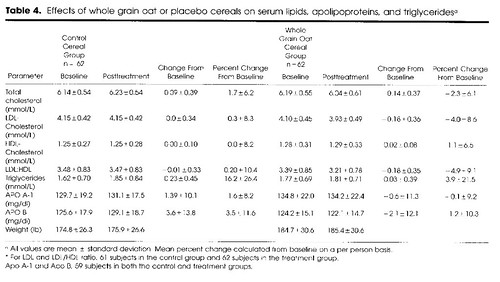
They've started trumpeting a 1998 study entitled "Cholesterol-lowering benefits of a whole grain oat ready-to-eat cereal". This study bases its conclusions entirely on this table, which is all about cornflakes vs. oaty cereal:
Now, with the help of this handy tool, I've calculated all the P-values:
Cornflakes before vs. after, 0.35; Oats b/a: 0.15; Cornflakes before/ oats before: 0.61; Cornflakes after/ oats after: 0.07. So there are no significant differences in this study, even for before and after oat consumption. Cheery oat cereals may reduce your cholesterol 4%- and that's only LDL, not total, but this study shows no statistical significance.
There are plenty of other studies showing that 5+ grams of oat fiber, or other soluble fibers, a day can help lower cholesterol. Which is all very well and good. My point is merely, this study does NOT demonstrate this effect. Nonsignificant differences might as well not exist. Don't believe everything you read!
So... all the same, eating more fruits and veggies and whole grains is good for your health. Who knew? (And if someone could convince my FIL, who has gout- gout! GOUT! - to stop eating meat at every meal, that'd be great too. I'm afraid he's going to meet his reward before he has grandkids.)
They've started trumpeting a 1998 study entitled "Cholesterol-lowering benefits of a whole grain oat ready-to-eat cereal". This study bases its conclusions entirely on this table, which is all about cornflakes vs. oaty cereal:
Now, with the help of this handy tool, I've calculated all the P-values:
Cornflakes before vs. after, 0.35; Oats b/a: 0.15; Cornflakes before/ oats before: 0.61; Cornflakes after/ oats after: 0.07. So there are no significant differences in this study, even for before and after oat consumption. Cheery oat cereals may reduce your cholesterol 4%- and that's only LDL, not total, but this study shows no statistical significance.
There are plenty of other studies showing that 5+ grams of oat fiber, or other soluble fibers, a day can help lower cholesterol. Which is all very well and good. My point is merely, this study does NOT demonstrate this effect. Nonsignificant differences might as well not exist. Don't believe everything you read!
So... all the same, eating more fruits and veggies and whole grains is good for your health. Who knew? (And if someone could convince my FIL, who has gout- gout! GOUT! - to stop eating meat at every meal, that'd be great too. I'm afraid he's going to meet his reward before he has grandkids.)

Monday, July 16, 2007
When English Majors Write About Genetics
Our favorite newspaper is at it again.
At no point does the DNA unzip one strand from another in order to put one strand in each new cell. And for people who would like to say 'But it's a little error! Why do you care?'... because it's the writer's job to get it right. It's like saying President Bush regularly wears an Alf tie to signings. Easily checkable, and wrong. But anyhow. On to the interesting stuff.
What actually causes Williams Syndrome is defective recombination.
Chromosomes are paired off during meiosis: of the 23 kinds of chromosomes, let's say each has an A and a B: 1a and 1b, 2a and 2b, etc. Since an egg has 23 chromosomes and a sperm also has 23 (in normal gametes), let's say A is inherited maternally, while B is inherited paternally.
During meiosis, the A and B chromosomes are stuck to each other (here's a very cool picture). This is part of a mechanism to make sure each new cell gets the right set of DNA- a correct 'genetic complement' . While they're stuck together, both strands of the chromosomes break through both strands in certain places. This enables, say, the top 'inch' of A to switch with the top 'inch' of B. There are certain places along the chromosomes where they don't usually break; think of them as armor-plated bits. One theory is that this prevents important genes from getting bits missing in the middle: if it can't break in the middle of a gene, it can't stick back together wrong.
 Recombination is an important mechanism for genetic variation. Say that genes are colors and A1 has a pattern that goes red, blue, blue, orange, red, while A2 has a pattern of yellow, blue, blue, green, yellow. If they both break between the blues and then re-combine differently, you would get one (call it A1a) that was red, blue, blue, green, yellow and another (A1b) that was yellow, blue, blue, orange, red. Both of these are called non-parental genotypes: neither A1 nor A2 had this pattern originally.
 Now here's what the author was trying to say. Imagine that A1 breaks after both blues, but A2 breaks between the blues, and then they recombine. You get A1a of red, blue, blue, blue, green, yellow and A1b of yellow, blue, orange, red. A1b is missing a chunk because of improper recombination. That's how people get Williams- a chunk with 25 genes is lost from somewhere in the middle of the chromosome, and the truncated chromosome is inherited by the child.
 As a side note, if I were going to say that DNA got unzipped, I'd think the teeth would be individual bases. Not genes. Yes?
*Except for that weird thing where the egg goes through Meiosis I but only partly through MII, and then sheds its spare 23 chromosomes once fertilized. So the sequence is a bit off. But the principle holds.
Williams syndrome rises from a genetic accident during meiosis, when DNA’s double helix is divided into two separate strands, each strand then becoming the genetic material in egg or sperm. Normally the two strands part cleanly, like a zipper’s two halves. But in Williams, about 25 teeth in one of the zippers — 25 genes out of 30,000 in egg or sperm — are torn loose during this parting. When that strand joins another from the other parent to eventually form an embryo, the segment of the DNA missing those 25 genes can’t do its work.A brief consultation of even, say, Wikipedia would tell this otherwise well-meaning author- who, by the way, apparently writes about science for a living:
During meiosis, the genome of a diploid germ cell, which is composed of long segments of DNA packaged into chromosomes, undergoes DNA replication followed by two rounds of division, resulting in haploid cells called gametes. Each gamete contains one complete set of chromosomes, or half of the genetic content of the original cell.For those of you reading at home- since meiosis is probably not on the top of your reading list- I remind you that like most stable DNA structures, chromosomes are double-stranded. You start with a cell containing 46 chromosomes- two copies of each 23 chromosomes. They duplicate; the cell has 92. The cell divides, then divides again. You end up with four cells, each of which has 23 chromosomes.*
At no point does the DNA unzip one strand from another in order to put one strand in each new cell. And for people who would like to say 'But it's a little error! Why do you care?'... because it's the writer's job to get it right. It's like saying President Bush regularly wears an Alf tie to signings. Easily checkable, and wrong. But anyhow. On to the interesting stuff.
What actually causes Williams Syndrome is defective recombination.
Meiotic recombination between polymorphic markers proximal and distal to the [7q11.23 1.4 Mb] deletion has been documented, suggesting that unequal crossing over between homologous regions is the mutational mechanism in most cases.16 17 However, the absence of recombination in other families suggests that intrachromosomal rearrangements may also occur. The presence of a genomic duplication at the deletion breakpoints may act as a hotspot for the recombination events causing Williams syndrome.All human cells are supposed to contain 46 chromosomes total. Many common conditions, including Down's Syndrome and various trisomies, are caused by having 47.
Chromosomes are paired off during meiosis: of the 23 kinds of chromosomes, let's say each has an A and a B: 1a and 1b, 2a and 2b, etc. Since an egg has 23 chromosomes and a sperm also has 23 (in normal gametes), let's say A is inherited maternally, while B is inherited paternally.
During meiosis, the A and B chromosomes are stuck to each other (here's a very cool picture). This is part of a mechanism to make sure each new cell gets the right set of DNA- a correct 'genetic complement' . While they're stuck together, both strands of the chromosomes break through both strands in certain places. This enables, say, the top 'inch' of A to switch with the top 'inch' of B. There are certain places along the chromosomes where they don't usually break; think of them as armor-plated bits. One theory is that this prevents important genes from getting bits missing in the middle: if it can't break in the middle of a gene, it can't stick back together wrong.
 Recombination is an important mechanism for genetic variation. Say that genes are colors and A1 has a pattern that goes red, blue, blue, orange, red, while A2 has a pattern of yellow, blue, blue, green, yellow. If they both break between the blues and then re-combine differently, you would get one (call it A1a) that was red, blue, blue, green, yellow and another (A1b) that was yellow, blue, blue, orange, red. Both of these are called non-parental genotypes: neither A1 nor A2 had this pattern originally.
 Now here's what the author was trying to say. Imagine that A1 breaks after both blues, but A2 breaks between the blues, and then they recombine. You get A1a of red, blue, blue, blue, green, yellow and A1b of yellow, blue, orange, red. A1b is missing a chunk because of improper recombination. That's how people get Williams- a chunk with 25 genes is lost from somewhere in the middle of the chromosome, and the truncated chromosome is inherited by the child.
 As a side note, if I were going to say that DNA got unzipped, I'd think the teeth would be individual bases. Not genes. Yes?
*Except for that weird thing where the egg goes through Meiosis I but only partly through MII, and then sheds its spare 23 chromosomes once fertilized. So the sequence is a bit off. But the principle holds.
Wednesday, April 25, 2007
Canards: Genetic Drift and Red Hair
Does every mutation have to be beneficial to succeed?
Imagine a change that increases incidence of red hair. Sound familiar?
In Africa, high melanin production (which makes skin and hair darker) is strongly selected because it's so sunny: low melanin= sunburn and dehydration --> death. In Ireland, on the other hand, it's much less sunny. In other words, there's almost no selection for high melanin because it's fairly irrelevant to reproductive success there. So the gene changes over time to low melanin production, which also causes red (and blond) hair.
When the frequency of a trait changes by chance, often because it is under weak or no selective pressure, this is called genetic drift. It's not necessarily beneficial. Sometimes it's neutral. Sometimes it's helpful. Sometimes it's not: Ashkenazi Jews have drifted-and-inbred enough to be strong carriers of Tay-Sachs.
Why are somany people in Ireland red-headed? Because it's an island. The population is limited, which increases the incidence of drift. Especially if there's a smaller generation once or twice, the effect is increased, because the drift goes through a bottleneck of sorts.
Imagine, for example, that an Irish generation had only four people, and three were carriers for red hair. The incidence of red hair would shoot up in the next generations. Now imagine it happened again: even more red hair. As drift increases in this or other ways, alleles (gene variants) head for fixation, or 100% occurrence in the population.
"The Age of Darwin" (still not worth reading) also tells us:
'Our genes were formed during the vast stretches when people were hunters and gatherers.' Riiiight. No, our genes were formed while we were the one-celled last common ancestor, and then a bunch of stuff and then squidgy fish things and then small furry mammals with lots of teeth and then larger mammals, and then monkeys. Oh yes, and then eventually hunters and gatherers. Earliest hominid: 8 to 4 million years ago. We only diverged from REPTILES 360 million years ago.
Eukaryotes and prokaryotes diverged from the last common ancestor around 1.5 billion years ago. Our genes were being 'formed' the whole time. They're still being formed.
As for being poorly adapted to nuclear weapons and fast food: Cheeseburger-eating Americans live a lot longer than the average Paleolithic hominid. And what's the world population again?
***
References:
1. Encyclopedia of Evolution. Mark Page, Ed. Oxford UP 2002
Genetic Drift: "Each genetic locus can exist in several versions that differ somewhat... Without selection, mutation, or migration, the relative frequencies of these alleles in a population are expected to remain the same from one generation to the next. However, because all populations are finite, allele frequencies can change by random chance, even when the frequency of alleles is expected to be the same on average. ... A good experimental example was provided by Buri (1956), who followed the frequency of eye color alleles in Drosophila populations of different sizes... In the extreme case, where only one allele copy by chance gives rise to all alleles in the next generation, the population will immediately become fixed (100%) for that allele and genetic drift will be at its maximum."
2. Classic Buri paper: "Gene Frequency in Small Populations of Mutant Drosophila",
Peter Buri. Evolution, Vol. 10, No. 4, 367-402. Dec., 1956. (Subscription through JSTOR, but if you want the article, email me.)
3. More on Drift: "Genetic drift additionally contributes to the evolutionary variance around expectations, under neutrality. Weak selection is difficult to distinguish against a background of genetic drift."
Imagine a change that increases incidence of red hair. Sound familiar?
In Africa, high melanin production (which makes skin and hair darker) is strongly selected because it's so sunny: low melanin= sunburn and dehydration --> death. In Ireland, on the other hand, it's much less sunny. In other words, there's almost no selection for high melanin because it's fairly irrelevant to reproductive success there. So the gene changes over time to low melanin production, which also causes red (and blond) hair.
When the frequency of a trait changes by chance, often because it is under weak or no selective pressure, this is called genetic drift. It's not necessarily beneficial. Sometimes it's neutral. Sometimes it's helpful. Sometimes it's not: Ashkenazi Jews have drifted-and-inbred enough to be strong carriers of Tay-Sachs.
Why are somany people in Ireland red-headed? Because it's an island. The population is limited, which increases the incidence of drift. Especially if there's a smaller generation once or twice, the effect is increased, because the drift goes through a bottleneck of sorts.
Imagine, for example, that an Irish generation had only four people, and three were carriers for red hair. The incidence of red hair would shoot up in the next generations. Now imagine it happened again: even more red hair. As drift increases in this or other ways, alleles (gene variants) head for fixation, or 100% occurrence in the population.
"The Age of Darwin" (still not worth reading) also tells us:
Human beings, in our current understanding, are jerry-built creatures, in which new, sophisticated faculties are piled on top of primitive earlier ones. Our genes were formed during the vast stretches when people were hunters and gatherers, and we are now only semi-adapted to the age of nuclear weapons and fast food.This kind of determinism postulates that we are headed for an 'evolved end', a higher function. Note that this same theory impelled colonization and forcible conversion: White people are more evolved. (See: number of times the word 'primitive' is used in the Jesuit Relations.) Again: mutation is random.
'Our genes were formed during the vast stretches when people were hunters and gatherers.' Riiiight. No, our genes were formed while we were the one-celled last common ancestor, and then a bunch of stuff and then squidgy fish things and then small furry mammals with lots of teeth and then larger mammals, and then monkeys. Oh yes, and then eventually hunters and gatherers. Earliest hominid: 8 to 4 million years ago. We only diverged from REPTILES 360 million years ago.
Eukaryotes and prokaryotes diverged from the last common ancestor around 1.5 billion years ago. Our genes were being 'formed' the whole time. They're still being formed.
As for being poorly adapted to nuclear weapons and fast food: Cheeseburger-eating Americans live a lot longer than the average Paleolithic hominid. And what's the world population again?
***
References:
1. Encyclopedia of Evolution. Mark Page, Ed. Oxford UP 2002
Genetic Drift: "Each genetic locus can exist in several versions that differ somewhat... Without selection, mutation, or migration, the relative frequencies of these alleles in a population are expected to remain the same from one generation to the next. However, because all populations are finite, allele frequencies can change by random chance, even when the frequency of alleles is expected to be the same on average. ... A good experimental example was provided by Buri (1956), who followed the frequency of eye color alleles in Drosophila populations of different sizes... In the extreme case, where only one allele copy by chance gives rise to all alleles in the next generation, the population will immediately become fixed (100%) for that allele and genetic drift will be at its maximum."
2. Classic Buri paper: "Gene Frequency in Small Populations of Mutant Drosophila",
Peter Buri. Evolution, Vol. 10, No. 4, 367-402. Dec., 1956. (Subscription through JSTOR, but if you want the article, email me.)
3. More on Drift: "Genetic drift additionally contributes to the evolutionary variance around expectations, under neutrality. Weak selection is difficult to distinguish against a background of genetic drift."
Wednesday, April 18, 2007
Canards: Evolution and Selection
"The Age of Darwin" (paid subscription, but not worth reading, trust me) tells us:
While criticizing the NYT's science is like shooting fish in a barrel, this is nonetheless a distressingly common misconception. So let's talk some biology here. [Lengthy refs at the end.]
Evolution is the process of change. Many evolved traits provide no benefits. Evolution is not 'raising us higher' or going towards an ever-more-complex end. It can go from simplicity to complexity, but it goes the other way. It causes a set of both adaptive and nonadaptive responses to the environment.
So you have an organism, and it has DNA. The DNA codes for all kinds of RNAs and proteins, and there are all kinds of complex regulation going on, including a 'fact-checker' system that goes around seeing if the DNA doesn't match, or if it's gone funny-shaped, or if there are holes.
These problems happen all the time: radiation damage, oxidation; various proteins make mistakes. Normally, if a cell's DNA is screwed up, it won't divide- but if the checkers are messed up, the errors go through. (This is a vastly simplified explanation.) Main message: mutation is random.
Some mutations are harmful, like if you stop cells from making protein, they're dead. We call this selective pressure: there is a need for the function, and doing it better increases chances of thriving. More or less. Say a mutation causes a bird to not fly: it probably won't reproduce. If it flies slower, it won't reproduce as well, because it can't catch mates, or whatever. Its reproductive fitness is hurt.
But imagine a mutation that makes a bird fly a tiny bit slower. Will this make a huge difference? If there is little competition, or if resources (food, twigs, mates) are abundant, it won't. There doesn't have to be a selective pressure on every function.
'Emotion.' Does it do us any good? Well, I'm sure 'fear of a large animal eating me' was a useful trait. One can imagine more examples. But it doesn't have to provide advantages- if the selection is weak. If there's a smallish disadvantage to having a trait, you don't need a huge advantage to balance it out: you don't necessarily need any.
****
References:
1. Encyclopedia of Evolution. Mark Page, Ed. Oxford UP 2002
SJ Gould:"Suppose... that a trend to smaller average body size among the species of a clade occurs not because smaller bodies confer adaptive advantages on organisms, but because species composed of small organisms tend to manifest properties... that enhance their rate of producing new species. In that case, decrease in average body size would spread as a trend through the clade by 'hitchhiking' on the correlated species-level trait of high speciation rates, and not because small bodies confer Darwinian advantages on organisms. In fact, smaller body size might well be neutral or even slightly detrimental to organisms in competition with [bigger animals, but if there's not a lot of competition, smaller size wins out]".
SC Stearns: "Why is our neurobiology organized in such a way that we can become addicted to certain chemicals? One idea is that the chemical structures of addictive drugs are an unfortunate coincidence. They hijack pathways that evolved to increase fitness... Thus, susceptibility to addictive drugs is a nonadaptive byproduct of structures and processes evolved for other reasons. There are also evolutionary hypotheses for the existence of emotional moods. Depression might be adaptive if it could cause avoidance of risky or dangerous situations... This is a plausible explanation for a moderate level of depression but not of serious depression leading to suicide. If a selection process had repeatedly encountered the problem of deep depression in people young enough to have some remaining reproductive potential, one would expect countermeasures to have evolved..." [Ed.: But they didn't, did they? So no strong-enough-to-take-it-all-the-way-out selective pressure was ever applied.]
The logic of evolution explains why people vie for status, form groups, fall in love and cherish their young. It holds that most everything that exists does so for a purpose. If some trait, like emotion, can cause big problems, then it must also provide bigger benefits, because nature will not expend energy on things that don’t enhance the chance of survival.Quack.
While criticizing the NYT's science is like shooting fish in a barrel, this is nonetheless a distressingly common misconception. So let's talk some biology here. [Lengthy refs at the end.]
Evolution is the process of change. Many evolved traits provide no benefits. Evolution is not 'raising us higher' or going towards an ever-more-complex end. It can go from simplicity to complexity, but it goes the other way. It causes a set of both adaptive and nonadaptive responses to the environment.
So you have an organism, and it has DNA. The DNA codes for all kinds of RNAs and proteins, and there are all kinds of complex regulation going on, including a 'fact-checker' system that goes around seeing if the DNA doesn't match, or if it's gone funny-shaped, or if there are holes.
These problems happen all the time: radiation damage, oxidation; various proteins make mistakes. Normally, if a cell's DNA is screwed up, it won't divide- but if the checkers are messed up, the errors go through. (This is a vastly simplified explanation.) Main message: mutation is random.
Some mutations are harmful, like if you stop cells from making protein, they're dead. We call this selective pressure: there is a need for the function, and doing it better increases chances of thriving. More or less. Say a mutation causes a bird to not fly: it probably won't reproduce. If it flies slower, it won't reproduce as well, because it can't catch mates, or whatever. Its reproductive fitness is hurt.
But imagine a mutation that makes a bird fly a tiny bit slower. Will this make a huge difference? If there is little competition, or if resources (food, twigs, mates) are abundant, it won't. There doesn't have to be a selective pressure on every function.
'Emotion.' Does it do us any good? Well, I'm sure 'fear of a large animal eating me' was a useful trait. One can imagine more examples. But it doesn't have to provide advantages- if the selection is weak. If there's a smallish disadvantage to having a trait, you don't need a huge advantage to balance it out: you don't necessarily need any.
****
References:
1. Encyclopedia of Evolution. Mark Page, Ed. Oxford UP 2002
SJ Gould:"Suppose... that a trend to smaller average body size among the species of a clade occurs not because smaller bodies confer adaptive advantages on organisms, but because species composed of small organisms tend to manifest properties... that enhance their rate of producing new species. In that case, decrease in average body size would spread as a trend through the clade by 'hitchhiking' on the correlated species-level trait of high speciation rates, and not because small bodies confer Darwinian advantages on organisms. In fact, smaller body size might well be neutral or even slightly detrimental to organisms in competition with [bigger animals, but if there's not a lot of competition, smaller size wins out]".
SC Stearns: "Why is our neurobiology organized in such a way that we can become addicted to certain chemicals? One idea is that the chemical structures of addictive drugs are an unfortunate coincidence. They hijack pathways that evolved to increase fitness... Thus, susceptibility to addictive drugs is a nonadaptive byproduct of structures and processes evolved for other reasons. There are also evolutionary hypotheses for the existence of emotional moods. Depression might be adaptive if it could cause avoidance of risky or dangerous situations... This is a plausible explanation for a moderate level of depression but not of serious depression leading to suicide. If a selection process had repeatedly encountered the problem of deep depression in people young enough to have some remaining reproductive potential, one would expect countermeasures to have evolved..." [Ed.: But they didn't, did they? So no strong-enough-to-take-it-all-the-way-out selective pressure was ever applied.]
Tuesday, January 09, 2007
Department of Random Outrage, 2
Also behold:

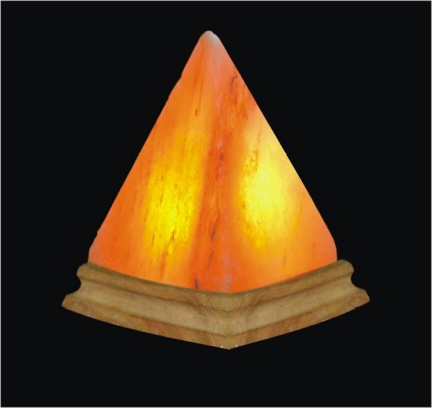
A salt lamp that “possess[es] the unique capability of generating negative ions in the air thus working as [an] ionizer. These negative ions are very essential for human beings because they purify the air, and kill bacteria and other harmful organisms and increase overall air quality.”
Magic Salt Lamp. As in, made of table salt, Na(+)Cl(-). Where are these negative ions supposed to come from? If from the salt, NaCl must be heated to 2575°F before it boils. Decomposition temperature- the heat necessary to make it break down into separate ions of Na(+) and Cl(-) - is much higher. And you’d get both anions and cations; both are very reactive. Chlorine anions may form ozone or chlorine gas; Cl2 gas is very poisonous. Sodium metal, whether ionized or not, is extremely reactive; the metallic form is prone to exploding, as we all remember from high school chemistry demos.
It is possible to ionize air using high voltage; this is what many commercial air ionizers do. But according to JPL , they must be calibrated regularly to ensure they continue to be negative ion sources. Polonium is also used; radioactive ionizers must be replaced yearly because of polonium's short half-life. (The manufacturer assures us that the capsules are very well sealed, to prevent anyone removing the polonium.)
A naked wire may indeed ionize air; this is part of why lightbulbs are evacuated- otherwise the wire would oxidize and burn out. UV light also ionizes air; many air purifiers are based on this, plus charged plates to remove the now-ionized dust and such. In any case, a sealed lightbulb won’t do it.
[By the way, I have no financial or other interest in any of the products or sites mentioned, nor indeed in any product or site. Links are provided solely for reference and entertainment.]
A salt lamp that “possess[es] the unique capability of generating negative ions in the air thus working as [an] ionizer. These negative ions are very essential for human beings because they purify the air, and kill bacteria and other harmful organisms and increase overall air quality.”
Magic Salt Lamp. As in, made of table salt, Na(+)Cl(-). Where are these negative ions supposed to come from? If from the salt, NaCl must be heated to 2575°F before it boils. Decomposition temperature- the heat necessary to make it break down into separate ions of Na(+) and Cl(-) - is much higher. And you’d get both anions and cations; both are very reactive. Chlorine anions may form ozone or chlorine gas; Cl2 gas is very poisonous. Sodium metal, whether ionized or not, is extremely reactive; the metallic form is prone to exploding, as we all remember from high school chemistry demos.
It is possible to ionize air using high voltage; this is what many commercial air ionizers do. But according to JPL , they must be calibrated regularly to ensure they continue to be negative ion sources. Polonium is also used; radioactive ionizers must be replaced yearly because of polonium's short half-life. (The manufacturer assures us that the capsules are very well sealed, to prevent anyone removing the polonium.)
A naked wire may indeed ionize air; this is part of why lightbulbs are evacuated- otherwise the wire would oxidize and burn out. UV light also ionizes air; many air purifiers are based on this, plus charged plates to remove the now-ionized dust and such. In any case, a sealed lightbulb won’t do it.
[By the way, I have no financial or other interest in any of the products or sites mentioned, nor indeed in any product or site. Links are provided solely for reference and entertainment.]
Wednesday, January 03, 2007
Department of Random Outrage
 Behold:
A dog blanket that, and I quote, has “Anion, Aloe, Anti-bacteria and Magnet complex functions” and “emit[s] Far Infrared Rays”.
I understand that people want cures, and are willing to suspend disbelief. But must they also suspend logic? Does anyone actually buy this stuff?
Magic Dog Blanket. I’ll believe it has aloe in it, and antibacterial fabric exists. But I bet you a dollar that any sterile dog is going right into surgery. Dogs, they roll in dead things. Additionally, no animal is ever truly sterile- there are always bacteria on the skin, in the gut, and in the mouth; alterations in natural flora can have bad consequences.
The blanket may even have magnets sewn into it. (You know, to align all the little iron particles in your cells.) But magnets don't do anything for circulation or pain. The greatest effect of magnetized fabric will be to erase the credit cards if Muffy gets close enough to your wallet- though only if it's a fairly strong magnet.
Far-IR rays are another thing altogether. Shorter IR wavelengths are what make you warm in the sun, and longer wavelengths (i.e., past far-IR) are what your microwave makes. But ceramic doesn’t just emit 'IR rays' [any more than anything else does at room temperature]. IR, just like a light bulb or an x-ray or every other part of the electromagnetic spectrum, is made of energy. Electricity goes into a microwave, is converted to IR, and is then converted to motion in the water molecules, which we call 'heat.' Energy input is required to sustain continuous [over-background] IR output.
This is also why microwaves have to be plugged in.
[Correction courtesy of Andre: I failed to specify that all materials emit some in the IR, as well as in other frequencies, at room temperature. See also: blackbody radiation in IR occurs between 30 and 4100 K.]
Monday, December 04, 2006
Angels in the Rain (Or: observation fails under the relentless assault of illogic)
L 26:4 I will provide you with rain at the right time, so that the land will bear its crops and the trees of the field will provide fruit.
Conversation: Mr. Scientist and their Turkish technician
-Did you ever wonder how it rains?
-Oh, in Turkey they tell children that there’s a little angel in each raindrop.
-But didn’t you wonder how it really works?
-No, there is an angel in each raindrop.
-…What?
-Because each raindrop has a little gravitational pull and so if you have a cloud of raindrops they would all make one big rain blob because of gravity. So God sends angels to keep them raindrops…. What, don’t you believe that here?
-You do know that gravity falls off as the square of the distance.
-Of course.
-So gravity between raindrops is negligible and the gravity of the earth is much more important.
-No, they’d make a blob!
-If I took this ice bucket and threw it in the air would all the ice come down as a big blob?
-No, but--
-If I threw a glass of water at you would it hit you as a big blob?
-No, but raindrops are different. Because of the angels.
-[Aaaaaaauuggggh.]
Even more distressing: the woman in question is a scientist.
Subscribe to:
Posts (Atom)