I recently learned that Ben Barres died at the end of the year.
When his article about gender came out in 2006, I was in grad school at Yale. (Also known as Snooty U, in past years). I wrote to Dr. Barres - and I don't remember, all these years later, exactly what I said - but I wrote that I was frustrated, and I could see discrimination around me, and I could feel the discrimination, and I didn't see how I would ever become a research scientist.
He wrote back to me, a great kindness to a stranger amidst what must have surely been hundreds and hundreds of similar messages. The West Coast is nicer, he wrote; maybe you could be happier here. The Yales of the world are the worst places for a young woman like you to be, he wrote. I hope you find perseverance and strength and success.
I didn't end up as research scientist, and I doubt I ever will, but I will always remember his kindness. Rest in power, and the knowledge that you did righteous work of so many kinds, Dr. Barres.
Showing posts with label Science. Show all posts
Showing posts with label Science. Show all posts
Monday, January 08, 2018

Monday, September 23, 2013
Draconian
Dr. S just graded his first batch of student papers. Per his department's and the university's policy, he requires all his students to sign that their work is honor-code-pledged: "I pledge on my word of honor that I have neither given nor received assistance on this assignment." They can and do expel students for violating the honor code - people leave their laptops laying around, for example, because it is an expelling offense to steal as well - and anyone who is caught plagiarizing gets the summary boot. Exams are not proctored, and if a student is travelling, they take the exam and an envelope, do it on their own, and seal the envelope.
As part of the faculty orientation, the student body president got up and explained that yes, the honor code is draconian, but the students overall like it, because they believe they're all getting a grade they earned, because nobody is cheating. (It is also an expellable offense to know someone else is cheating, and not report it.)
I have a theory that this works best at schools like this, where the reputation of the degree matters more to the students than the fact of the degree. And the town is so small and rural that outside influences (and/or theft) pretty much don't happen either.
It's also traditional to announce after the first exam, "Well, I see from these scores that the honor code is alive and well at Mountain University!"
As part of the faculty orientation, the student body president got up and explained that yes, the honor code is draconian, but the students overall like it, because they believe they're all getting a grade they earned, because nobody is cheating. (It is also an expellable offense to know someone else is cheating, and not report it.)
I have a theory that this works best at schools like this, where the reputation of the degree matters more to the students than the fact of the degree. And the town is so small and rural that outside influences (and/or theft) pretty much don't happen either.
It's also traditional to announce after the first exam, "Well, I see from these scores that the honor code is alive and well at Mountain University!"
Tuesday, June 11, 2013
"Grad School Is a Sunk Cost"
Some pratty little business-school first-year once told me that my experience in grad school was a sunk cost and therefore I should quit since I hated it. He then compared it to an opera ticket to a bad performance of Aida.
Although I'm the first to admit that economic theory goes whoosh over my head, the way I understand a sunk cost is like this: You paid/invested quantity X for Thing Y. You have received or will receive benefit amount Z. If you can receive more benefit from doing Thing A, then you should ignore the X you paid and not do Thing Y any more.
This dude- who is, I fervently hope, not doing anything with people any more - tried to say that I had put X amount of suffering into grad school and thus far received nothing, therefore I should quit. However, scientists can generally estimate whether or not they will ever graduate, and in how many years (+/- 2, but still). So further investment in grad school does in fact get you something - a PhD - which is worth more in future earnings, respect, and career possibilities than not having it. (At least, we hope.)
So I think grad school isn't like a sunk cost fallacy. It's like a 5-year T-bill. Cash it in early and get nothing, wait it out painfully and maybe get your investment back with some interest. Hope the government doesn't go bankrupt in the meantime.
(This happened to someone I knew in grad school: the lab's funding ran out before she graduated. You can imagine the disaster that ensued.)
(This happened to someone I knew in grad school: the lab's funding ran out before she graduated. You can imagine the disaster that ensued.)
Friday, May 17, 2013
Book Review: ALL NATURAL by Nathanael Johnson
I reserved our public library's copy of this book because the author is a friend of a friend, who told me I might like it. Here's the verdict: I do! I like it immensely! I am thinking of buying a copy for my mother, since she would also enjoy it!
(Nobody paid me anything to write this. I sent the author a message once, but we are largely unacquainted.)
The book starts out with a very amusing recounting of the author's childhood, being raised bywolves radical back-to-nature types. (They make my mother's Vegetarian Nut Loaf look positively mainstream.) He meets his future wife, the daughter of a surgeon, and they marry and are soon expecting a child, at which point we segue into a chapter on birth in America.
I could have written this chapter. My favorite line: "I was looking for something more like No Nonsense Evidence-Based Midwifery." Ah, Bug's midwives, of "a zero-transfer C-section rate is unrealistic and dangerous" fame! He goes into the statistics of C-sections, maternal morbidity and mortality, and ensuing complications carefully, in detail, and in a very understandable manner - and also talks about the bad outcomes that can happen in the absence of medical care, and the fine line between lifesaving interventions and overcautious practices that harm patients (like routine continuous fetal monitoring).
The next chapters are about raw milk, nutrition, vegetables, sugar (really, doesn't affect immunity; nicely dissected and taken down, with a fine understanding of the phrase "There is no evidence."), pork farming, immunity, vaccines, the environment. These subjects are all handled delicately and in a very neutral manner with no proselytizing.
The last chapter is about medicine, and how to balance lifesaving treatments with unnecessary testing and intervention. The author shares an anecdote from his mother, who intelligently researches a possible hepatitis infection, and insists on a second test because the first one has a high false-positive rate. He also relates his own bout of appendicitis. He talks about primary care, emergency medicine, and end-of-life care, our problems with dealing with the root causes of... well, everything - and one of medicine's great failures, that of treating the symptoms. The last chapter is a nice bookend to the first- C-sections and suicides, birth and death.
There are 19 pages of closely-spaced endnotes. A lot of research went into this book. I would like to add I've found no inaccuracies in this book, which is high praise from this pedantic, proofreading-maniac of a scientist. In some cases, I would perhaps have liked to see a stronger opinion come through (if you want to read about vaccines go look up Andrew Wakefield's financial interest in scaring people, and the reasons for his medical license being revoked in Great Britain). Some subjects could perhaps use a bit more depth; for example, the author talks about the 'immunity hypothesis', that more dirt and germs prevent autoimmune disease, and cites the rise of things like asthma in developed countries- but he doesn't mention the role of pollution, or of cheap and accurate sequencing in diagnosis. On the other hand, there's only so many pages in a book, and the author clearly doesn't want to be prescriptive or evangelical. He is leading you through his journey of exploration.
If you have a friend who thinks that ridiculous, stupid, inaccurate, dangerous Sears book is the gospel, this will not convince him or her. If you know someone who has an actual inquring mind - especially people who are not trained as scientists- this is perfect. As for you, dear readers, you should all go read it immediately.
* Did you know this strain has a stable plasmid with a horizontally-transferred Shigella toxin, which binds to ribosomes, and that's why it's so toxic? I wrote a paper about it in college.
(Nobody paid me anything to write this. I sent the author a message once, but we are largely unacquainted.)
The book starts out with a very amusing recounting of the author's childhood, being raised by
I could have written this chapter. My favorite line: "I was looking for something more like No Nonsense Evidence-Based Midwifery." Ah, Bug's midwives, of "a zero-transfer C-section rate is unrealistic and dangerous" fame! He goes into the statistics of C-sections, maternal morbidity and mortality, and ensuing complications carefully, in detail, and in a very understandable manner - and also talks about the bad outcomes that can happen in the absence of medical care, and the fine line between lifesaving interventions and overcautious practices that harm patients (like routine continuous fetal monitoring).
The next chapters are about raw milk, nutrition, vegetables, sugar (really, doesn't affect immunity; nicely dissected and taken down, with a fine understanding of the phrase "There is no evidence."), pork farming, immunity, vaccines, the environment. These subjects are all handled delicately and in a very neutral manner with no proselytizing.
The last chapter is about medicine, and how to balance lifesaving treatments with unnecessary testing and intervention. The author shares an anecdote from his mother, who intelligently researches a possible hepatitis infection, and insists on a second test because the first one has a high false-positive rate. He also relates his own bout of appendicitis. He talks about primary care, emergency medicine, and end-of-life care, our problems with dealing with the root causes of... well, everything - and one of medicine's great failures, that of treating the symptoms. The last chapter is a nice bookend to the first- C-sections and suicides, birth and death.
There are 19 pages of closely-spaced endnotes. A lot of research went into this book. I would like to add I've found no inaccuracies in this book, which is high praise from this pedantic, proofreading-maniac of a scientist. In some cases, I would perhaps have liked to see a stronger opinion come through (if you want to read about vaccines go look up Andrew Wakefield's financial interest in scaring people, and the reasons for his medical license being revoked in Great Britain). Some subjects could perhaps use a bit more depth; for example, the author talks about the 'immunity hypothesis', that more dirt and germs prevent autoimmune disease, and cites the rise of things like asthma in developed countries- but he doesn't mention the role of pollution, or of cheap and accurate sequencing in diagnosis. On the other hand, there's only so many pages in a book, and the author clearly doesn't want to be prescriptive or evangelical. He is leading you through his journey of exploration.
If you have a friend who thinks that ridiculous, stupid, inaccurate, dangerous Sears book is the gospel, this will not convince him or her. If you know someone who has an actual inquring mind - especially people who are not trained as scientists- this is perfect. As for you, dear readers, you should all go read it immediately.
* Did you know this strain has a stable plasmid with a horizontally-transferred Shigella toxin, which binds to ribosomes, and that's why it's so toxic? I wrote a paper about it in college.
Tuesday, May 01, 2012
In Which A Giant Ego Is Good For Something
My former advisor and I did not get along for many long years; in fact, until one day when I politely told him off. He was, in fact, delighted that I had come up with a whole new project, made it work, set the old one on fire, and tossed it out the window.
You see, his ego was big enough to take being wrong. Like a good parent, he was pleased that his lab children had outgrown him- that I had proved his theory wrong. *
Dr. S's current advisor... let's just say that the self-esteem isn't nearly as large as my advisor's was.
And as a result, this advisor is more like the hand-holding helicopter parent whose 30-year-old children don't know how to do their own laundry. Scientifically speaking.
I never thought I'd be grateful for overwhelming ego.
*To be fair, it was a good theory. There were 73 reported instances in the literature of Condition X + Thing Y= Result Z. I got Condition X + Thing Y = The Sitting Alone In The Dark Crying Experiment.
You see, his ego was big enough to take being wrong. Like a good parent, he was pleased that his lab children had outgrown him- that I had proved his theory wrong. *
Dr. S's current advisor... let's just say that the self-esteem isn't nearly as large as my advisor's was.
And as a result, this advisor is more like the hand-holding helicopter parent whose 30-year-old children don't know how to do their own laundry. Scientifically speaking.
I never thought I'd be grateful for overwhelming ego.
*To be fair, it was a good theory. There were 73 reported instances in the literature of Condition X + Thing Y= Result Z. I got Condition X + Thing Y = The Sitting Alone In The Dark Crying Experiment.
Sunday, December 04, 2011
Lab Report
I was reading about Miss MSE's lab-teaching joys and it reminded me of when I was TAing
Bear in mind that Snooty U, as an institution, doesn't care about the science TAs and generally ignores them. There is no training, there are no standards, and mileage varies widely. (The grad school has some opportunities for individuals, but it's caveat magister. Or possibly caveat discipulus.)
So I TA'd for a lab course that was, apparently, organized by monkeys. We were given the labs, but no syllabus, no guidelines, and no outline of the accompanying lecture. (Possibly because the lab bore it no resemblance.) This is going to sound really mean, but I took the opportunity to rigorously enforce Good Science Writing. I wrote my students a syllabus with the following criteria:
1) Your first lab report will be marked and returned. I will grade the second version.
2) After the first lab report, you will lose a point for each spelling or grammatical error.
3) You can write as much as you want (in Times 12 point with one-inch margins), but I will stop reading after five pages.
4) Plagiarism will get you a failing grade.
After the first batch of lab reports, which were, with two exceptions, truly appalling, I got nice, concise, five-page, well-organized reports. After the second batch, which lost a lot of points for grammatical errors, they were much better-written. And after a couple weeks of me writing the most appalling errors up on the board(without attribution; however, in genetics, "compliment" and "complement" are very different)... they started proofreading, too.
Low grades are an amazing motivational tool.
Bear in mind that Snooty U, as an institution, doesn't care about the science TAs and generally ignores them. There is no training, there are no standards, and mileage varies widely. (The grad school has some opportunities for individuals, but it's caveat magister. Or possibly caveat discipulus.)
So I TA'd for a lab course that was, apparently, organized by monkeys. We were given the labs, but no syllabus, no guidelines, and no outline of the accompanying lecture. (Possibly because the lab bore it no resemblance.) This is going to sound really mean, but I took the opportunity to rigorously enforce Good Science Writing. I wrote my students a syllabus with the following criteria:
1) Your first lab report will be marked and returned. I will grade the second version.
2) After the first lab report, you will lose a point for each spelling or grammatical error.
3) You can write as much as you want (in Times 12 point with one-inch margins), but I will stop reading after five pages.
4) Plagiarism will get you a failing grade.
After the first batch of lab reports, which were, with two exceptions, truly appalling, I got nice, concise, five-page, well-organized reports. After the second batch, which lost a lot of points for grammatical errors, they were much better-written. And after a couple weeks of me writing the most appalling errors up on the board(without attribution; however, in genetics, "compliment" and "complement" are very different)... they started proofreading, too.
Low grades are an amazing motivational tool.
Monday, August 15, 2011
Could Have Been Worse, Could Be Better
My former advisor had a small number of extremely reasonable questions (How much of this reagent? What species? For how long?) which took about 15 minutes to answer, including the hunt through boxes for an old lab notebook. Fortunately, all my old lab notebooks contain an index in the front and are surprisingly clear and detailed. It's almost like I did it on purpose. Yes, I know most labs have you leave your notebooks; my old lab had everybody take them, because it took me 15 minutes, but it would take someone else an hour or two to figure out. Also, most people don't bother with an index.
The headache persists and I foresee some thrilling times ahead.
The headache persists and I foresee some thrilling times ahead.
Saturday, August 13, 2011
So True
On a related note, my old advisor would like me, my toddler, my thwompy fetus, and my nail-through-cranium headache to edit my !@#$% paper. Which I haven't seen in two years (Bug was a newborn, and I was dictating to Dr. S while nursing).
My father's summary of Dr. S's thesis defense neatly encapsulates my entire memory of my graduate work: "Things Do Things To Other Things."
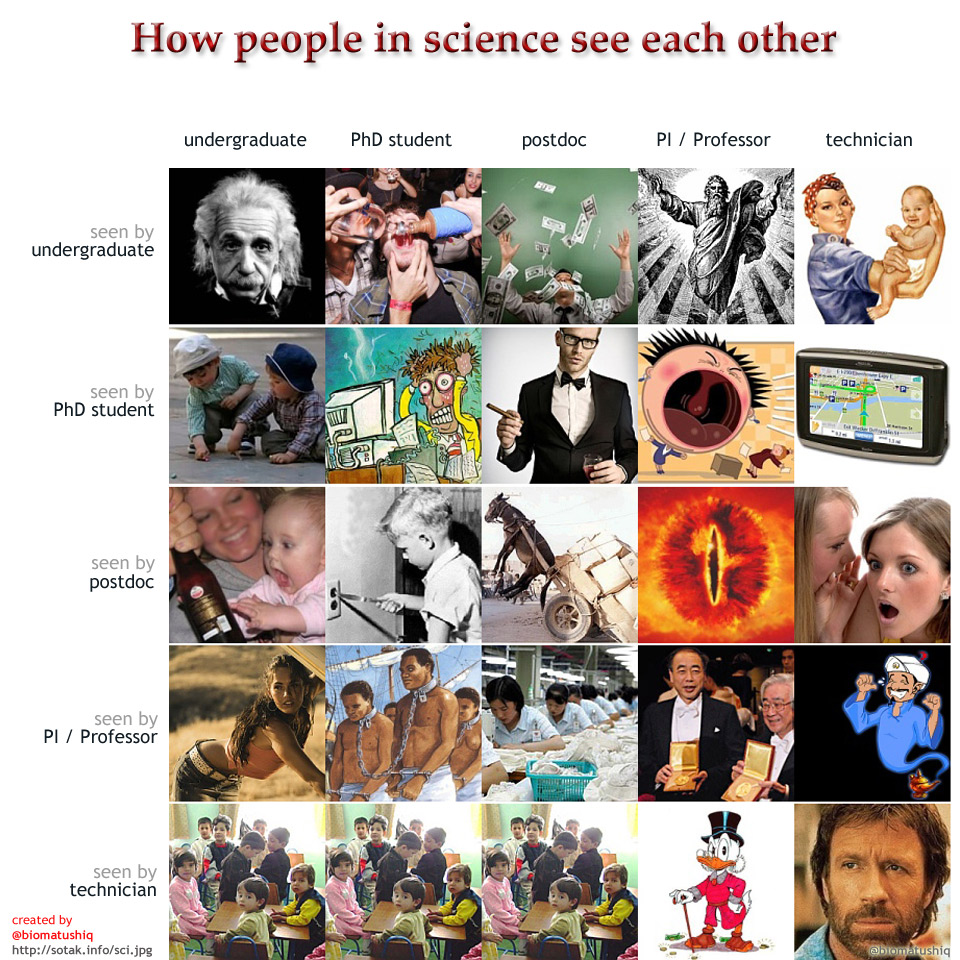
My father's summary of Dr. S's thesis defense neatly encapsulates my entire memory of my graduate work: "Things Do Things To Other Things."
Monday, July 18, 2011
Annoyance By Proxy
Dr. S's boss, as I have mentioned before, is a mildly psychotic tinpot tyrant.
They are trying to get a paper published. They submitted it; the rejection came back today. They agreed to consider their options for a day. Dr. S and I talked about it; he would have to do a lot of reformatting, but he wants to submit it to Appropriate Respected Journal, one of whose editors has already told him, in person, at a conference, that they would be very interested. He went downstairs to email his boss and try to boot her into action (her turnaround time for editing papers is eight months because she is insane; normal people do this in two to four weeks).
She had ALREADY submitted it to Third Tier Completely Inappropriate Journal- without Dr. S's consent. If it is published in TTCIJ, his job-application prospects go down by an order of magnitude. Also, it's a journal full of unicycle-repair diagrams, and this paper is about how to grow orange trees in cold climates: completely inappropriate. He's upset, I'm upset, and I don't see any way this is going to end well. He can and will withdraw the submission, but then it needs to go somewhere else, and will she take another eight months just for spite? Probably.
And people ask me why I don't miss academic science.
They are trying to get a paper published. They submitted it; the rejection came back today. They agreed to consider their options for a day. Dr. S and I talked about it; he would have to do a lot of reformatting, but he wants to submit it to Appropriate Respected Journal, one of whose editors has already told him, in person, at a conference, that they would be very interested. He went downstairs to email his boss and try to boot her into action (her turnaround time for editing papers is eight months because she is insane; normal people do this in two to four weeks).
She had ALREADY submitted it to Third Tier Completely Inappropriate Journal- without Dr. S's consent. If it is published in TTCIJ, his job-application prospects go down by an order of magnitude. Also, it's a journal full of unicycle-repair diagrams, and this paper is about how to grow orange trees in cold climates: completely inappropriate. He's upset, I'm upset, and I don't see any way this is going to end well. He can and will withdraw the submission, but then it needs to go somewhere else, and will she take another eight months just for spite? Probably.
And people ask me why I don't miss academic science.
Saturday, June 18, 2011
Skepticism
The point of the elevator/door story is, of course, that scientists are trained skeptics.
It never fails to amaze me when people just take their doctor's word for something insane. I could give examples all day ("Your kid won't use a fork! He must have something wrong with him!!" Or... he's two). Or when they simply believe something insane (vaccines cause autism! sinus infections are contagious! homeopathy is not the placebo effect!) that is contrary to all evidence.
I know that I spent ten years being trained to evaluate evidence. I know that my already-high level of skepticism is now at the top of the scale, and that respect for authority, including medical, is ingrained in kindergarten, along with standing-in-line.*
But I always think of that line from The Wizard of Oz: "But they have one thing you haven't got: a diploma."
*Such a truly American thing, our patient and orderly line-forming. Or possibly, legacy of British Empire.
It never fails to amaze me when people just take their doctor's word for something insane. I could give examples all day ("Your kid won't use a fork! He must have something wrong with him!!" Or... he's two). Or when they simply believe something insane (vaccines cause autism! sinus infections are contagious! homeopathy is not the placebo effect!) that is contrary to all evidence.
I know that I spent ten years being trained to evaluate evidence. I know that my already-high level of skepticism is now at the top of the scale, and that respect for authority, including medical, is ingrained in kindergarten, along with standing-in-line.*
But I always think of that line from The Wizard of Oz: "But they have one thing you haven't got: a diploma."
*Such a truly American thing, our patient and orderly line-forming. Or possibly, legacy of British Empire.
Subscribe to:
Posts (Atom)