A propos of the next Scientiae carnival- as usual, I'm just too late!- on inner voices:
Here's a surprise for you: I talk to myself. All the time.
In the lonelier years of grad school, I would have entire conversations with absent friends and relatives. I would come up with biting retorts- inevitably, of course, three days later.
The voice in my head is focused now. It's there to help me graduate. It talks about experiments, hypotheses, things I should remember. It says, every day, 'You can do it. You will do it.'
Most importantly, I have a stock of answers. You know when Professor Dinosaur says something horrendous? My inner voice always has a snippy reply. 'Such an attractive young lady!' 'I'd rather you pay attention to my genius ideas and brilliant mind, thank you.' When someone flames me in lab meeting, the inner voice pulls something out of the files. 'Yes, it is surprising, but real data's like that.' 'Shut up, I'm talking.' 'In my extensive experience with this experiment that YOU have never done...'
Sometimes the inner snark creeps into the outside voice in full-on Southern. 'Don't you ever talk to me like that.' 'I beg your pardon but I do believe you are mistaken.' And sometimes, when I'm really losing it, 'Listen to the WORDS coming out of my MOUTH!!!'
The inner voice gets a real workout when I'd rather be smacking someone. I recite every day, 'I am not here to vent my feelings. I am here to accomplish my goals. I am here to accomplish my goals. I am here to get my FUCKING PHD, what is wrong with these people?!?!.. Deep breath... I am not here to vent my feelings...'
Tuesday, October 30, 2007
Monday, October 29, 2007
Three Things, Including Isotopes
1. Happy birthday to my poor, neglected blog. It's one. I think it may be teething.
2. In honor of which (okay, not really) I am giving away a hat and scarf; see below. [Update: Taken by an intrepid reader.]
3. In keeping with The Internet Is Made of Clogged Tubes, we have a dispatch from the 'Chairman of Science and Technology Subcommittee on Investigations and Oversight', i.e. one Brad Miller.
Fearmongering the Nuclear Way
Recently on NPR:
First of all, the government in the person of Brad Miller is being moronic. This problem has been studied in exhausting detail already, by the government, the WHO, the military, Brookhaven, and so on.
The government runs a whole testing facility to simulate ‘dirty’ bombs. It’s called Sandia. Last year, they published a paper entitled “Emergency Response Guidance for the First 48 hours after the outdoor detonation of an explosive radiological dispersal device.’ (Health Physics, April 2006 90:4, Musolino and Harper.)
Quick! A bomb just went off in Downtown Your City. By extraordinary chance, your Geiger counter was pointed out the window and it's screaming. What do you do? You get the hell away from the explosion, that’s what you do. Do you need to be tested immediately for radiation in your blood, as only a few labs can do? No. You need a building to not fall on you.
As emergency responders who suspect a dirty bomb, this is what you do: evacuate the area, set up a perimeter outside the dangerously radioactive area, and make sure you’re upwind. If a large number of people have been exposed- say the experts- they’re going to evacuate themselves anyways, so set up some roadblocks to direct traffic away from the bad bits.
For most people outside the ‘high zone’, nearest the explosion, assume they didn’t get a dangerous acute exposure. Tell them to go home, put their clothes in a bag, and take a shower.
If you have a radiation monitor, set it up somewhere safe. Put people through it if you suspect they were close to the center. If you miss some people- and you will- you can contact them later. Assume that if someone inhaled a lot, their skin will be very hot too, and so you don't need blood tests to estimate exposure. Take the people who have very high radiation readings and decontaminate them. Give them the most common and least harmful prophylactic treatments (Prussian Blue, DPTA) while someone's figuring out what was in the bomb. If anyone’s sick, burnt, or whatever, decontam them, take another radiation reading, and send them to the hospital before they stop breathing, in which case total exposure will be entirely moot.
Why did they test the polonium-exposed people in London? Two reasons. One, alpha emitters are very hard to detect at low amounts because they are easily stopped by skin, etc. Beta (electron) emitters like Sr and Cs are more amenable to whole-body counting [pdf]. Two, the treatment for Po exposure is Dimercaprol, a very nasty compound. You would probably want to know the exact exposure of someone before unnecessarily adminstering it.
Why would contaminated people even need a blood or urine test? According to the military analysis, 'to evaluate whether an exposure has occurred, and if so, its seriousness. ' In other words, to figure out what the exposure was. But for many heavy metals, including uranium, 'about 90% is excreted in urine by the kidneys within a few days.'
So how do you treat radiation exposure? You don't. There are exactly two treatment regimens for radiation exposure: chelators soon after to internally decontam, and palliative care to treat symptoms.* The FDA recommends guessing what isotope is most likely and beginning treatment right away, 'to significantly increase the probability of successful internal decontamination.' As for internal damage, it's done. A precise knowledge of how much damage there is will only tell patients what symptoms they might expect; it will never fix the problems. (Notice that the upshot of the London testing was 'Your lifetime risk of cancer is slightly higher. Cheers.')
For this we should spend millions of dollars on specialized labs? In North Carolina, no doubt.
*There is a third treatment, currently experimental, to boost bone marrow activity.
2. In honor of which (okay, not really) I am giving away a hat and scarf; see below. [Update: Taken by an intrepid reader.]
3. In keeping with The Internet Is Made of Clogged Tubes, we have a dispatch from the 'Chairman of Science and Technology Subcommittee on Investigations and Oversight', i.e. one Brad Miller.
Fearmongering the Nuclear Way
Recently on NPR:
The U.S. has a shortage of laboratories to test the thousands of people who might be exposed to radiation if a "dirty bomb" detonated in a major city, according to a recent congressional investigation... Should this happen in real life, the nation would not be able to quickly conduct tests for these people, because there are few labs capable of doing so in the country; and the tests available only address six of the 13 radiological isotopes that would likely be used in a dirty bomb.Sounds alarming, doesn’t it? You could be contaminated with radiation! And it would take years to get tested! Oh no!
First of all, the government in the person of Brad Miller is being moronic. This problem has been studied in exhausting detail already, by the government, the WHO, the military, Brookhaven, and so on.
The government runs a whole testing facility to simulate ‘dirty’ bombs. It’s called Sandia. Last year, they published a paper entitled “Emergency Response Guidance for the First 48 hours after the outdoor detonation of an explosive radiological dispersal device.’ (Health Physics, April 2006 90:4, Musolino and Harper.)
Quick! A bomb just went off in Downtown Your City. By extraordinary chance, your Geiger counter was pointed out the window and it's screaming. What do you do? You get the hell away from the explosion, that’s what you do. Do you need to be tested immediately for radiation in your blood, as only a few labs can do? No. You need a building to not fall on you.
As emergency responders who suspect a dirty bomb, this is what you do: evacuate the area, set up a perimeter outside the dangerously radioactive area, and make sure you’re upwind. If a large number of people have been exposed- say the experts- they’re going to evacuate themselves anyways, so set up some roadblocks to direct traffic away from the bad bits.
For most people outside the ‘high zone’, nearest the explosion, assume they didn’t get a dangerous acute exposure. Tell them to go home, put their clothes in a bag, and take a shower.
If you have a radiation monitor, set it up somewhere safe. Put people through it if you suspect they were close to the center. If you miss some people- and you will- you can contact them later. Assume that if someone inhaled a lot, their skin will be very hot too, and so you don't need blood tests to estimate exposure. Take the people who have very high radiation readings and decontaminate them. Give them the most common and least harmful prophylactic treatments (Prussian Blue, DPTA) while someone's figuring out what was in the bomb. If anyone’s sick, burnt, or whatever, decontam them, take another radiation reading, and send them to the hospital before they stop breathing, in which case total exposure will be entirely moot.
Why did they test the polonium-exposed people in London? Two reasons. One, alpha emitters are very hard to detect at low amounts because they are easily stopped by skin, etc. Beta (electron) emitters like Sr and Cs are more amenable to whole-body counting [pdf]. Two, the treatment for Po exposure is Dimercaprol, a very nasty compound. You would probably want to know the exact exposure of someone before unnecessarily adminstering it.
Why would contaminated people even need a blood or urine test? According to the military analysis, 'to evaluate whether an exposure has occurred, and if so, its seriousness. ' In other words, to figure out what the exposure was. But for many heavy metals, including uranium, 'about 90% is excreted in urine by the kidneys within a few days.'
So how do you treat radiation exposure? You don't. There are exactly two treatment regimens for radiation exposure: chelators soon after to internally decontam, and palliative care to treat symptoms.* The FDA recommends guessing what isotope is most likely and beginning treatment right away, 'to significantly increase the probability of successful internal decontamination.' As for internal damage, it's done. A precise knowledge of how much damage there is will only tell patients what symptoms they might expect; it will never fix the problems. (Notice that the upshot of the London testing was 'Your lifetime risk of cancer is slightly higher. Cheers.')
For this we should spend millions of dollars on specialized labs? In North Carolina, no doubt.
*There is a third treatment, currently experimental, to boost bone marrow activity.

Wednesday, October 24, 2007
All Work and No Play
This weekend a friend asked what we do for fun. I laughed and laughed.
***
The spouse gets up. My eyes pop open. 6 AM. Dark. Very dark. Why is it so dark? Get up. Look out the front window. The whole town is dark.
My heart starts racing. Are my freezers going to defrost?!?!?
***
And yes, in case you were wondering, the lack of content is due to work, work, and more work, with a side of stress and a large helping of deep-fried anxiety. Cheers!
***
The spouse gets up. My eyes pop open. 6 AM. Dark. Very dark. Why is it so dark? Get up. Look out the front window. The whole town is dark.
My heart starts racing. Are my freezers going to defrost?!?!?
***
And yes, in case you were wondering, the lack of content is due to work, work, and more work, with a side of stress and a large helping of deep-fried anxiety. Cheers!
Monday, October 22, 2007
The Inner Advisor LIVES!!
Over the last five years, my average interaction with my advisor has inspired me to scream, cry, quit grad school, or all three.
Then, one day, the Inner Advisor emerged from hibernation. I was amazed; here, suddenly, was the supportive, interested advisor I'd always needed! Now that I need nothing but editing and money, and the occasional consult, everything's great! (Alternative hypothesis: Now that I need practically nothing, he can supply.) I didn't think it would last.
Last week I went to talk to my advisor, with a list of Figures For My Paper Dammit and Experiments To Graduate By August So Help Me.
He made relevant and helpful suggestions, asked about the technical framework of one experiment, and helped me formulate the best approaches to get out. Then he said it was shaping up to be a really nice paper, and was I going to submit in March? And then I fell out of my chair in shock.
Somehow- I suspect by stubbornly doing whatever I wanted, plus getting results- I appear to have gotten his professional respect.
I don't know if it's his personality, or this whole ludicrous academic-politics framework, or lingering 1960s-style misogyny, but I do believe everyone who joins a lab should get some respect. The PI should assume that his or her people are competent, intelligent scientists, at least until they prove otherwise. We are professionals, not children, and if more of the stick-in-the-mud faculty* would recognize this fact, grad school could be a great deal more pleasant.
Only took it five years to be tolerable.
*Not all faculty, merely the jerks.
Then, one day, the Inner Advisor emerged from hibernation. I was amazed; here, suddenly, was the supportive, interested advisor I'd always needed! Now that I need nothing but editing and money, and the occasional consult, everything's great! (Alternative hypothesis: Now that I need practically nothing, he can supply.) I didn't think it would last.
Last week I went to talk to my advisor, with a list of Figures For My Paper Dammit and Experiments To Graduate By August So Help Me.
He made relevant and helpful suggestions, asked about the technical framework of one experiment, and helped me formulate the best approaches to get out. Then he said it was shaping up to be a really nice paper, and was I going to submit in March? And then I fell out of my chair in shock.
Somehow- I suspect by stubbornly doing whatever I wanted, plus getting results- I appear to have gotten his professional respect.
I don't know if it's his personality, or this whole ludicrous academic-politics framework, or lingering 1960s-style misogyny, but I do believe everyone who joins a lab should get some respect. The PI should assume that his or her people are competent, intelligent scientists, at least until they prove otherwise. We are professionals, not children, and if more of the stick-in-the-mud faculty* would recognize this fact, grad school could be a great deal more pleasant.
Only took it five years to be tolerable.
*Not all faculty, merely the jerks.
Friday, October 19, 2007
Thursday, October 18, 2007
If you live near NYC, read this
November 2 and 3 at Columbia and NYU: "What Can You Be With A Ph.D.?"
A large career fair is happening in two weeks. If your university sponsored it, you get in free; see the Registration page to check if you're covered. Otherwise, I'm told it's $50.
[I may be going; if you are, and live in NYC, email me and we'll try to get together. If I go.]
The first day will focus on industry and non-academic jobs and will have seminars and recruiters from:
A large career fair is happening in two weeks. If your university sponsored it, you get in free; see the Registration page to check if you're covered. Otherwise, I'm told it's $50.
[I may be going; if you are, and live in NYC, email me and we'll try to get together. If I go.]
The first day will focus on industry and non-academic jobs and will have seminars and recruiters from:
- Biomedical, physical science and technology based industry careers
- Financial, legal and corporate careers
- Special focus entrepreneurship and international opportunities
- Academic, private and government research and administrative careers.
- Careers in publishing and communications
- Frontier Careers
- Special focus entrepreneurship and international opportunities
Wednesday, October 17, 2007
Where Can I Get Some Advice Around Here?
Or: Free-Range Mentoring
Sometimes people ask, 'So where do I find mentoring?'
I have two answers:
1) Wherever you can.
2) Everywhere.
Maybe your school has a formal program set up, and they'll match you with some kind person who will give you good advice. Maybe there's a young professional or faculty member, or an old faculty member, who you think is sane; ask her if she'll have lunch with you next week. I think you can't count on any one person meeting even most of your professional needs. Find a variety of people who have what you need, and ask them all.
My Philosophy on Learning v.5.3 is this: If you need to know something, first look it up, and then if you need to, find someone who knows. Then ask. Will you teach me how to do this? What would you do in this situation? I'm thinking of X, do you have any other ideas to add? How did you make it through grad school? Does it get any better? Because most of the time, there's no framework set up. You have to do it yourself.
It's kind of a part of the whole academic-politics system: shyness gets you nowhere. If you don't have confidence, fake it. If you can't find the thing you need, make it.
Go out and find people. Grad school isn't set up to educate you. You have to do it yourself.
Other mentoring thoughts?
Sometimes people ask, 'So where do I find mentoring?'
I have two answers:
1) Wherever you can.
2) Everywhere.
Maybe your school has a formal program set up, and they'll match you with some kind person who will give you good advice. Maybe there's a young professional or faculty member, or an old faculty member, who you think is sane; ask her if she'll have lunch with you next week. I think you can't count on any one person meeting even most of your professional needs. Find a variety of people who have what you need, and ask them all.
My Philosophy on Learning v.5.3 is this: If you need to know something, first look it up, and then if you need to, find someone who knows. Then ask. Will you teach me how to do this? What would you do in this situation? I'm thinking of X, do you have any other ideas to add? How did you make it through grad school? Does it get any better? Because most of the time, there's no framework set up. You have to do it yourself.
It's kind of a part of the whole academic-politics system: shyness gets you nowhere. If you don't have confidence, fake it. If you can't find the thing you need, make it.
Go out and find people. Grad school isn't set up to educate you. You have to do it yourself.
Other mentoring thoughts?
Tuesday, October 09, 2007
We Interrupt Our Regularly Scheduled
I keep wondering if there's something wrong with me; I'm so tired. Sick? Some sort of syndrome? The return of the Awful Horrible Black Slough of Despond? I always conclude, no, I don't have chronic fatigue syndrome, I'm just chronically fatigued.
Also, I'm sick. Excuse me; I'm going to lie down for a day or two.
***
A real job ad:
From my hometown newspaper. They always feature a sick kid (Human! Interest!), and someone is always piously thanking God for their trials. But this one's special:
Also, I'm sick. Excuse me; I'm going to lie down for a day or two.
***
A real job ad:
We seek applications to fill one or two tenure-track positions at either the ASSISTANT or ASSOCIATE PROFESSOR levels from individuals studying fundamental molecular processes in eukaryotic organisms. We encourage applications in structural biology, genomics, membrane biology, and bioinformatics.A real job ad that reads like a satire on academic politics:
We invite applications for a tenure-track ASSISTANT PROFESSOR appointment. The applicant should conduct research at the interface of molecular biology and systems neuroscience aimed at understanding neural circuits and the control of behavior.***
From my hometown newspaper. They always feature a sick kid (Human! Interest!), and someone is always piously thanking God for their trials. But this one's special:
Sarah Fitchett had a bruise on her left arm, and it wouldn't go away.... "I let go of the door and it came back and hit my arm," she said. "It was the size of a goose egg," said her mother, Michelle Bendle.Sure. And I have this divine sign on my knee.
...
The Bendles are hopeful that the drug therapy will continue to be successful, and Michelle feels that the bruise on her daughter's left arm was a sign from God. "It was God causing the bruise and leading me to call the nurse," said Bendle.
Friday, October 05, 2007
When Inattention Meets Absent-Mindedness
Or: 'Before Coffee'
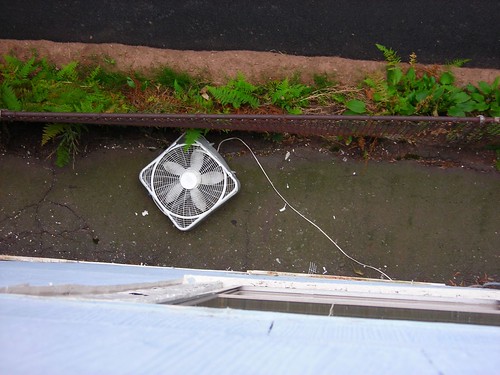
(I supplied the absent-mindedness.)
I have: complaining about my sister; a report on the adorableness of my nephew, who was kind enough to immediately spit up on me; continued amazement at the Inner Advisor's emergence; the vague but increasingly determined hope that I shall graduate; further thoughts on mentoring, at Aurelia's request; and a great deal of risk-in-science philosophy to consider, courtesy of Kevin. In the meanwhile, I leave you all to ponder the effects of gravity. How long would it take a fan to reach terminal velocity?
Happy weekends to all, with hopes for fall weather.
(I supplied the absent-mindedness.)
I have: complaining about my sister; a report on the adorableness of my nephew, who was kind enough to immediately spit up on me; continued amazement at the Inner Advisor's emergence; the vague but increasingly determined hope that I shall graduate; further thoughts on mentoring, at Aurelia's request; and a great deal of risk-in-science philosophy to consider, courtesy of Kevin. In the meanwhile, I leave you all to ponder the effects of gravity. How long would it take a fan to reach terminal velocity?
Happy weekends to all, with hopes for fall weather.
Wednesday, October 03, 2007
And then it knocked me down and took my wallet.
I went out to get: a haircut, an orange, two limes, maraschino cherries, and brandy.
I got a haircut.

I drove by a library book sale. It grabbed me by the arm and said 'If you come along quietly, nobody will get hurt.'
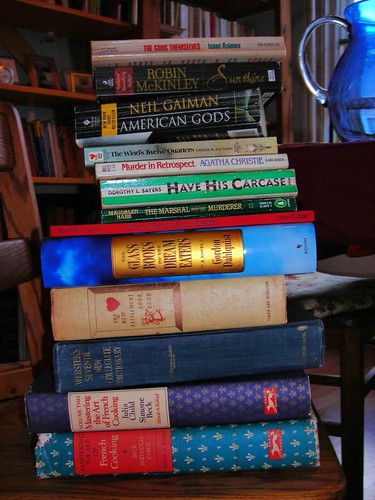
I went to the liquor store. There was a 'bargain bin' by the door. What could I do?

It became obvious that I was going to accomplish utterly nothing that day. So I picked ten pounds of raspberries.
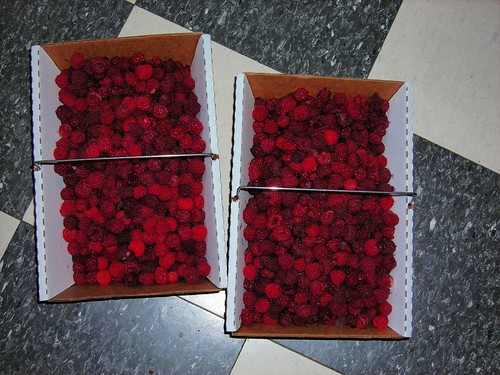
And finally, I got an orange, two limes, and brandy. No cherries; they were green.

I got a haircut.
I drove by a library book sale. It grabbed me by the arm and said 'If you come along quietly, nobody will get hurt.'
I went to the liquor store. There was a 'bargain bin' by the door. What could I do?
It became obvious that I was going to accomplish utterly nothing that day. So I picked ten pounds of raspberries.
And finally, I got an orange, two limes, and brandy. No cherries; they were green.
Subscribe to:
Posts (Atom)