Thursday, February 08, 2007

Ask a Scientist: Antidepressants and Pregnancy (5)

Series: Antidepressants, Pregnancy, Risks

  • Introduction
  1. Spontaneous abortion
  2. Premature birth
  3. Congenital or teratogenic defects; that is, malformations in utero
    • Cardiac defects
  4. Antenatal/ postnatal adaptation problems
    • Muscle stiffness
    • Breathing distress at birth
    • Neurological withdrawal symptoms
  5. Breastfeeding risks
    • Infant weight gain
    • Infant serotonin levels
    • Long-term neurologic development
  6. Maternal risks of going without treatment
    • Relapses
    • Infant failure to thrive
    • Parenting problems, attachment, child behavior
This information is drawn from published articles in medical journals, some of which are compiled here, and from public databases. (See also: summaries on Motherisk, FDA registries for pregnant women, this excellent Medscape article, and the FDA's index by drug name.) Information is also available through PubMed by searching various terms; I suggest starting with 'antidepressants and pregnancy'.

A list of generic and trade names is here.


*****
5. Breastfeeding risks
Okay, folks, there are a LOT of articles about this. If you want to see them, search 'breastfeeding antidepressants' on Pubmed. As far as I can tell, they largely come to the same conclusions. So here's a summary of the first 50 or so.

Did you know there's a Journal of Human Lactation??? They have an excellent 2001 review of various ADs in lactation.

Motherisk has a lovely patient-oriented summary about drugs and breastfeeding. (Thanks, Aurelia.)

Summary:

Use of SSRIs and TCAs (except doxepin) is considered safe. Occasional adverse events are reported. They generally resolve once either breastfeeding is stopped, the schedule is altered to minimize infant exposure, or the mother stops taking the drug.

Of the SSRIs, sertraline and paroxetine have very low numbers of adverse events. Mild adverse events are associated with fluoxetine and citalopram (colic, crying, etc.).

Antipsychotics and lithium are not recommended in breastfeeding.

5a. Infant weight gain

A study comparing the 5 most common SSRIs and venlafaxine shows absolutely normal weights in all infants. They note, however, that maternal depression of >2 months DOES make the babies gain less weight.

Paroxetine in 27 mothers has no effect on weight gain or developmental milestones. A meta-analysis of SSRIs (other than fluoxetine) and TCAs also showed no effect on weight gain.

One study on 26 breastfed infants whose mothers took fluoxetine, however, showed an average 1-pound difference in weight gain over 6 months. The JHL review notes that none of the weights, even the lower ones, were below the national mean. Another study notes lower birth weights in fluoxetine usage, but only studies five exposed infants (i.e., not enough to say).

5b. Infant serotonin levels

Unsurprisingly, this isn't exactly studied a lot. One editorial (pdf) summarizes a few studies on the matter: rats exposed to fluoxetine had a 50% occupancy of their serotonin reuptake protein (5-HTT); however, apparently about 80% is necessary for an AD effect. (Also, nobody's quite sure exactly what 5-HTT does or how it relates to depression.)

A human study on fluoxetine says that "most infants may continue to breastfeed without experiencing meaningful changes in" serotonin uptake and metabolism. A small study that lumps together three ADs seems to suggest that newborn serotonin levels are changed by maternal AD use, but stabilize within one month. They go on to suggest that it could have terrible! developmental! consequences but I think they're full of beans (and hand-waving).

5c. Long-term neurologic development

You'll be shocked (shocked!) to learn that basically, nobody has a clue. In infants followed for up to a year, they're perfectly normal. After that, well, neurology is complicated and poorly understood anyways. The best that can be said is that SSRIs and other ADs don't appear to do anything either a) really nasty b) quick or c) much of the time.

Reported infant exposures in breastfeeding

The medical literature says that infant exposure of <10% is largely considered safe. In addition, some data indicate that breastfeeding can alleviate neonatal abstinence syndromes (here in, for example, methadone exposure. Think how much more innocuous sertraline is.).

These exposures and reported adverse effects in lactation are taken from the JHL article and a review in Drug Safety. Both studies note that changing dosage time and breastfeeding times can significantly reduce/ minimize infant exposure.

A modeling study notes that the total infant yearly dose (of fluoxetine) is generally about 1 or 1.5 of the mother's daily dose. This isn't very much. Another meta-analysis summarizes overall exposures for many psychoactive drugs.

Fluoxetine: Infants may receive up to 20% of maternal daily dose (MD). Some reports of extreme infant fussiness which resolve on maternal drug or breastfeeding discontinuation. Other studies indicate no complications in infants. Labelling recommends not using in breastfeeding, but is generally considered low-risk.

Paroxetine: Infant exposure ~3% MD.

Fluvoxamine: May be contraindicted in infants who are taking caffeine (i.e. for apnea). Infant breastmilk dose 0.75%-1.4% MD. Alternatively, undetectable in infant serum.

Citralopram: 0.4%-1.8% MD. No adverse effects reported.

Sertraline: 0.5-2% MD; sometimes undetectable in infant. No known adverse effects. Considered safe and well-studied.

Nefadozone: Adverse event in preterm infant receiving 0.45% of maternal dose; attributed to reduced hepatic function. Calculated to be safe if infant is confirmed to receive less than 10%.

Bupropion: ~0.02% MD; therefore considered very safe in lactating mothers. One case report of seizures; may be avoided if family history of seizure.

Venlafaxine: up to 7.6% MD; metabolized well by infants. No apparent effect on weight. Well-tolerated.

Conclusions:
  • Being depressed affects infant weight gain.
  • SSRIs and TCAs in breastmilk don't.
  • There are no data on long-term neurological consequences.
  • In any case, infant AD dosage through breastmilk is very low.
  • On the other hand, infant/child exposure to maternal depression definitely has bad effects on weight gain, "emotional and behavioural development", maternal-infant bonding, cognitive development, and children's levels of fear and anxiety.
  • Many ADs are well-studied in lactating mothers; few-to-no adverse events are reported. Most are widely considered to be safe.


Wednesday, February 07, 2007

Only (Weak Unprofessional Emotional) Gurrrrls Cry

My mentor is a woman in her forties who has left academia; I am in love with her, she is wonderful, and I wish I'd met her years ago. Be advised, o women scientists: go ye forth and find women mentors, for verily, thy quality of life shall improve.

It was such a pleasure to connect with someone who has experience!! and useful advice!!! So we were talking about the need to be tough and on guard all the time, and I said, 'It's just been really hard...' and burst dramatically into tears.

Of course she was wonderful about it.

But here's the thing: I could not under any circumstances cry in front of my advisor, or any of the male professors; they would never take me seriously again. This is true of some of the female professors, but on the whole, I would expect it to be less career-destroying.

Why is there such a heavy penalty for women to cry in professional settings? I have a few theories:

1) Men project their own socialized constraints onto women: The social expectation that men only cry in serious crisis is projected onto women in professional settings. Because the dominant paradigm is still so male, a woman who cries in a situation where a man would not is judged by the male stereotype, and seen as weak and overly emotional.

2) Crying is simply not seen as professional: Emotion has no place at work, and showing emotion violates the normative code. Because the paradigm is dominated by a male tradition, especially in academia where turnover is glacial. See this Chronicle article: after a miscarriage, a woman holds back her tears, because "justified or not, I could not get past the thought that women who cry at work cannot easily, in the next breath (or on the next page), describe themselves as competent professionals."

3) Men are conditioned to be uncomfortable when a woman cries: Men are not expected to respond well to tears. Perhaps they have difficulty gauging the magnitude of the upset because of (1). This is complicated in professional settings because physical comfort might be seen as harassment. WISELI has a guide(pdf) which mentions this effect: the male prof next door sends all his crying advisees to the female prof, even when it's about, say, grades. Which she can't help with.

The problem is, this is a structure which fundamentally discriminates against women. First we're socialized to believe crying is okay, and then we're penalized for it. Even if it's women who are applying this paradigm, they are still guided by a norm which was not established by women.

-Opinions? Feel free to completely disagree.

-Have any of you ever cried in front of your advisor or committee? Other profs?

Tuesday, February 06, 2007

Learning and Memory

When people ask me how grad school is, I tell them, 'I've learned a lot of things, and almost none of them are what I thought I'd learn.'

Last night I realized I must unlearn the 'You're doing it all wrong! Give it to me!'. Mr. S and I may strangle one another before his thesis is done.

***
Yesterday I ran into a guy I hadn't seen in a couple years.

'You've changed,' he said, 'a lot. You're so assertive. But not in a mean or annoying way. Just so confident and together.'

'It's selected for,' I said.

'You're kind of scary now actually, in a totally take-no-nonsense way.... Most of the people I'm scared of are women.'

'Dear, we have to be a little scary, twice as tough as the men, or nobody will take us seriously. Five years of misogynistic BS, you don't put up with it any more.'

'Oh. Yeah, I think it's one of those things I'll never have to learn, because people will do their jobs and listen to me, and I can just smile and carry on, and it'll be fine.'

'Yep. Count your blessings: nobody will ever dismiss you because of what you're wearing.'

'Well, it's working for you. I'm impressed. And a little scared.'

'Thanks!'

And I wasn't even trying to scare him. It's the nicest compliment I've gotten in a while.

Monday, February 05, 2007

Messages to Google

"Is dioxin bad when you're pregnant?": Honey, dioxin's bad for you ALL the time. Did you see those pictures of Yuschenko?

On hallucinating plastic globules oozing out of one's skin: You have bigger problems than I can help you with. Have you considered calling the nice psychiatrist?

What happens if you eat plastic wrap?: Very little; plastic is fairly inert to stomach acids. It will make returns in short order. Unless it's a really big piece, in which case, it's likely surgery for you, dearie.

Microwave use in pregnancy
: Don't microwave yourself or the baby, and for the bazillionth time, microwaves do not cause cancer. Nor do cellphones. No.

How does friction act on a sliding penny?: The same way it works with anything else sliding. Sliding friction.

Any more questions?

Ask a Scientist: Antidepressants and Pregnancy (4)

Series: Antidepressants, Pregnancy, Risks
  • Introduction
  1. Spontaneous abortion
  2. Premature birth
  3. Congenital or teratogenic defects; that is, malformations in utero
    • Cardiac defects
  4. Antenatal/ postnatal adaptation problems
    • Muscle stiffness
    • Breathing distress at birth
    • Neurological withdrawal symptoms
  5. Breastfeeding risks
    • Infant weight gain
    • Long-term neurologic development
  6. Maternal risks of going without treatment
    • Relapses
    • Infant failure to thrive
    • Parenting problems, attachment, child behavior

[Disclaimer: I am not a medical professional; this is an academic summary of the evidence available and not a medical opinion. I do not offer medical advice. If you require medical opinions or treatment, please consult your physician.]

This information is drawn from published articles in medical journals, some of which are compiled here, and from public databases. (See also: summaries on Motherisk, FDA registries for pregnant women, this excellent Medscape article, and the FDA's index by drug name.) Information is also available through PubMed by searching various terms; I suggest starting with 'antidepressants and pregnancy'.

A list of generic and trade names is here.


*****
4. Antenatal/ postnatal adaptation problems

Certain post-birth symptoms are associated with maternal antidepressant- usually SSRI, but also venlafaxine- use in the last trimester. They are all categorized as 'neonatal withdrawal [or abstinence] syndrome'. These syndromes rarely lead to anything other than an unpleasant week with a cranky baby, and maybe a couple days in the NICU.

Muscle stiffness and/or convulsions are treated with support and/or low doses of SSRIs. A certain amount of breathing and/or neonatal distress is associated with maternal SSRI usage; it is rarely fatal except in infants with other complications, and is treated supportively.

4a. Muscle stiffness

A recent study looked at reported incidences of seizure-like symptoms in mothers taking SSRIs. They found 93 reported cases of these symptoms in a large adverse-event database and tried to eliminate other factors and drugs that might have caused the symptoms. Then they compared the incidence to the overall incidence in the adverse-event database. 74 cases were 'certain'; of those, 51 involved paroxetine use, 10 fluoxetine, 7 sertraline, and 6 citalopram.
Most of the incidents were neurological (see below); there were 11 total instances of hypertonia and convulsions.

Two case studies on venlafaxine report increased hypertonia (stiffness) in neonates; one treats with a low dose for a week, and the other recommends breastfeeding to mitigate withdrawal.

One case study reports convulsions associated with paroxetine.

4b. Breathing distress at birth (and other distress, ICU)

Third-trimester SSRI use is associated with babies more often having to go the NICU with breathing problems, neonatal lowered heart rate, or other unspecified distress. Various studies estimate the risk at various levels.

A large Canadian cohort of 75,000 mothers taking any of 6 SSRIs showed that 13.9% vs. 7.8% of controls had some neonatal respiratory distress (that is, had to spend some time in the NICU). A Finnish population study likewise showed that, of infants whose mothers bought SSRIs in the 3rd trimester, 15.7% vs. 11.2% for infants whose mothers bought SSRIs in the 1st trimester. A Motherisk study specifically on citralopram found an increased chance of having to go to a special-care nursery.

Another study, the inspiration for a recent mildly hysterical FDA alert, looked for infants with PPHN (a condition where there is high blood pressure in the lungs and therefore oxygen deficit) and then tried to see how many mothers used SSRIs. They found an increased risk of about 6-fold; that is, in their study, from 7/1000 to 37/1000. The problem with this study is they looked for a condition and then tried to check drug usage. It would be better to look among a large cohort of SSRI users (like in the Canadian study) and check for PPHN. Also, they only find 14 cases of PPHN with SSRI use. I find this not terribly credible due to poor design and small sample size.

4c. Neurological withdrawal symptoms

Many newborns with SSRI exposure do manifest neurological signs of a 'neonatal abstinence syndrome.' In addition to the higher incidence of respiratory distress (as above), many infants cry a lot and have trouble sleeping. This number is reported as high as 30% in a small study (60 infants). Of these, 8 had 'severe' and 10 'mild' symptoms. The average duration was about three days.

Another small study examines 76 mothers who took ADs and 90 control. 63% of exposed infants had some neurological symptoms. 75% of these infants resolved within 3 days; premature infants were more strongly affected by SSRI side effects. And yet one more study of 46 infants found much the same: about 30% of infants have mild respiratory distress or twitchiness. (They also found that clonazepam, a benzodiazapene, exacerbated the effect, probably due to metabolic effects.)

Numerous case reports have been published on neonatal withdrawal symptoms in maternal use of citralopram, fluoxetine, paroxetine, and I'm sure other drugs.
The above case studies on venlafaxine also report irritability, etc.

One exceedingly crappy case report tries to correlate paroxetine levels in one newborn with- gasp!- pneumothorax. They do not measure maternal paroxetine levels, but cord-blood levels are four times above the normal therapeutic range. And then the infant is irritable in addition to intubated, but gets better within a week. Correlation is NOT causation here.

Conclusions:
  • SSRIs cause some increase in post-natal problems.
  • These manifest as mild breathing distress, NICU time, and longer hospital stays.
  • Some infants will experience muscle stiffness and, occasionally, convulsions.
  • Some incidents of severe respiratory distress are reported.
  • Many 3rd-trimester-SSRI-exposed infants will be irritable for several days after birth, due to neurological withdrawal.
  • If symptoms are severe, some doctors recommend treating with tapered SSRI doses.
  • Breastfeeding may mitigate withdrawal.
  • These effects can be worse in premature infants, who are predisposed to breathing distress.
  • Motherrisk reminds us that "Among pregnant women, abrupt discontinuation of antidepressants has been associated with withdrawal symptoms, including nausea and vomiting, diarrhea, sweating, anxiety and panic attacks, mood swings, and suicidal thoughts."
  • They recommend exposed infants be monitored for a week or so after birth.
  • This sounds really alarming, but remember, this is an increase in nonfatal events.
  • A review on AD withdrawal in adults tells us that "Most reactions are mild and short-lived and require no treatment other than patient reassurance."

Friday, February 02, 2007

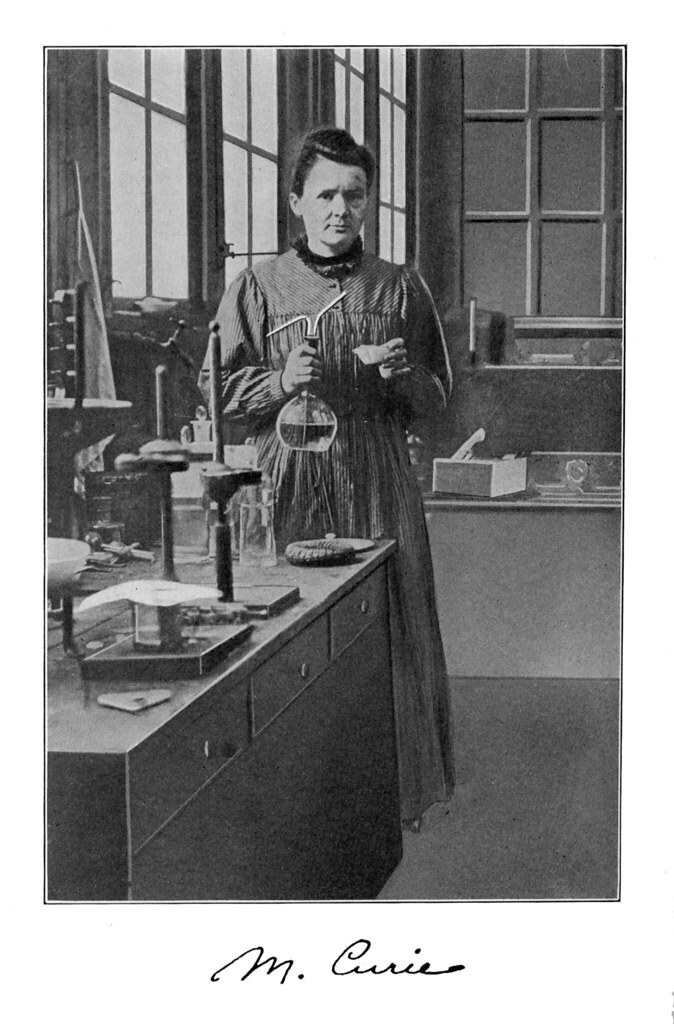
Friday Library: Marie Curie

I know she's over-done, but I have this great old book about People, Mostly Men, Oh And Also Marie Curie!, In Science.

A propos of FSP's 'endless array of bearded men', the photo inside the front cover:

Men in Science
Top: Ladenburg, Jorgensen, Hjelt, Landolt, Winkler, Thorpe; Bottom: van't Hoff, Beilstein, Ramsay, Menedleeff, von Baeyer, Cossa.

It starts out pretty good: Here's a brilliant woman did great work and isn't being recognized! And then... worsens. She's an exception, you see, a genius, and that makes her equal to men. And 'mental fog which has incapacitated many a man' is fine, but weren't we talking about women's repression here?

This wouldn't be quite so distressing if these attitudes were, y'know, gone. Women have to work twice as hard to get recognition? Check. Given lesser positions for equal work? Excluded from Old Boys' Club? Check. It's tradition? Check. 'Don't worry, science doesn't make her completely unwomanly, she still cooks and cleans and dresses pretty'? CHECK.

This book is 80 years old. As long as science departments remain 80% male, as long as grant moneys go to men out of proportion to numbers and ability, as long as we keep discussing Nancy Pelosi's clothing, these attitudes won't change. We've been working on it; let's keep working.

****

Mme Curie

Eminent Chemists of Our Time
Benjamin Harrow
Van Nostrand; 1927 (2nd ed.)

The foremost scientist of France, and the greatest woman scientist in the history of mankind, [Curie] counts politically less than many a man fit for the lunatic asylum. And as if to encourage that conception of women to which so many men cling tenaciously, the French Academy, numbering among its members the élite of French intellect, decide [sic] that woman, be she ever so much a genius, cannot be admitted into their sanctum. If further proof were needed that intellect often runs counter to freedom, and that scientists who work so strenuously for an enlargement of their scientific horizon often belong to the most reactionary group in politics, the case of Madame Curie affords an excellent example.

Within the space of ten short years this woman has created a new science, radioactivity, and this has opened up more fertile chemical soil than any other discovery in the history of science... In speed of progress, radioactivity is to the science which has gone before what the aeroplane is to the tortoise.

This momentous discovery belongs to Madame Curie. To be sure, the way was paved for her by many; to be sure, her husband was a good helpmate; but in spite of analogous work in various parts of the world by the world's most gifted scientists, this woman triumphed where all others failed, and to her belongs the reward... to-day she stands crowned as the greatest woman and among the very greatest scientists of all times.

The inherent qualities which go to the making of genius certainly never have been the exclusive possession of half mankind, but whereas the male geniuses have, at times, been allowed to blossom, the females belonging to this species, have until recently, been suppressed with a Cossack's ferocity and a Cossack's justice. The past four years [WW I] of critical history from which mankind has just emerged will, perhaps, help to remove the mental fog which has incapacitated many a man [or woman?] from using his brains to the advantage of himself and of the world.
...
In the history of doctor's dissertations, Madame Curie's easily takes first place for importance of contribution, with Arrhenius's as a close second... With a bound Mme. Curie leaped from complete obscurity to the center of the world's stage...

Within the next few months the Nobel Prize, the highest mark of distinction that can come to any scientist, was divided between the Curies and Becquerel.

In [1901] Madame Curie was appointed Chef de Travaux, or chief of the laboratory, in the department at the Sorbonne that was especially created for her husband. [After his death, she was made head of this department.]
...
In 1911 Madame Curie was again the recipient of the Nobel Prize... So far Madame Curie is the only individual who has received the award more than once; this in itself speaks volumes as to her standing in the eyes of her fellow-scientists... In this same year the French Institute dishonored itself by refusing to elect Madame Curie to membership... This gave rise to a lively discussion on the eligibility of women for membership when Mme. Curie's name was brought before the one hundred and fifty Academicians at the quarterly meeting of the five academies... this august body went on record to the effect that... there was 'an immutable tradition against the election of women, which it seemed eminently wise to respect.' Science in its search for truth has thrown tradition overboard on innumerable occasions.
...
Mme. Curie may be the great scientist, but she has many of the traits of femininity and motherhood which most men of all ages have admired. Aside from her work, her attention is devoted almost exclusively to the welfare of her two daughters... When the two children were younger Mme. Curie made all their dresses, and washed and ironed the more delicate pieces of lingerie.

Thursday, February 01, 2007

Ask a Scientist: Antidepressants and Pregnancy (3)

Series: Antidepressants, Pregnancy, Risks

  • Introduction
  1. Spontaneous abortion
  2. Premature birth
  3. Congenital or teratogenic defects; that is, malformations in utero
    • Cardiac defects
  4. Antenatal adaptation problems
    • Muscle stiffness
    • Breathing distress at birth
    • Neurological withdrawal symptoms
  5. Breastfeeding risks
    • Infant weight gain
    • Long-term neurologic development
  6. Maternal risks of going without treatment
    • Relapses
    • Infant failure to thrive
    • Parenting problems, attachment, child behavior

[Disclaimer: I am not a medical professional; this is an academic summary of the evidence available and not a medical opinion. I do not offer medical advice. If you require medical opinions or treatment, please consult your physician.]

This information is drawn from published articles in medical journals, some of which are compiled here, and from public databases. (See also: summaries on Motherisk, FDA registries for pregnant women, this excellent Medscape article, and the FDA's index by drug name.) Information is also available through PubMed by searching various terms; I suggest starting with 'antidepressants and pregnancy'.

A list of generic and trade names is here.


*****
3. Congenital or teratogenic defects; that is, malformations in utero
  • All defects; cardiac defects
There is a lot of very good data tracking birth defects (and post-natal events) in SSRIs and several other antidepressants. These studies have used large numbers of study subjects, and have characterized the various possible adverse effects. I would say that these data are reliable and believable.

These studies are often reported as odds ratios (ORs): the chance that X will happen under condition Y, divided by the rate of X without condition Y. Sometimes ORs are high: 2-fold, 4-fold. Remember that the basal rate is important; does it increase from 1% to 2% or 10% to 20%? Is the basal rate noisy; that is, is it small enough that there is doubt what the basal rate really is; could it be 1-3% in reality? So a high OR is not always cause for alarm. (Moral: Read articles carefully.)

It is believed that first-trimester exposure has the most impact on congenital (i.e. pre-birth) deformities; for an example, see this; this is why many of these studies focus on women who took ADs in the first trimester.

For comparison, the CDC runs a long-term birth defect database called the MACDP. Its latest report, from 2004, reports 1.2% cardiac defects and 2.3% all birth defects (including trisomies) among all births in the study.

The same large Finnish database mentioned in Part 1 investigated rate of birth defects among women with SSRI purchases in 1st, 2nd, 3rd, or all trimesters. About 1400 women bought SSRIs in the first trimester, being: citalopram, fluoxetine, paroxetine, sertraline, and fluvoxamine. Most SSRIs had no effect on birth defect incidence. There was a questionable association between 1st-trimester fluoxetine exposure and cardiac defects: 2.3% vs. a reported rate of 0.8% in Finland. After the authors adjusted for other factors, however(they don't specify, but probably things like smoking, family history, cocaine use, etc.), they found no association.

A study of 150 women on venlafaxine (Effexor) detected no defects above the basal level of 1-3% in the general population. A literature review of many other studies says that fluoxetine, sertraline (SSRIs), bupropion, and low doses of paroxetine are not associated with birth defects. A few isolated cases are reported with venlafaxine.

A large study/database (pdf) by Glaxo-Smith-Kline tracking reported defects (incident reporting), especially in bupropion use for all purposes, finds the following incidences (selected data):

All congenital defects:
Bupropion: 3.4%
All other ADs: 2.5%

1st trimester use (smaller cohorts), all defects:
Paroxetine: 4%
Citralopram: 3.2%
Trazodone: 5%
Venlafaxine: 1.9%
Sertraline: 1.4%

Bupropion is associated with a 1.9% incidence of cardiac defects (CDC: 1.2%).

A recent study on the Quebec pregnancy registry also reports that 7% of infants in 1403 women taking paroxetine had congenital defects, and 1.7% had cardiac defects.

CONCLUSIONS:
  • SSRIs (except for paroxetine) are probably not associated with increased risk of birth defects, including cardiac defects. Neither is venlafaxine.
  • Paroxetine and trazodone are associated with increased risk of birth defects.
  • The Quebec study indicates that low doses of paroxetine are NOT associated with increased risk.
  • Bupropion may slightly increase cardiac defects; however, the effect is small and therefore not certain.