Science has destroyed my tolerance for other people talking. Or, more precisely: vague blathering.
In ordinary scientific interactions in my field, one must provide evidence and explanation, clearly and concisely, within five minutes. Or else no-one will listen. We're too busy to pretend to care.
As a result, my colleagues are quite good at brevity. (Plus no-one is listening in lab meeting anyways, so why not be brief?) Alas, a recent seminar reminded me that in the real world, people do tend to waffle on. And on and on. And on. I want to smack them: Get to the point already! Shut up, you're wasting my TIME!
I don't mind listening to informative and effective speech. I don't mind meetings where no time is wasted. I don't mind hearing others' ideas.
But I foresee problems in the working world. Business meetings? Torture.
Thursday, January 31, 2008
Monday, January 28, 2008
Wasn't On Today's Menu
I was talking to Dr. S. 'I suppose at some point in a few years when you and I are both ready we'll think about trying for a kid,' I said. To which he replied, 'Dear, I'm ready now.'
Erp.
***
My dad interviewed with a big contract-research company last week. The interviewer mentioned that she was flying to Cold Utopia the next day. 'Oh, Cold Utopia?' my dad said. 'My daughter, who's getting a PhD in Bricklaying in Biology from Snooty U, is moving there in the fall.'
The interviewer's ears perked up and her eyes shone. 'Please tell her to call me soon,' she said.
***
It had only vaguely crossed my mind to apply to industry jobs. But apparently they want scientists who know biology and can write! To write and edit! Who knew! It's almost like this dreadful PhD will be good for something one day.
Erp.
***
My dad interviewed with a big contract-research company last week. The interviewer mentioned that she was flying to Cold Utopia the next day. 'Oh, Cold Utopia?' my dad said. 'My daughter, who's getting a PhD in Bricklaying in Biology from Snooty U, is moving there in the fall.'
The interviewer's ears perked up and her eyes shone. 'Please tell her to call me soon,' she said.
***
It had only vaguely crossed my mind to apply to industry jobs. But apparently they want scientists who know biology and can write! To write and edit! Who knew! It's almost like this dreadful PhD will be good for something one day.

Friday, January 25, 2008
Trials (Now With More Tribulations)
Micromanipulation is a fun and exciting way to move tiny things around. With a little microscope and, usually, a force transducer, you can do all kinds of things to cells/ bits of things/ small structures. You can poke it with a stick, or inject it with a needle, or move it around, or cut out little bits, or stick on a tiny, tiny voltmeter.
A good micromanipulator is a breeze to use. It is as simple as cutting a piece of paper or picking up a penny. (Well, realistically it's more like taking a splinter out of your hand...) The [micromanipulator bit] immediately does what you ask of it, removing that section with ease or transporting that cell as on a breeze.
A bad micromanipulator is like picking up dandelion fluff with a tweezers, using only your teeth.
Our micromanipulator ran out of [microminipulator bit] which I needed to pick tiny bits of brick up and move them around for further analysis. This being my lab, nobody ordered more. I tried to use [old bit]. It works like your great-grandpa's rusted together iron tweezers. Nobody knows where [bit] came from. Apparently it can only be purchased in a) lots of ten costing 1000 times as much as making it ourselves or b) in quantities 100,000 times what we need.
This is why big labs need lab managers.
A good micromanipulator is a breeze to use. It is as simple as cutting a piece of paper or picking up a penny. (Well, realistically it's more like taking a splinter out of your hand...) The [micromanipulator bit] immediately does what you ask of it, removing that section with ease or transporting that cell as on a breeze.
A bad micromanipulator is like picking up dandelion fluff with a tweezers, using only your teeth.
Our micromanipulator ran out of [microminipulator bit] which I needed to pick tiny bits of brick up and move them around for further analysis. This being my lab, nobody ordered more. I tried to use [old bit]. It works like your great-grandpa's rusted together iron tweezers. Nobody knows where [bit] came from. Apparently it can only be purchased in a) lots of ten costing 1000 times as much as making it ourselves or b) in quantities 100,000 times what we need.
This is why big labs need lab managers.
Wednesday, January 23, 2008
A Day In
Inappropriate comparisons:
Advisor at journal club: 'Okay, so if I'm a sperm and the tail's coming out of my head...'
Thoughts of being in the wrong profession:
Me: 'The plastic thing with a bunch of spokes in it, looks like a starfish, about six inches across.'
Tech Support: 'Oh, yes. I have that part number for you: 6383-100.'
Me: And how much does it cost?
TS: '$1345.'
Me: 'For a piece of plastic????'
TS: 'Or $2625 with the screws.'
Me: [Beating head on desk] Are you taking job applications?
High-tech solutions:
Grad student from other lab: 'My tube imploded.'
Me: 'It's the vise grips for you, dearie.'
[An hour later]
GSFOL: 'Er, and how would I get the pellet out of the tube now?
Me: 'Well, I'd wrap it in foil and hit it with a hammer.'
GSFOL: [Gives me incredulous look.]
Me: 'Hard. Hit it hard.'
Finis.
Advisor at journal club: 'Okay, so if I'm a sperm and the tail's coming out of my head...'
Thoughts of being in the wrong profession:
Me: 'The plastic thing with a bunch of spokes in it, looks like a starfish, about six inches across.'
Tech Support: 'Oh, yes. I have that part number for you: 6383-100.'
Me: And how much does it cost?
TS: '$1345.'
Me: 'For a piece of plastic????'
TS: 'Or $2625 with the screws.'
Me: [Beating head on desk] Are you taking job applications?
High-tech solutions:
Grad student from other lab: 'My tube imploded.'
Me: 'It's the vise grips for you, dearie.'
[An hour later]
GSFOL: 'Er, and how would I get the pellet out of the tube now?
Me: 'Well, I'd wrap it in foil and hit it with a hammer.'
GSFOL: [Gives me incredulous look.]
Me: 'Hard. Hit it hard.'
Finis.
Monday, January 21, 2008
Friday, January 18, 2008
PCR: Wow. Like, Duuuude.
PCR: Still cool!
Back in the day it was possible to get an entire PhD for cloning a gene. (See the person at the bottom of this list, for example.) This is because it was hard. Before PCR... well, I don't really know how genes were cloned, but I've heard stories. It involved a lot of restriction enzymes to cut DNA at specific spots. You often had to make your own. Sometimes this meant you had to discover a new one, and then make it. Apparently people used phages- viruses that prey upon bacteria- sometimes. Beyond this I would have to look it up in a book. An actual, physical book. Anyhow.
Nowadays I can clone and sequence a gene in two weeks at the most, or a week if I'm efficient. The whole genomes of many, many organisms are publicly available. Primers can be bought for about $4 each. Aging thermocyclers abound in every corner. Sequencing became immensely cheaper as well, because it's done by PCR-based methods now. The benefits of this are immediately obvious. If a researcher wants to do something to a gene, well, she can PCR it up, make some mutations with primers, and pop it back into the organism. If she wants to find a mutation in a human gene, extensive mapping to figure out about where it is will still be necessary, but then she can sequence the whole darn gene if she feels like it.* She can also knock out a gene by making a long DNA sequence which will replace the normal gene. Knockout mice are so widely used that it seems every lab has one, on the theory that if you take away the gene maybe then you'll know what it did. (However, frequently the answer is 'kept it alive.' Less informative.)
PCR made it possible to know a great deal more about your DNA sequence, in much greater detail than ever before. It made genetic testing routine and genetic work in organisms an everyday event. It made genetics and therefore science move a hundred times faster. Without PCR, I'd still be slogging away trying to stick little pieces of DNA together with the equivalent of Elmer's Glue.
On an unrelated note, when I was in college, I went and xeroxed this article by Kary Mullis (the inventor of PCR). Tragically, it is unavailable online. However, I will summarize from memory. "Duuuude. I was so high, driving around in California and acid is totally mind-blowing let me tell you, and there were hills. And I was driving through the hi9lls and my mind was like totally blown and I saw the lines on the road and they were going back and forth and back and forth in this wavy line and I was totally like that's like DNA because it has two lines, see? And then I thought, duuuude, polymerase is like my car moving along the road and then I went back to lab and sat around with a bunch of waterbaths and amplified a gene and it sucked but then I was rich and famous. The end." If you have the opportunity to read the original, I suspect your reaction will be like mine: "I can't believe they published this."
On an even less related note- do you think drugs were maybe, just maybe, involved?:
*Older methods involving sticking bits of DNA to chopped-up bits of genomic DNA can still be useful here.
Back in the day it was possible to get an entire PhD for cloning a gene. (See the person at the bottom of this list, for example.) This is because it was hard. Before PCR... well, I don't really know how genes were cloned, but I've heard stories. It involved a lot of restriction enzymes to cut DNA at specific spots. You often had to make your own. Sometimes this meant you had to discover a new one, and then make it. Apparently people used phages- viruses that prey upon bacteria- sometimes. Beyond this I would have to look it up in a book. An actual, physical book. Anyhow.
Nowadays I can clone and sequence a gene in two weeks at the most, or a week if I'm efficient. The whole genomes of many, many organisms are publicly available. Primers can be bought for about $4 each. Aging thermocyclers abound in every corner. Sequencing became immensely cheaper as well, because it's done by PCR-based methods now. The benefits of this are immediately obvious. If a researcher wants to do something to a gene, well, she can PCR it up, make some mutations with primers, and pop it back into the organism. If she wants to find a mutation in a human gene, extensive mapping to figure out about where it is will still be necessary, but then she can sequence the whole darn gene if she feels like it.* She can also knock out a gene by making a long DNA sequence which will replace the normal gene. Knockout mice are so widely used that it seems every lab has one, on the theory that if you take away the gene maybe then you'll know what it did. (However, frequently the answer is 'kept it alive.' Less informative.)
PCR made it possible to know a great deal more about your DNA sequence, in much greater detail than ever before. It made genetic testing routine and genetic work in organisms an everyday event. It made genetics and therefore science move a hundred times faster. Without PCR, I'd still be slogging away trying to stick little pieces of DNA together with the equivalent of Elmer's Glue.
On an unrelated note, when I was in college, I went and xeroxed this article by Kary Mullis (the inventor of PCR). Tragically, it is unavailable online. However, I will summarize from memory. "Duuuude. I was so high, driving around in California and acid is totally mind-blowing let me tell you, and there were hills. And I was driving through the hi9lls and my mind was like totally blown and I saw the lines on the road and they were going back and forth and back and forth in this wavy line and I was totally like that's like DNA because it has two lines, see? And then I thought, duuuude, polymerase is like my car moving along the road and then I went back to lab and sat around with a bunch of waterbaths and amplified a gene and it sucked but then I was rich and famous. The end." If you have the opportunity to read the original, I suspect your reaction will be like mine: "I can't believe they published this."
On an even less related note- do you think drugs were maybe, just maybe, involved?:
The raccoon spoke. ‘Good evening, doctor [Mullis],’ it said. I said something back, I don’t remember what, probably, ‘Hello.’ The next thing I remember, it was early in the morning. I was walking along a road uphill from my house.”Yep. I bet you were, buddy.
*Older methods involving sticking bits of DNA to chopped-up bits of genomic DNA can still be useful here.
Tuesday, January 15, 2008
PCR: A Primer (Ha, Ha; Biologists Can Skip This)
PCR. Right. Amazing! Miraculous! Biological!
What is PCR, you ask? Polymerase chain reaction. In other words, replicating DNA over many times. You can start with, in theory, as little as one copy and make, in theory, as many copies as you want.
Brief DNA review: adenine, thymine, guanine, and cytosine are the bases; they always pair A/T and G/C. The beginning is called the 5' end, and the sequence is therefore directional, like an arrow. A sequence of 5'-GCATC-3' will have a complement of 5'-GATGC-3', which will meet up with it in reverse. (See
this.)
Let's say you have some DNA from a plant. This plant has a mutation in a gene, which causes its flowers to be white instead of red. Through a great deal of painful back-crossing, you know which gene this is; now you want to know what the mutation is. How?
First you want more copies of the gene to work with than 'a few', so you need to amplify it.
But DNA polymerase- the protein which takes nucleotides and sticks them together- needs two more things to work: a template, and a primer. The template is whatever piece of DNA you've put in. The primer is a short sequence complementary to some of the sequence you have; it's necessary because polymerases need a 'starter' to get them going. Let's assume the sequence of the gene is known. So you design primers on either side of the gene you're looking at, one going down the 'top' strand and the other headed the opposite way on the 'bottom' strand. That is, each primer matches up with the 5' end of the gene so that both strands have a starter bit.
The polymerase we use nowadays is thermostable: it works at high temperatures, and likewise isn't killed by heat. So to amplify a gene, you mix polymerase, template, primers, nucleotides, a buffer and a little salt to keep the enzyme happy (among other things), and... a little water. In a tube.* Then you heat it up to unstick the two DNA strands of your template, cool it down so the primers can bind, heat it up so the polymerase starts polymerizing, and repeat. And repeat and repeat. Luckily there are little machines for this.**
Now you have a zillion- actually, (2)^ number of cycles- copies of your gene. You can sequence it yourself, or send it out. Commercial dye-terminator sequencing typically costs $5/10 per 600 base pairs. In-house, radioactive will cost about 25 cents per 100 bp, though you can do dye-terminator, but the machines in dye-terminator are quite expensive. And then you know what the mutation is.
Sequencing genomes or SNPs or all manner of other things is generally done by different methods due to scale, but the principle is the same.
Next: Why PCR Revolutionized Biology
*Molecular biology: a) Clear liquids in a tube; b) Something that comes in a kit from Qiagen.
**Back in the day water baths and a great deal of patience were required, not least because the enzyme died after every round and had to be added back. Every time. Erf.
What is PCR, you ask? Polymerase chain reaction. In other words, replicating DNA over many times. You can start with, in theory, as little as one copy and make, in theory, as many copies as you want.
Brief DNA review: adenine, thymine, guanine, and cytosine are the bases; they always pair A/T and G/C. The beginning is called the 5' end, and the sequence is therefore directional, like an arrow. A sequence of 5'-GCATC-3' will have a complement of 5'-GATGC-3', which will meet up with it in reverse. (See
this.)

Let's say you have some DNA from a plant. This plant has a mutation in a gene, which causes its flowers to be white instead of red. Through a great deal of painful back-crossing, you know which gene this is; now you want to know what the mutation is. How?
First you want more copies of the gene to work with than 'a few', so you need to amplify it.
But DNA polymerase- the protein which takes nucleotides and sticks them together- needs two more things to work: a template, and a primer. The template is whatever piece of DNA you've put in. The primer is a short sequence complementary to some of the sequence you have; it's necessary because polymerases need a 'starter' to get them going. Let's assume the sequence of the gene is known. So you design primers on either side of the gene you're looking at, one going down the 'top' strand and the other headed the opposite way on the 'bottom' strand. That is, each primer matches up with the 5' end of the gene so that both strands have a starter bit.
The polymerase we use nowadays is thermostable: it works at high temperatures, and likewise isn't killed by heat. So to amplify a gene, you mix polymerase, template, primers, nucleotides, a buffer and a little salt to keep the enzyme happy (among other things), and... a little water. In a tube.* Then you heat it up to unstick the two DNA strands of your template, cool it down so the primers can bind, heat it up so the polymerase starts polymerizing, and repeat. And repeat and repeat. Luckily there are little machines for this.**
Now you have a zillion- actually, (2)^ number of cycles- copies of your gene. You can sequence it yourself, or send it out. Commercial dye-terminator sequencing typically costs $5/10 per 600 base pairs. In-house, radioactive will cost about 25 cents per 100 bp, though you can do dye-terminator, but the machines in dye-terminator are quite expensive. And then you know what the mutation is.
Sequencing genomes or SNPs or all manner of other things is generally done by different methods due to scale, but the principle is the same.
Next: Why PCR Revolutionized Biology
*Molecular biology: a) Clear liquids in a tube; b) Something that comes in a kit from Qiagen.
**Back in the day water baths and a great deal of patience were required, not least because the enzyme died after every round and had to be added back. Every time. Erf.
Friday, January 11, 2008
Midterm
1. Consider a spherical grad student.*
*Actual exam question: 'Calculate the capacitance of a human.' And you can imagine how the answer started. (If you can't, see this; first entry under 'Comparisons.')
[PCR, still coming, really, any day now.]
1a. Assume that information density (D) increases as time elapsed in grad school by the sum of I. an exponential function F including (e)^x where x=1.25 and the half-time of D doubling is 0.6 year and II. a simple sinusoidal function with period=1y. If mental health declines proportionately to 0.2F, calculate the sanity remaining to student N after 5.5 y.2. Calculate work output:
1b. Write an equation for anxiety (A) using chaos equations. Make sure your equation for A includes a random spike every 3 months on average and include a parameter such that anxiety increases with time.
2a. Determine energy intake E if N takes in approximately 2.5 meals per day and loses weight at the rate of 0.07 kg/ week. Remember to time I as follows: meal 1, 7 a.m.; meal 1.5, 2 p.m.; meal 2.5, 8:30 p.m; and to include a constant rate of energy output during waking hours (17/day).3. If sanity is generally described by a shallow hyperbola centered around 'graduation date', explain how any student ever graduates.
2b. Work output is proportional to the product of energy input and information density. Express output as an integral function, but do not solve.
*Actual exam question: 'Calculate the capacitance of a human.' And you can imagine how the answer started. (If you can't, see this; first entry under 'Comparisons.')
[PCR, still coming, really, any day now.]
Tuesday, January 08, 2008
Before You Sign Up For Indentured Servitude
Every student should work a year before coming to grad school. (And then, a la Columbia, one should be limited to five years except in exceptional cases.*) Why? Because one only learns to recognize a bad fit by experience. Also because advisors have no incentive to get people out in five when they're so much more productive in the 6th year, but that's another story.
Not a one of the straight-from-college little darlings know what to look for. Even if they've worked in a research lab at an R1, it is NOT THE SAME. Of course one can still spot grossly abusive/ neglectful/ crazy labs, even as an undergrad. But the chances of observing the full range of things which will affect one's own research... are low. Unhappy labbies are unproductive labbies. Joining a lab that makes one miserable, even if it is a good lab for many other people, stretches out the PhD.
Of course, some of them are bright enough to observe and catch on. But a lot of them, especially this crop (decreasing funding means this Uni admits 'better' students, i.e. snootier ones, who tend to have little to no real work experience, and also to be extremely sheltered)- a lot of them will learn the hard way.
Alternatively, every PI could step up and do their jobs. The university could establish standards, teach mentoring, make regular checks of progress (not those lame forms we fill out now, which are read by a historian, so helpful). Advisors would see that new students are properly trained in techniques, guide their experimental designs so they learn how, provide feedback on a project's success, and so on.
But don't hold your breath.
This post brought to you by the letter D and the rotation students, who make me grind my teeth. D is for data, that's good enough for me...***
*Extreme bad luck, ill health, working on plants,** etc.
**Because gene mapping in plants typically takes years, and there's NOTHING YOU CAN DO ABOUT IT. Or, why to work with a short-generation-time organism.
***I have a hard time not empathizing with their future selves.
Not a one of the straight-from-college little darlings know what to look for. Even if they've worked in a research lab at an R1, it is NOT THE SAME. Of course one can still spot grossly abusive/ neglectful/ crazy labs, even as an undergrad. But the chances of observing the full range of things which will affect one's own research... are low. Unhappy labbies are unproductive labbies. Joining a lab that makes one miserable, even if it is a good lab for many other people, stretches out the PhD.
Of course, some of them are bright enough to observe and catch on. But a lot of them, especially this crop (decreasing funding means this Uni admits 'better' students, i.e. snootier ones, who tend to have little to no real work experience, and also to be extremely sheltered)- a lot of them will learn the hard way.
Alternatively, every PI could step up and do their jobs. The university could establish standards, teach mentoring, make regular checks of progress (not those lame forms we fill out now, which are read by a historian, so helpful). Advisors would see that new students are properly trained in techniques, guide their experimental designs so they learn how, provide feedback on a project's success, and so on.
But don't hold your breath.
This post brought to you by the letter D and the rotation students, who make me grind my teeth. D is for data, that's good enough for me...***
*Extreme bad luck, ill health, working on plants,** etc.
**Because gene mapping in plants typically takes years, and there's NOTHING YOU CAN DO ABOUT IT. Or, why to work with a short-generation-time organism.
***I have a hard time not empathizing with their future selves.
Saturday, January 05, 2008
On Cloning (But Not Sheep)
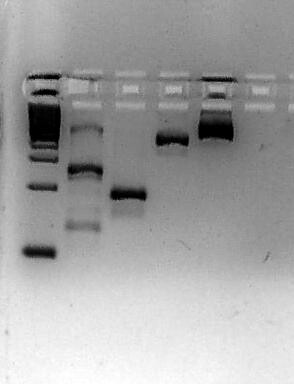
Agarose gel of PCR products (DNA fragments). Lanes: 1, ladder; 2-5, pieces-o-gene.
Since this is supposed to be a blog about science...
When people hear 'cloning', their minds often turn to Dolly the Sheep, Carbon Copy the Cat, or Glowy the Glofish and his 5,000 cousins. (There is a variety of other successfully cloned livestock, apparently.)

Cloning and genetically modified organisms manage to inspire great hysteria. "Defects in clones are common,"- true, and the phenotype is usually DEAD- "and cloning scientists warn that even small imbalances in clones could lead to hidden food safety problems in clones' milk or meat," a 'Center for Food Safety' squeaks at us. (I would like to meet these scientists.)
On the other hand, animal studies involving cloning are the backbone of much biology. Want to know what your mammalian gene does? Eventually, you're probably going to knock it out in a mouse. How? You take embryonic mouse cells, genetically modify them so the gene in question is terminally screwed up, culture a bunch of cell clones (i.e. you put the cells on a plate and they grow into clonal, or identical, populations), transfer some cells back to an early-stage mouse embryo, and stick the whole deal back in a mouse.
But I'm not going to talk about any of that.
No, let's talk about PCR, which revolutionized biology in ways that cloning may never achieve. Making a million copies of DNA bits, rapidly and cheaply, made everyone's lives a great deal easier. Back in the day, one could get a PhD- a whole PhD!- for cloning and sequencing a single gene. Nowadays, I can do that in a week or less, for under $100.
Next: How PCR Works (More Than You Ever Wanted To Know)
Subscribe to:
Posts (Atom)