It's not 60%.
No, it's closer to 70%.
Sunday, September 30, 2007
Realistic Mentors Say 'I'm Telling You This For Your Own Good' (3)
Or: And this has what to do with mentoring?
Part 1: Funding
Part 2: Publishing and Grant Writing
Part 3: Realism
A few further cheering statistics: Of the 30% of sci/eng PhDs who are in academia, only about 50% of them get tenure. (This reminds me of the 5% tenure rate among humanities profs here; they all think they'll get tenure, but 95% of them are wrong.)
And, if you factor in, say, gender?
So what does this have to do with mentoring? These are all things your advisor should tell you, and judging from the sample around here, likely hasn't.
I'm not saying: Nobody should go into academia. If you love science and want to be an academic researcher, great! Good for you! Hip hip hurrah. And all that. I'm saying: Nobody should go into academia blind.
A good mentor is realistic. He or she will do their best to help you write a good grant application, or help come up with productive ideas, or just supply decent letters of reference. But your advisor should be straight with you: You have a 16% chance of being funded.
It's the difference between, oh, going somewhere new when you know how far it is, and driving along lost with a burnt-out headlight in the middle of nowhere. In the first case, you can check your speedometer; you know how much gas you need, when you need a tune-up, etc. In the second case you have no idea what you're going to need. It's easier to do hard work when you know how hard it's going to be. If you know it's going to hurt, it hurts less. (Plus, apparently you're less anxious. Hmmm.)
I think part of what happens is the best scientists leave. Anyone who is too frustrated with the Byzantine grant system, the old-boys' club,the long postdocs and the cult-like work culture, leaves. Only thosewhose determination to play the game is greatest become NIH-funded
researchers (or HHMI, or NSF, or whatever). This does not necessarily overlap with the most innovative minds, though sometimes it does. But it surely does not SELECT for it.
What can a mentor do? Teach you how to play the game. Tell you the tricks. Encourage you through the difficult bits, because funding is tough. Tell you straight up you'll have a 1 in 2 chance of getting tenure, and that only 15% of science PhDs end up with tenure. Give you a realistic picture of what your path will be like, and give you enough data to make an informed decision.
Good mentoring is honest. But also: not deluded.
If you want to be faculty and your mentor hasn't talked to you about money, here's what I think you should do: go talk to three junior professors at your school, and at the kind of place you want to work. Ask them how their funding really works. Ask what they wish they'd known X years ago. Ask them how arbitrary they've found the tenure process, and what helps. Then go ask your advisor, armed with a slightly expanded perspective. Get advice on negotiating your salary. Start writing your grant as soon as possible.
Now you'll have some idea of where the bumps will be in your road. At least you'll be warned.
scientiae-carnival
Part 1: Funding
Part 2: Publishing and Grant Writing
Part 3: Realism
A few further cheering statistics: Of the 30% of sci/eng PhDs who are in academia, only about 50% of them get tenure. (This reminds me of the 5% tenure rate among humanities profs here; they all think they'll get tenure, but 95% of them are wrong.)
And, if you factor in, say, gender?
- After accounting for controls, women are less likely than men to be tenured. Gender differences in tenure rates decline if we exclude from our samples doctorate recipients employed in nontenure-track positions.
- Our analysis suggests that women's chances for earning tenure are influenced by family characteristics, both directly and indirectly through the relation of family characteristics to the likelihood of being employed in tenure-track positions.
- Having young children later in their careers is positively related to women's chances for earning tenure.
- Estimates of gender differences in tenure rates are relatively insensitive to the characteristics of the employer or to the primary work activity.
So what does this have to do with mentoring? These are all things your advisor should tell you, and judging from the sample around here, likely hasn't.
I'm not saying: Nobody should go into academia. If you love science and want to be an academic researcher, great! Good for you! Hip hip hurrah. And all that. I'm saying: Nobody should go into academia blind.
A good mentor is realistic. He or she will do their best to help you write a good grant application, or help come up with productive ideas, or just supply decent letters of reference. But your advisor should be straight with you: You have a 16% chance of being funded.
It's the difference between, oh, going somewhere new when you know how far it is, and driving along lost with a burnt-out headlight in the middle of nowhere. In the first case, you can check your speedometer; you know how much gas you need, when you need a tune-up, etc. In the second case you have no idea what you're going to need. It's easier to do hard work when you know how hard it's going to be. If you know it's going to hurt, it hurts less. (Plus, apparently you're less anxious. Hmmm.)
I think part of what happens is the best scientists leave. Anyone who is too frustrated with the Byzantine grant system, the old-boys' club,the long postdocs and the cult-like work culture, leaves. Only thosewhose determination to play the game is greatest become NIH-funded
researchers (or HHMI, or NSF, or whatever). This does not necessarily overlap with the most innovative minds, though sometimes it does. But it surely does not SELECT for it.
What can a mentor do? Teach you how to play the game. Tell you the tricks. Encourage you through the difficult bits, because funding is tough. Tell you straight up you'll have a 1 in 2 chance of getting tenure, and that only 15% of science PhDs end up with tenure. Give you a realistic picture of what your path will be like, and give you enough data to make an informed decision.
Good mentoring is honest. But also: not deluded.
If you want to be faculty and your mentor hasn't talked to you about money, here's what I think you should do: go talk to three junior professors at your school, and at the kind of place you want to work. Ask them how their funding really works. Ask what they wish they'd known X years ago. Ask them how arbitrary they've found the tenure process, and what helps. Then go ask your advisor, armed with a slightly expanded perspective. Get advice on negotiating your salary. Start writing your grant as soon as possible.
Now you'll have some idea of where the bumps will be in your road. At least you'll be warned.
scientiae-carnival

Friday, September 28, 2007
Realistic Mentors Say 'Play the Game (And If You Want To Innovate, Game the System)' (2)
Or: Science Assessment and Publishing: Was It Perhaps Set Up By Monkeys?
Part 1: Funding
Part 2: Publishing and Grant Writing
Part 3: Realism
This whole funding and publishing system largely rewards brick-in-the-wall science (so to speak), because it has continual publishable payouts. It's the moral equivalent of school testing: each PI creates their own little empire, and their people can only work on things that fit into the grant. There is no chasing of interesting asides; I can't work on the bizarre RNA suppression phenomena that I observe, because we're not an RNA lab. Everyone has to pursue a 'publishable story' to get money/ papers/ PhDs. And, to sweeten the pot, papers are frequently rejected if the results are, and I quote, 'Too different and new.'*
As Henry so feelingly expressed in the comments, you have to have preliminary data to get a grant, but you can't get preliminary data without money, so everyone (well, at least almost everyone) fudges their grants (by including a fraction of the results).
And then further grants are judged by your citation index.
The NIH recently started a new award for daring projects and young researchers, but there are only a tiny, tiny number. Meanwhile, the mean age at first NIH grant has risen to 42, and 4% of grants go to people under 35. Yes, that's right: FOUR PERCENT.
Somewhere around 30% of all science and engineering PhDs work in academia. Half of all PhD scientists work in non-science, or only tangentially scientific, jobs- consulting, business, law, whatever. Cause, or effect? Hard to say.
*This happened to someone I know. Or: why many truly groundbreaking papers appeared in PNAS rather than the Unholy Trinity; it publishes any solid work, and with more words; there's even a non-reviewed track, though that's cheating. The Unholies also have enormously high retraction rates, for obvious reasons.
scientiae-carnival
Part 1: Funding
Part 2: Publishing and Grant Writing
Part 3: Realism
This whole funding and publishing system largely rewards brick-in-the-wall science (so to speak), because it has continual publishable payouts. It's the moral equivalent of school testing: each PI creates their own little empire, and their people can only work on things that fit into the grant. There is no chasing of interesting asides; I can't work on the bizarre RNA suppression phenomena that I observe, because we're not an RNA lab. Everyone has to pursue a 'publishable story' to get money/ papers/ PhDs. And, to sweeten the pot, papers are frequently rejected if the results are, and I quote, 'Too different and new.'*
As Henry so feelingly expressed in the comments, you have to have preliminary data to get a grant, but you can't get preliminary data without money, so everyone (well, at least almost everyone) fudges their grants (by including a fraction of the results).
And then further grants are judged by your citation index.
"It is fun to imagine song writers being assessed in the way that scientists are today. Bureaucrats employed by DAFTA (Ditty, Aria, Fugue and Toccata Assessment) would count the number of songs produced and rank them by which radio stations they were played on during the first two weeks after release. The song writers would soon find that producing junky Christmas tunes and cosying up to DJs from top radio stations advanced their careers more than composing proper music. It is not so funny that, in the real world of science, dodgy evaluation criteria such as impact factors and citations are dominating minds, distorting behaviour and determining careers."This is exactly what's happened to biology. Supervisors write grants all the time; almost no senior professors do bench research. They are glorified lab managers, and my boss for one has virtually no contact with the day-to-day operations of the lab. There is no funding for 'risky' projects; many arise as some grad student's (or postdoc's) on-the-side unmentioned thingummy.
The NIH recently started a new award for daring projects and young researchers, but there are only a tiny, tiny number. Meanwhile, the mean age at first NIH grant has risen to 42, and 4% of grants go to people under 35. Yes, that's right: FOUR PERCENT.
Somewhere around 30% of all science and engineering PhDs work in academia. Half of all PhD scientists work in non-science, or only tangentially scientific, jobs- consulting, business, law, whatever. Cause, or effect? Hard to say.
*This happened to someone I know. Or: why many truly groundbreaking papers appeared in PNAS rather than the Unholy Trinity; it publishes any solid work, and with more words; there's even a non-reviewed track, though that's cheating. The Unholies also have enormously high retraction rates, for obvious reasons.
scientiae-carnival
Wednesday, September 26, 2007
Realistic Mentors Say 'Chances of Funding Are Slim, Check Magic 8 Ball' (1)
Or: How Science Funding (Doesn't) Really Work (What Your Mentor Should Tell You But Probably Hasn't)
Part 1: Funding
Part 2: Publishing and Grant Writing
Part 3: Realism
A friend set me off by sending me this. The current Scientiae's theme is mentoring, so let's talk how to mentor honestly and effectively on careers and money.
The NSF gets about $4.5b for research funding, currently. A good chunk of this goes to permanent and/or large initiatives: telescopes, education projects, grad student training grant. The NSF 'receives approximately 40,000 proposals each year for research, education and training projects, of which approximately 11,000 are funded'.
The NIH gets about $30 billion total, half of which goes to research. Approximately 20% of all grants are funded, including 'competetive' renewals. Only 17% of new grants are funded, but 37% of renewals and 30% of supplements are.* You will note that established labs have a two-fold advantage. Applications are sometimes semi-blinded, but everyone in the field will know who wrote it anyways. This ensures that some labs may coast on their reputations.
'Average grant sizes have grown by 40% since the doubling began, from $275,000 in 1998 to $400,000 today', which is part of why- ironically- success rates are lower now that the NIH has more money.
Equally ironically, more money doesn't correspond to more productivity, in part because papers now have six figures and ten pages of supplemental, and in part because of... inefficiency? Expensive clinical trials? 60% overhead?
At Snooty U, we get over $300 million from the NIH alone, and 90% if it goes to the med school. Internal med all by its little lonesome gets 25%, and Psych gets 15%. Biology gets the remaining 10%, and another $180 million goes straight into the university's pockets. Per year. (By the way, this handy little tool will show you your tax dollars at work.)
When Leo Szilard was asked how to slow science, he said:
*My skepticism about the competetiveness derives in part from the supplement my lab got last year. We wrote a two-page thing about how we wanted a super-fancy electronically controlled brick baking oven with automatic feedback and bells on. We got $200,000. Noncompetetive.
**Or: why many groundbreaking papers appeared in PNAS rather than the Unholy Trinity; it publishes any solid work, and with more words; there's even a non-reviewed track, though that's cheating. The Unholies also have enormously high retraction rates, for obvious reasons. (Edited: Whoops, this one belongs with the next part...)
scientiae-carnival
Part 1: Funding
Part 2: Publishing and Grant Writing
Part 3: Realism
A friend set me off by sending me this. The current Scientiae's theme is mentoring, so let's talk how to mentor honestly and effectively on careers and money.
The NSF gets about $4.5b for research funding, currently. A good chunk of this goes to permanent and/or large initiatives: telescopes, education projects, grad student training grant. The NSF 'receives approximately 40,000 proposals each year for research, education and training projects, of which approximately 11,000 are funded'.
The NIH gets about $30 billion total, half of which goes to research. Approximately 20% of all grants are funded, including 'competetive' renewals. Only 17% of new grants are funded, but 37% of renewals and 30% of supplements are.* You will note that established labs have a two-fold advantage. Applications are sometimes semi-blinded, but everyone in the field will know who wrote it anyways. This ensures that some labs may coast on their reputations.
'Average grant sizes have grown by 40% since the doubling began, from $275,000 in 1998 to $400,000 today', which is part of why- ironically- success rates are lower now that the NIH has more money.
Equally ironically, more money doesn't correspond to more productivity, in part because papers now have six figures and ten pages of supplemental, and in part because of... inefficiency? Expensive clinical trials? 60% overhead?
At Snooty U, we get over $300 million from the NIH alone, and 90% if it goes to the med school. Internal med all by its little lonesome gets 25%, and Psych gets 15%. Biology gets the remaining 10%, and another $180 million goes straight into the university's pockets. Per year. (By the way, this handy little tool will show you your tax dollars at work.)
When Leo Szilard was asked how to slow science, he said:
"You could set up a foundation with an annual endowment of thirty million dollars. Research workers in need of funds could apply for grants, if they could make a convincing case. Have ten committees, each composed of twelve scientists, appointed to pass on these applications. Take the most active scientists out of the laboratory and make them members of these committees. …First of all, the best scientists would be removed from their laboratories and kept busy on committees passing on applications for funds. Secondly the scientific workers in need of funds would concentrate on problems which were considered promising and were pretty certain to lead to publishable results. …By going after the obvious, pretty soon science would dry out. Science would become something like a parlor game. …There would be fashions. Those who followed the fashions would get grants. Those who wouldn't would not."You know the old joke: 'What's a camel?' 'A horse designed by a committee.'
*My skepticism about the competetiveness derives in part from the supplement my lab got last year. We wrote a two-page thing about how we wanted a super-fancy electronically controlled brick baking oven with automatic feedback and bells on. We got $200,000. Noncompetetive.
**Or: why many groundbreaking papers appeared in PNAS rather than the Unholy Trinity; it publishes any solid work, and with more words; there's even a non-reviewed track, though that's cheating. The Unholies also have enormously high retraction rates, for obvious reasons. (Edited: Whoops, this one belongs with the next part...)
scientiae-carnival
Monday, September 24, 2007
Justice, Served Cold
Once upon a time, a young man of fourteen took it into his head to mug someone. She saw he had a fake gun; the police caught him. One day, he went to a courtroom for his trial.
He got 35 years.
****
The young man was charged with something like 'assault with a deadly weapon and intent to kill'. As if it had been a real gun, capable of causing real harm. Not 'brandishing a weapon' (which applies even to fake weapons) or 'assault' or even 'robbery'.
In this state, fake guns are treated as real, in crimes. This young man, who may have said 'Give me your money or I'll shoot you', and who wanted a few dollars for a pack of smokes (or whatever) is going to jail to become a hardened criminal. Because we all know how well American jails 'rehabilitate' criminals.
Why is a kid going to jail for an unsuccessful holdup with a fake gun? I'd say, because this law about fake guns is well-intentioned but misguided. Surely there is a sharp difference between breaking the law to acquire a gun* and then threatening someone with the possibility of real bodily harm, and breaking the law by pretending to threaten someone. If you hold up a gas station with a fake gun, you can be charged with battery etc. so you'll go to jail for longer. It should be sufficient to charge people with crimes they did commit: robbery, criminal threatening, and whatever else.
Why is the kid going to jail? Because he probably got a public defender. Public defenders are notoriously overburdened in this country, typically having 400-600 cases/clients per year. This kid went to jail because he got the best defense anyone could come up with in an hour, which wasn't any good. And the white people in this city are afraid of the people who keep stealing things and mugging us, and many of the poorest people in this city are black or Hispanic. He went to jail because he committed a crime that fires up fear in the better-off muggees. He went to jail because he's poor and black, and he didn't get justice. He got revenge.
*Most guns used in crimes are not licensed by their users, and also licensing requirements are very strict in this state. So now you all know I'm not in Texas. Or Arizona.
He got 35 years.
****
The young man was charged with something like 'assault with a deadly weapon and intent to kill'. As if it had been a real gun, capable of causing real harm. Not 'brandishing a weapon' (which applies even to fake weapons) or 'assault' or even 'robbery'.
In this state, fake guns are treated as real, in crimes. This young man, who may have said 'Give me your money or I'll shoot you', and who wanted a few dollars for a pack of smokes (or whatever) is going to jail to become a hardened criminal. Because we all know how well American jails 'rehabilitate' criminals.
Why is a kid going to jail for an unsuccessful holdup with a fake gun? I'd say, because this law about fake guns is well-intentioned but misguided. Surely there is a sharp difference between breaking the law to acquire a gun* and then threatening someone with the possibility of real bodily harm, and breaking the law by pretending to threaten someone. If you hold up a gas station with a fake gun, you can be charged with battery etc. so you'll go to jail for longer. It should be sufficient to charge people with crimes they did commit: robbery, criminal threatening, and whatever else.
Why is the kid going to jail? Because he probably got a public defender. Public defenders are notoriously overburdened in this country, typically having 400-600 cases/clients per year. This kid went to jail because he got the best defense anyone could come up with in an hour, which wasn't any good. And the white people in this city are afraid of the people who keep stealing things and mugging us, and many of the poorest people in this city are black or Hispanic. He went to jail because he committed a crime that fires up fear in the better-off muggees. He went to jail because he's poor and black, and he didn't get justice. He got revenge.
*Most guns used in crimes are not licensed by their users, and also licensing requirements are very strict in this state. So now you all know I'm not in Texas. Or Arizona.
Friday, September 21, 2007
Things That Don't Make Me Want to etc.
-The journal's new website and new open-access publishing both going online the same day.
-The fact that we have content for the next four-and-a-half issues. So one day, we'll catch up to the present.
Things that do:
-We're still a year (ulp) behind in publishing.
-And my co-editor-in-chief? Spent the last month incommunicado somewhere between here and the West Coast.
On the bright side, she's back now.
-The fact that we have content for the next four-and-a-half issues. So one day, we'll catch up to the present.
Things that do:
-We're still a year (ulp) behind in publishing.
-And my co-editor-in-chief? Spent the last month incommunicado somewhere between here and the West Coast.
On the bright side, she's back now.
Wednesday, September 19, 2007
Things That Make Me Want To Gouge Out My Eyes
Do you know what we have every week? We have journal club. You're thinking, okay, journal club, not so painful, is it now?
At 8:30. Every week.
Well, 8:30 isn't that early! And you get to hear about an interesting paper or two.
And also we get to hear many, many uninteresting papers. Because each person gets seven minutes, the Book Report edition of journal club.
Scientific discussions on the merits of the papers are good for you!
And I quote 'We don't have time to discuss the science! Next!'
At least it's for your own good. So you can learn things. And be ever so conversant with the literature.
Yes. I now have an excellent breadth of knowledge on decorative-welding tournaments, the mechanisms of book writing, and other topics utterly unrelated to my work. And really? It's so my advisor can take notes for his !@#$% book.
Err.. at least it couldn't get much worse?
Aha! No! My advisor has added the joy of his timer. He's brought a timer that ticks. Which can't seewe. Tocktocktocktocktocktock. Tocktocktocktocktocktock. Tocktocktocktocktocktock bzzzzzzzzzzzzzbzzzz.
Now imagine this for an hour and a half, weekly.
I wonder: if I grabbed the timer halfway through my paper, smashed it with a hammer, and then continued presenting... would anyone notice?
Or I could try 'Your timer annoys the living hell out of me and the noise is so distracting that I'd rather be poked by hot needles. Could we PLEASE use this normal, non-buzzing timer???'
Except maybe a little more polite.
At 8:30. Every week.
Well, 8:30 isn't that early! And you get to hear about an interesting paper or two.
And also we get to hear many, many uninteresting papers. Because each person gets seven minutes, the Book Report edition of journal club.
Scientific discussions on the merits of the papers are good for you!
And I quote 'We don't have time to discuss the science! Next!'
At least it's for your own good. So you can learn things. And be ever so conversant with the literature.
Yes. I now have an excellent breadth of knowledge on decorative-welding tournaments, the mechanisms of book writing, and other topics utterly unrelated to my work. And really? It's so my advisor can take notes for his !@#$% book.
Err.. at least it couldn't get much worse?
Aha! No! My advisor has added the joy of his timer. He's brought a timer that ticks. Which can't seewe. Tocktocktocktocktocktock. Tocktocktocktocktocktock. Tocktocktocktocktocktock bzzzzzzzzzzzzzbzzzz.
Now imagine this for an hour and a half, weekly.
I wonder: if I grabbed the timer halfway through my paper, smashed it with a hammer, and then continued presenting... would anyone notice?
Or I could try 'Your timer annoys the living hell out of me and the noise is so distracting that I'd rather be poked by hot needles. Could we PLEASE use this normal, non-buzzing timer???'
Except maybe a little more polite.
Monday, September 17, 2007
Dear First-Year Grad Students,
Oh, you're so adorable. So young and doe-eyed. So naïve. (Such twiggy little people… are you old enough to be in grad school?)
If you're here just because you dream of a faculty job, GO HOME. Only 30% of postdocs find faculty jobs. And 20% of grads don't postdoc. You do the math.
But if you love science and want to do research, good for you! Write that down and tape it to your mirror. You'll need the daily reminder.
Your Snooty U classes have started. You suffer from the delusion that they matter. Children, no-one will see your grades (except fellowship applications.) Aside from that? Nobody cares. Also, you will forget everything irrelevant to your thesis. Get a passing grade and move the hell on.
The dean just sent you an email about teaching. That highfalutin' talk about how it's such a great opportunity, and you should have the chance to give a lecture, and meet with faculty for fabulous feedback? Hah. (Ha ha ha. Ha. Excuse me for a moment; I may choke.) That bit about how you mustn't Xerox things or do grunt work? Hah. Welcome to science education at an R1! 200 iterations of 'Will this be on the test?', followed by grading 180 bad wrong answers. We recommend drinking; it dulls the pain.
If you expect the undergrads to be bright eager little beavers, think again. They're good at memorizing! Don't ask them to think too hard; it overheats the brain.
You're about to start rotations! How exciting. Some of you are clever enough to ask grad students what labs are like. (Here's a hint: the PIs don't know.) Some of you are even intelligent enough to believe us. The rest of you think 'Oh, they're so old and bitter, I'll never be like that.' Riiiiight.
You think it doesn't matter how your advisor treats you- only the science matters, and personal interactions don’t. WRONG! Your advisor gets to say when you leave! He can support you when you want to quit, or make you want to quit more. You'll have years to learn this one, kiddos!
It's so cute how you work 80 hours a week. (Gag.) Here's a hint: this will not make you graduate in 4 years. Only extreme luck can do that. Besides, your rotations are useless. Don't waste your time. Effort and graduation do not scale together, my dears. Work until 6 and GO HOME.
Are you seeing a theme here?
Now go have a drink and lighten up.
Cheers!
Jenny F. Scientist
Brickmason Extraordinaire
B.A, B.A., M.S.
(6th year, Snooty U PhD Candidate)
If you're here just because you dream of a faculty job, GO HOME. Only 30% of postdocs find faculty jobs. And 20% of grads don't postdoc. You do the math.
But if you love science and want to do research, good for you! Write that down and tape it to your mirror. You'll need the daily reminder.
Your Snooty U classes have started. You suffer from the delusion that they matter. Children, no-one will see your grades (except fellowship applications.) Aside from that? Nobody cares. Also, you will forget everything irrelevant to your thesis. Get a passing grade and move the hell on.
The dean just sent you an email about teaching. That highfalutin' talk about how it's such a great opportunity, and you should have the chance to give a lecture, and meet with faculty for fabulous feedback? Hah. (Ha ha ha. Ha. Excuse me for a moment; I may choke.) That bit about how you mustn't Xerox things or do grunt work? Hah. Welcome to science education at an R1! 200 iterations of 'Will this be on the test?', followed by grading 180 bad wrong answers. We recommend drinking; it dulls the pain.
If you expect the undergrads to be bright eager little beavers, think again. They're good at memorizing! Don't ask them to think too hard; it overheats the brain.
You're about to start rotations! How exciting. Some of you are clever enough to ask grad students what labs are like. (Here's a hint: the PIs don't know.) Some of you are even intelligent enough to believe us. The rest of you think 'Oh, they're so old and bitter, I'll never be like that.' Riiiiight.
You think it doesn't matter how your advisor treats you- only the science matters, and personal interactions don’t. WRONG! Your advisor gets to say when you leave! He can support you when you want to quit, or make you want to quit more. You'll have years to learn this one, kiddos!
It's so cute how you work 80 hours a week. (Gag.) Here's a hint: this will not make you graduate in 4 years. Only extreme luck can do that. Besides, your rotations are useless. Don't waste your time. Effort and graduation do not scale together, my dears. Work until 6 and GO HOME.
Are you seeing a theme here?
Now go have a drink and lighten up.
Cheers!
Jenny F. Scientist
Brickmason Extraordinaire
B.A, B.A., M.S.
(6th year, Snooty U PhD Candidate)
Wednesday, September 12, 2007
Dining in the Library, or: Is Untidiness a Sin?
Jeni and Matt! Had a baby! An adorable baby! Go see!
****

(1) Most of our books. Because you never know when you might need to look up the melting point of benzophenone.
(2) Strangely, the most useful wedding gift we received.
(3) Set of five oak school chairs, rescued by my father from the dump and refinished with a hand-rubbed oil finish.
(4) Five copies of the spouse's thesis, that he keeps swearing he'll take to get bound. Any day now.
(5) A legacy of growing up in the ant-infested South.
(6) Antique oak table, rescued by my father from the dump, etc. Given with the chairs because I complained about not having any furniture. Also because Mom was tired of the chair forest living in the front hall. Still pushed together with other table, from last Friday. (So we're lazy.)
(7) Computer, handily positioned for post-dinner working. O laptop! How I love thee! Especially since lightning got our other computer and all.
***
I shall be attempting to repent me of my sins for the remainder of the week. Somehow, the thousand-person service usually fails to inspire me to religious fervor. Happy Rosh Hashanah to all as celebrate it. May your rabbi's sermon be brief, and may the appeals for money intrude minimally on your worship.
****
(1) Most of our books. Because you never know when you might need to look up the melting point of benzophenone.
(2) Strangely, the most useful wedding gift we received.
(3) Set of five oak school chairs, rescued by my father from the dump and refinished with a hand-rubbed oil finish.
(4) Five copies of the spouse's thesis, that he keeps swearing he'll take to get bound. Any day now.
(5) A legacy of growing up in the ant-infested South.
(6) Antique oak table, rescued by my father from the dump, etc. Given with the chairs because I complained about not having any furniture. Also because Mom was tired of the chair forest living in the front hall. Still pushed together with other table, from last Friday. (So we're lazy.)
(7) Computer, handily positioned for post-dinner working. O laptop! How I love thee! Especially since lightning got our other computer and all.
***
I shall be attempting to repent me of my sins for the remainder of the week. Somehow, the thousand-person service usually fails to inspire me to religious fervor. Happy Rosh Hashanah to all as celebrate it. May your rabbi's sermon be brief, and may the appeals for money intrude minimally on your worship.
Monday, September 10, 2007
Also
You should immediately go read Henry's hilarious metaphorical account of his work. I especially like the 'future job options.'
On Assumptions and Power Balance
We have two friends named Casey, as I've mentioned before. (They're engaged now. We can't wait to see if they'll be the Casey Parkers.) Casey 1 is a scientist; he wants an academic job. Casey 2 is a... let me make something up... a librarian, so she can work pretty much anywhere.
Casey 2 and I were chatting about marriage several months ago, before they were engaged. "You should protect yourself before you move across the country with him," I said. "I'm sure you want to be married first."
Later it struck me: I would never say that to a man. Why should marriage be protective? She's a highly trained paid professional! She's gainfully employed! She doesn't need protecting!
Casey 1 is getting first choice of geography and employment; Casey 2 is trailing, and so maybe she is giving up more in terms of ideal jobs and so on. As a woman, she will on average earn less than him, because even in the same jobs. women earn less than men. She is more likely to stay home or take leave when she has children, which will cut her future salary as well as, probably, her retirement fund.
On the other hand, why would marriage be a protective commitment for her? She can pick up and leave any time she wants. This is an outmoded social myth, and I'm ashamed of myself.
Children, now- is that different? Is marriage then protective for a woman who continues to work? After reading The Price of Motherhood, I'd say yes. Because women are more likely to stay home, they end up at a financial disadvantage; in case of a divorce, the woman's standard of living drops dramatically and the man's typically does not.
Do men who stay home need protecting? Do their future salaries drop out of proportion to their time out of the work force, as women's do? I don't know, but I rather doubt it. Their lifetime earnings, etc., will certainly drop nonetheless. Like women, the years they spent with children are years they do not get raises and bonuses.
So perhaps anyone who stays home with a child could use some financial protection: their own savings account, an IRA or two, an independent line of credit, some way to keep up their credentials if necessary. These things could minimize the financial impact on either Casey, even if they stay married- if, God forbid, one should die unexpectedly or become ill, the other would not be left destitute.
This is part of why it makes me edgy when my girlfriends stay home with their children. They're counting on their husbands staying healthy, married, and employed. I worry that the unexpected will happen, and they will be left in a bad position. (But if I end up doing the same, you can laugh at me.)
Casey 2 and I were chatting about marriage several months ago, before they were engaged. "You should protect yourself before you move across the country with him," I said. "I'm sure you want to be married first."
Later it struck me: I would never say that to a man. Why should marriage be protective? She's a highly trained paid professional! She's gainfully employed! She doesn't need protecting!
Casey 1 is getting first choice of geography and employment; Casey 2 is trailing, and so maybe she is giving up more in terms of ideal jobs and so on. As a woman, she will on average earn less than him, because even in the same jobs. women earn less than men. She is more likely to stay home or take leave when she has children, which will cut her future salary as well as, probably, her retirement fund.
On the other hand, why would marriage be a protective commitment for her? She can pick up and leave any time she wants. This is an outmoded social myth, and I'm ashamed of myself.
Children, now- is that different? Is marriage then protective for a woman who continues to work? After reading The Price of Motherhood, I'd say yes. Because women are more likely to stay home, they end up at a financial disadvantage; in case of a divorce, the woman's standard of living drops dramatically and the man's typically does not.
Do men who stay home need protecting? Do their future salaries drop out of proportion to their time out of the work force, as women's do? I don't know, but I rather doubt it. Their lifetime earnings, etc., will certainly drop nonetheless. Like women, the years they spent with children are years they do not get raises and bonuses.
So perhaps anyone who stays home with a child could use some financial protection: their own savings account, an IRA or two, an independent line of credit, some way to keep up their credentials if necessary. These things could minimize the financial impact on either Casey, even if they stay married- if, God forbid, one should die unexpectedly or become ill, the other would not be left destitute.
This is part of why it makes me edgy when my girlfriends stay home with their children. They're counting on their husbands staying healthy, married, and employed. I worry that the unexpected will happen, and they will be left in a bad position. (But if I end up doing the same, you can laugh at me.)
Friday, September 07, 2007
Friday Photo Library: Plants, Bags, and Dresses
First, a fashion dilemma: I must go the the extraordinarily posh wedding of one of Dr. S's many cousins. Should I wear: a) my deep-burgundy-red velvet cocktail dress, which is a bit tight through the thighs (of all places) because I last wore it when I was 18; or b) my long emerald-green taffeta ball skirt, whose crinoline has been appropriated by my sister, and which no longer has a top to go with? And attempt to pull off... something like this or this or this over it? Aaargh.
****


Someone's rather nice front walk; someone else's quite nice front garden.

More garden.

A memento from Dr. S's post-defense party.

Here kitty kitty! A very friendly three-legged cat. Lately I am struck by periodic bouts of longing for a) a cat; b) a puppy; c) a baby. I have none of the above. Yesterday, when I got a package addressed to 'Dr. J.F. Scientist', also longing for a PhD; ditto.

Coleus, and something that looks like a distant cousin of Dusty Miller.

Looks like sweet pea on a stick.

Osteospermum, possibly?
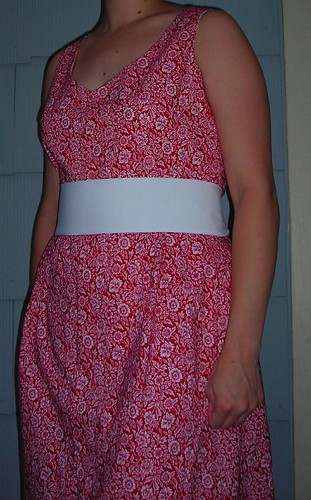
Latest garment project. See, it only took me two months to put in the zipper! Worn for our anniversary dinner.
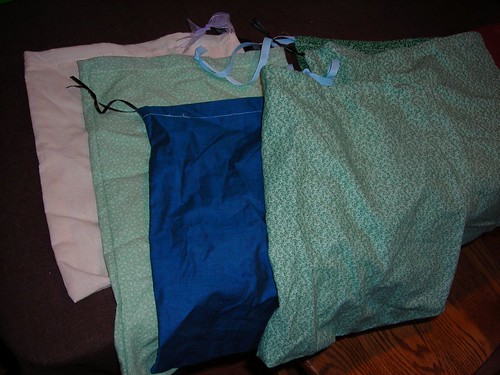
The latest chapter in my plastic-reduction efforts. Veggie and fruit bags.
****
Someone's rather nice front walk; someone else's quite nice front garden.
More garden.
A memento from Dr. S's post-defense party.
Here kitty kitty! A very friendly three-legged cat. Lately I am struck by periodic bouts of longing for a) a cat; b) a puppy; c) a baby. I have none of the above. Yesterday, when I got a package addressed to 'Dr. J.F. Scientist', also longing for a PhD; ditto.
Coleus, and something that looks like a distant cousin of Dusty Miller.
Looks like sweet pea on a stick.
Osteospermum, possibly?
Latest garment project. See, it only took me two months to put in the zipper! Worn for our anniversary dinner.
The latest chapter in my plastic-reduction efforts. Veggie and fruit bags.
Thursday, September 06, 2007

Wednesday, September 05, 2007
Don't Believe People Who Profit From Lying (Or: Are Oats That Great?)
Ever eat that round cereal with a hole in the middle? Made of oats?
They've started trumpeting a 1998 study entitled "Cholesterol-lowering benefits of a whole grain oat ready-to-eat cereal". This study bases its conclusions entirely on this table, which is all about cornflakes vs. oaty cereal:
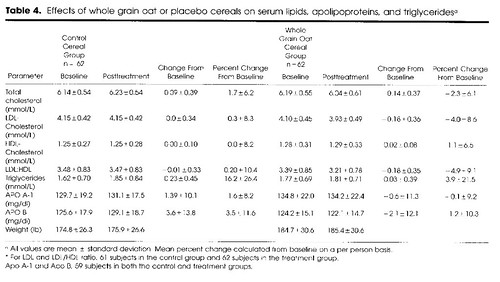
Now, with the help of this handy tool, I've calculated all the P-values:
Cornflakes before vs. after, 0.35; Oats b/a: 0.15; Cornflakes before/ oats before: 0.61; Cornflakes after/ oats after: 0.07. So there are no significant differences in this study, even for before and after oat consumption. Cheery oat cereals may reduce your cholesterol 4%- and that's only LDL, not total, but this study shows no statistical significance.
There are plenty of other studies showing that 5+ grams of oat fiber, or other soluble fibers, a day can help lower cholesterol. Which is all very well and good. My point is merely, this study does NOT demonstrate this effect. Nonsignificant differences might as well not exist. Don't believe everything you read!
So... all the same, eating more fruits and veggies and whole grains is good for your health. Who knew? (And if someone could convince my FIL, who has gout- gout! GOUT! - to stop eating meat at every meal, that'd be great too. I'm afraid he's going to meet his reward before he has grandkids.)
They've started trumpeting a 1998 study entitled "Cholesterol-lowering benefits of a whole grain oat ready-to-eat cereal". This study bases its conclusions entirely on this table, which is all about cornflakes vs. oaty cereal:
Now, with the help of this handy tool, I've calculated all the P-values:
Cornflakes before vs. after, 0.35; Oats b/a: 0.15; Cornflakes before/ oats before: 0.61; Cornflakes after/ oats after: 0.07. So there are no significant differences in this study, even for before and after oat consumption. Cheery oat cereals may reduce your cholesterol 4%- and that's only LDL, not total, but this study shows no statistical significance.
There are plenty of other studies showing that 5+ grams of oat fiber, or other soluble fibers, a day can help lower cholesterol. Which is all very well and good. My point is merely, this study does NOT demonstrate this effect. Nonsignificant differences might as well not exist. Don't believe everything you read!
So... all the same, eating more fruits and veggies and whole grains is good for your health. Who knew? (And if someone could convince my FIL, who has gout- gout! GOUT! - to stop eating meat at every meal, that'd be great too. I'm afraid he's going to meet his reward before he has grandkids.)
Monday, September 03, 2007
Further Disgruntlement: "We're Not Safe In Our Beds!"
Or: At Least It's Better Than a Broken Finger
Crime in SnootyTown is on the rise. Rather a lot. (Alas.) The economy, the increasing poverty rate, the phase of the moon: who knows. But my bed is practically the only place I AM safe any more. Muggings, especially, are growing ever more audacious. Consider the following true incidents:
*As in: dingy, wearing hooded sweatshirt, looking about with a furtive air. Me: 'Oh, I'm racially profiling, I mustn't... hey! He just stole that bike!'
Crime in SnootyTown is on the rise. Rather a lot. (Alas.) The economy, the increasing poverty rate, the phase of the moon: who knows. But my bed is practically the only place I AM safe any more. Muggings, especially, are growing ever more audacious. Consider the following true incidents:
- Bike stolen in broad daylight, Saturday 3pm, from a busy street. Suspicious-looking African-American youth* slinks up, looks around, rides off. Passers-by are stunned into silence.
- Every car window on a main street smashed in. Side mirrors stolen. Someone's tape collection pawed through and abandoned. Tires slashed for good measure.
- Person on bike is mugged. Thrown to ground; muggers take bike and wallet and ride off.
- Thieves break into an apartment at midday. Take all electronics, $6.38 in change. Find car keys. Load electronics into car and drive away. Victim: officer of student Senate.
- Former Army member is mugged in driveway. Looks at gun and says 'That's not a real gun!' (Sadly, no Crocodile Dundee line follows.) Mugger runs off.
- Large, noisy party mugged on front lawn. Give mugger what they have. Mugger threatens persons; ex-Marine attacks mugger, is shot. (Recovers.)
- Car vanishes in the night. Found three weeks later, two states away, with 10,000 extra miles on it, acupuncture needles, and a baseball bat
- Person waiting for escort shuttle, outside main building with security guard inside, and 20 feet from emergency phone, is mugged. Guard doesn't notice.
- Person gets off the escort shuttle 50 feet from own front door. Mugged.
*As in: dingy, wearing hooded sweatshirt, looking about with a furtive air. Me: 'Oh, I'm racially profiling, I mustn't... hey! He just stole that bike!'
Subscribe to:
Posts (Atom)